Alicia Móndolo’s next chapter arrived with three responsibilities: sustainability strategy, risk management, and compliance. In August 2026, Tenaris appointed its former chief financial officer to the board as vice chair. She had joined the Techint Group in 1984. Forty-two years later, the assignment put her experience to work overseeing some of the questions that extend furthest beyond a reporting period.
A career in industrial finance comes with an unusual cast of characters. There are accountants, certainly, but also furnaces, freight routes, currencies, and customers whose drilling plans can change. A steel pipe occupies space, consumes energy, and needs to reach somebody. The accounts eventually record the result of all that activity. Móndolo’s career has moved progressively closer to the machinery behind the result.
Her route runs through administration and finance in Latin America, the audit function at Tenaris, nearly six years as its CFO, and now board responsibilities at two steel companies. The interesting detail is the continuity between those jobs. Each changes the scale at which she encounters the business, from its controls to its financial decisions to its oversight.
A long apprenticeship in how companies work
The starting date is 1984, when Móndolo joined the Techint Group. Her qualifications combine a public accounting degree from the Universidad Nacional de La Plata with an MBA from IAE Business School. The pairing brings together two familiar vantage points: preparing and examining financial information, and understanding the management decisions that information is meant to support.
Her earlier positions included directing administration and finance at Sidor in Venezuela and Ternium México. Those are specific places in a career often compressed into the phrase “group experience.” They give it geographical substance. Her professional history also includes leading IDEA’s internal audit division, connecting her company work with the wider practice of audit in Argentina.
From 2010 to 2016, she served as Tenaris’s chief audit executive. Audit can sound like the part of corporate life reserved for checking what has already happened. Its practical questions reach into how a company operates: how information travels, who authorizes a decision, and whether a control works when somebody actually needs it. It is an education in the distance between a written procedure and a working business.
Between 2016 and 2019, Móndolo held financial officer positions in several Techint Group companies. Then came the appointment announced in June 2019: she would become Tenaris’s CFO on August 5, succeeding Edgardo Carlos. By the time she reached that office, her experience already included both the financial function and the business of examining its controls.
- 1984Joins the Techint Group
- 2010Begins six years leading Tenaris audit
- 2019Becomes Tenaris CFO
- 2023Adds process improvement and IT
- 2025CFO handover; joins Ternium’s board
- 2026Named Tenaris vice chair
When the CFO’s desk gets bigger
In April 2023, her remit expanded again. Alongside finance, she assumed responsibility for Tenaris’s process improvement and information technology department. The addition is easy to miss beside the larger title. Yet it captures something concrete about the work: the quality of financial information depends partly on the systems and processes that produce it.
A management team can want faster answers without having a faster way to assemble them. Improving that relationship requires attention to the route from a transaction to useful information. Putting process improvement and IT within Móndolo’s responsibilities placed that route alongside the financial function. A spreadsheet may be the final visitor to the meeting; a considerable amount of organizational work arrives before it.
Her own account of global finance emphasized regular contact with regional teams, attention to local conditions, and the importance of meeting colleagues in person. She described international work as requiring adaptation to each country’s legal and cultural particulars. In advice to aspiring CFOs, she paired technical preparation with international assignments, clear priorities, and curiosity.
“be curious”
Alicia Móndolo’s advice to aspiring CFOs, March 2023
She also discussed cybersecurity, changing regulation, and the work of retaining talent as matters within the CFO’s field of attention. That range makes the later move into board oversight easier to follow. Risk had become a recurring subject in the job well before it appeared in her vice chair mandate.
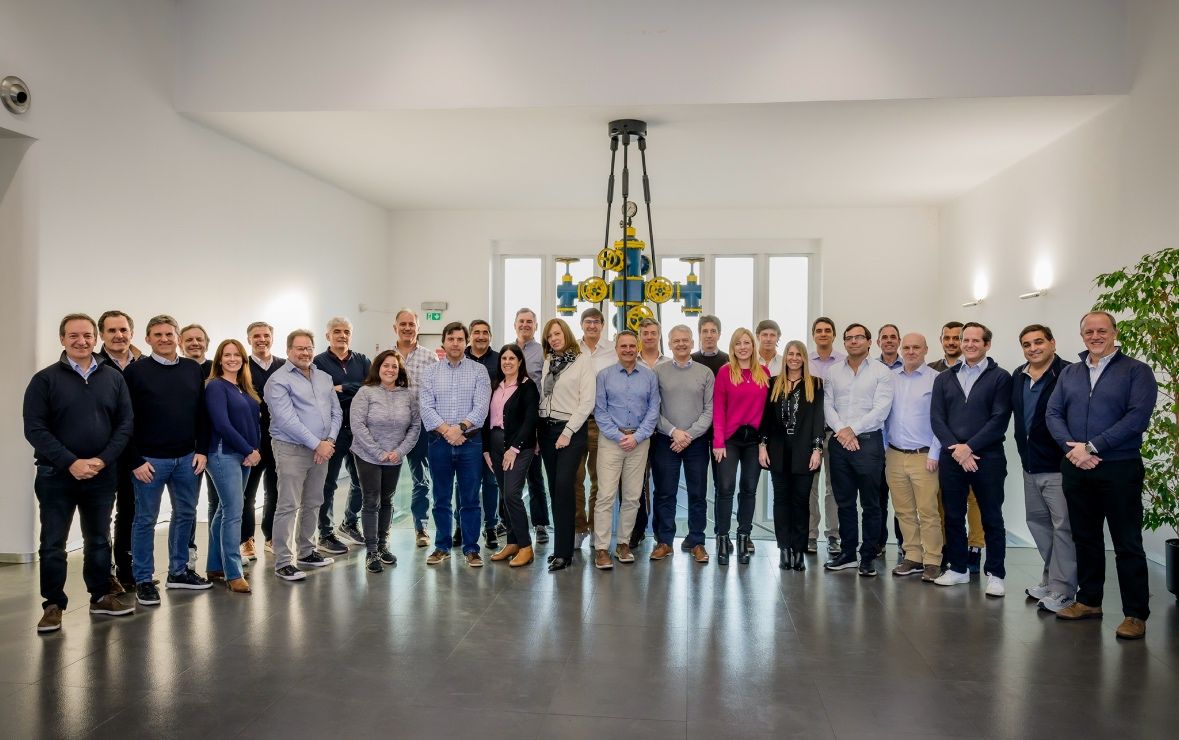
Her Dalmine convention post offers a small, less formal companion to the corporate chronology. She described an intensive week of exchanging experiences and projects, and thanked the team. The photograph shows a roomful of colleagues gathered together. Its scale is useful: a global function still consists of people who need time to compare their work.
The professional connection between those colleagues is unusually visible in the career itself. By this point, Móndolo’s responsibilities crossed the departments represented in the convention’s name. The photograph adds no grand claim about her character. It supplies a modest scene from the work: colleagues assembled in Dalmine, taking a moment to mark a week spent together.
The numbers had factories attached
Consider the business near the end of her CFO tenure. Tenaris reported sales of $12.5 billion for 2024, down 16 percent from 2023. Among the reasons were lower tubular product prices in onshore drilling markets in the Americas, reduced drilling activity in Mexico and Colombia, and fewer shipments for pipeline projects in Argentina. Geography, customers, and product demand were all present in the same financial result.
For that year, operating activities generated $2.9 billion in cash. Capital expenditure was $694 million, dividend payments were $758 million, and share repurchases totaled $1.44 billion. The company ended December 2024 with about $3.6 billion in net cash. These are company figures from her tenure, rather than personal achievements assigned to one executive. They show the scale of the business in which she worked.
Different uses. One industrial balance sheet.
US dollars. Bars share a common scale; selected figures are not a complete cash-flow reconciliation.There is a useful distinction between a profit figure and the cash available to put into a project or distribute to shareholders. The 2024 results put both the continuing investment in the business and the returns to shareholders in view. For a reader following Móndolo’s career, they also replace the vague label “global finance” with a set of tangible magnitudes.
Steel, electricity, and a longer clock
During her CFO years, Tenaris also began operating its first wind farm. Buena Ventura entered full operation in Argentina in October 2023 with 24 turbines. The company said it would supply close to half the electricity required by its industrial facilities in Campana through the interconnected grid, with an expected annual emissions reduction of 152,000 tons of carbon dioxide.
The following month, the board approved an approximately $214 million investment plan for a second Argentine wind farm. These were company projects. Their relevance to Móndolo’s story is the setting they provide for her later oversight of sustainability strategy: industrial decarbonization involves construction, capital allocation, electricity supply, and decisions whose consequences extend beyond a single year.
A wind turbine makes an obligingly photogenic symbol. The less photogenic work includes assessing an investment, obtaining a grid connection, and matching power generation with industrial demand. Sustainability in this setting belongs in the same conversation as operations and finance. Her 2026 mandate brings those subjects together explicitly, alongside risk management and compliance.
The timescales are different, too. An annual report has a closing date. A capital project passes through approvals, construction, commissioning, and years of operation. Board oversight must accommodate both. That is what gives the combination of sustainability and risk a particular meaning in a company that makes physical products: long commitments sit beside results measured every quarter.
A handover with another chapter attached
The CFO succession was announced in February 2025. Carlos Gómez Álzaga would take over on May 2; Móndolo would continue as senior advisor to the chairman and CEO. The announcement thanked her for her contribution as CFO and for 41 years of service within the Techint Group. The dates describe a departure from a particular office and the continuation of a much longer professional association.
On May 6, 2025, she joined Ternium’s board. She now serves as its vice chair with responsibility for overseeing risk management and compliance. In August 2026, Tenaris added its own board appointment and vice chair responsibilities. Her work therefore spans governance at both companies, with sustainability strategy additionally included in the Tenaris brief.
The Tenaris appointment was made by the board under Luxembourg law and the company’s articles of association, with her director’s term running to the next shareholders’ meeting. It placed her on a ten-member board. The arrangement gives the new chapter a formal timetable as well as a defined set of responsibilities.
The distinction between executive work and board oversight matters here. Tenaris has a CFO succeeding her in that role; Ternium has its own executive management. Her current responsibilities sit at the level of oversight. The progression preserves a connection to financial and operational questions while changing the capacity in which she addresses them.
There are other divisions of responsibility on the Tenaris board. Guillermo Vogel’s vice chair brief covers financial reporting and investor relations. The audit committee has its own membership and chair. Those distinctions matter when considering Móndolo’s assignment: a board distributes its work among people with specified oversight roles.
Her two vice chair roles have overlapping language, but their remits deserve to be read precisely. Ternium identifies risk management and compliance. Tenaris identifies those subjects and sustainability strategy. Keeping the assignments distinct gives a clearer picture of her current work than treating every board title as an interchangeable line on a résumé.
Look back along the dates and the current assignment has a legible history. Accounting and administration, audit, financial management, process improvement, and information technology all precede it. The career has acquired breadth through identifiable responsibilities. Its latest chapter asks her to apply that accumulated experience to risks and decisions that will keep unfolding after the next set of accounts is closed.