A pipe can be perfectly made and still arrive at the wrong moment. It can have the right dimensions and the wrong paperwork, or be ready for a well whose schedule has changed. Gabriel Podskubka’s public working life keeps returning to this unglamorous stretch of territory: everything that must happen between making something and making it useful.
There are more theatrical places to build a career. Podskubka built his across marketing, commercial and industrial assignments, then across regions, before taking responsibility for coordinating much of Tenaris’s operating machinery. On May 6, 2026, the company appointed him chief executive. He had joined its Argentine operations in 1995. The promotion was announced in a day; the preparation occupied three decades.
His story has the satisfying complication of a career that stayed within one industrial group while moving across much of the world. The employer supplies continuity. The assignments supply the movement. Together, they explain considerably more than a photograph beside a new job title.
An engineer arrives in marketing
Podskubka studied industrial engineering at the Instituto Tecnológico de Buenos Aires and later earned an MBA at Harvard Business School. His international working life has included Argentina, the United States, Italy, Romania and the United Arab Emirates. He is an Argentine citizen, based in Dubai.
For all that engineering education, his first department at Siderca was marketing. He joined in 1995, beginning a career that would take him through commercial and industrial functions. The combination matters in a business where a customer’s requirements eventually become a manufacturing problem, and a manufacturing decision eventually becomes a customer’s experience.
In 2006, he became oil and gas sales director in the United States. In 2009, he took charge of Eastern European operations. Four years later came the presidency of Eastern Hemisphere operations, based in Dubai. He held that responsibility until 2023. The sequence widened his geographical brief while keeping him close to the same basic question: how to serve energy customers across very different operating environments.
Marketing
Operations
President
COO
CEO
The distance between a mill and a customer
One clue to Podskubka’s approach appears in his discussions of digitalization. In 2020, while leading the Eastern Hemisphere, he described digital supply chains and industrial operations as central to reducing customers’ costs and inefficiencies. The emphasis was on the work a tool could remove from a process.
Consider PipeTracer, a mobile system for identifying and tracking individual pipes. At the Culzean development in the North Sea, Maersk Oil began using it in 2017; the business later became part of Total. The system recorded details including pipe length and wall thickness in a digital running tally. In Thailand in 2019, its use was associated with time reductions of up to 80 percent in length measurement and deck tally preparation.
Those are project-specific results, rather than a universal promise. They explain the appeal of the idea, though. Information travels with the product, making repeated handling and recording less necessary. The administrative life of a pipe can be surprisingly eventful. Giving it a dependable digital record is one way to calm things down.
Local industrial capacity supplies another part of that approach. In February 2024, Podskubka joined Paolo Rocca at the inauguration of Etihad Tubulars in Abu Dhabi. Tenaris’s $60 million complex combined a pipe service yard, premium threading facilities and an industrial training center. It put storage, preparation, manufacturing work and technical learning in one local footprint, close to a longstanding customer, ADNOC.
The working connection / Rig Direct
- 01Plan the well
- 02Make & prepare
- 03Coordinate supply
- 04Support the rig
An illustrative sequence of services, not a map of every project.
A job description with very few edges
In April 2023, Podskubka became chief operating officer. His remit covered sales and marketing, supply chain and production operations, and product and service development. Written out, it sounds like several people’s diaries accidentally bound into one book.
The scope is useful for understanding the later CEO appointment. It joined the functions that decide what customers need, what a company can make, how it delivers, and what it should develop next. In a manufacturer with operations spread across countries, coordinating those decisions is substantial work in its own right.
At CERAWeek in 2024, he described meeting colleagues from Tenaris and the Techint Group and talking with the senior management of major customers. His account of the conference also touched on just-in-time deliveries to rigs, digital operations and the company’s wind farm in Argentina. The meeting brought several strands of his job into the same conversation: customer relationships, the delivery model and investment in how steel is produced. It is a compact view of the range he was expected to cover as COO.
It also gave him a global version of the regional responsibilities he had already held. Eastern European leadership had become Eastern Hemisphere leadership; the COO role then linked the company’s operating functions across its network. By the time he became CEO, his career had passed through both geographical and functional coordination. That breadth is visible in the assignments themselves, without requiring a heroic account of every promotion.
The Atlantic gets closer
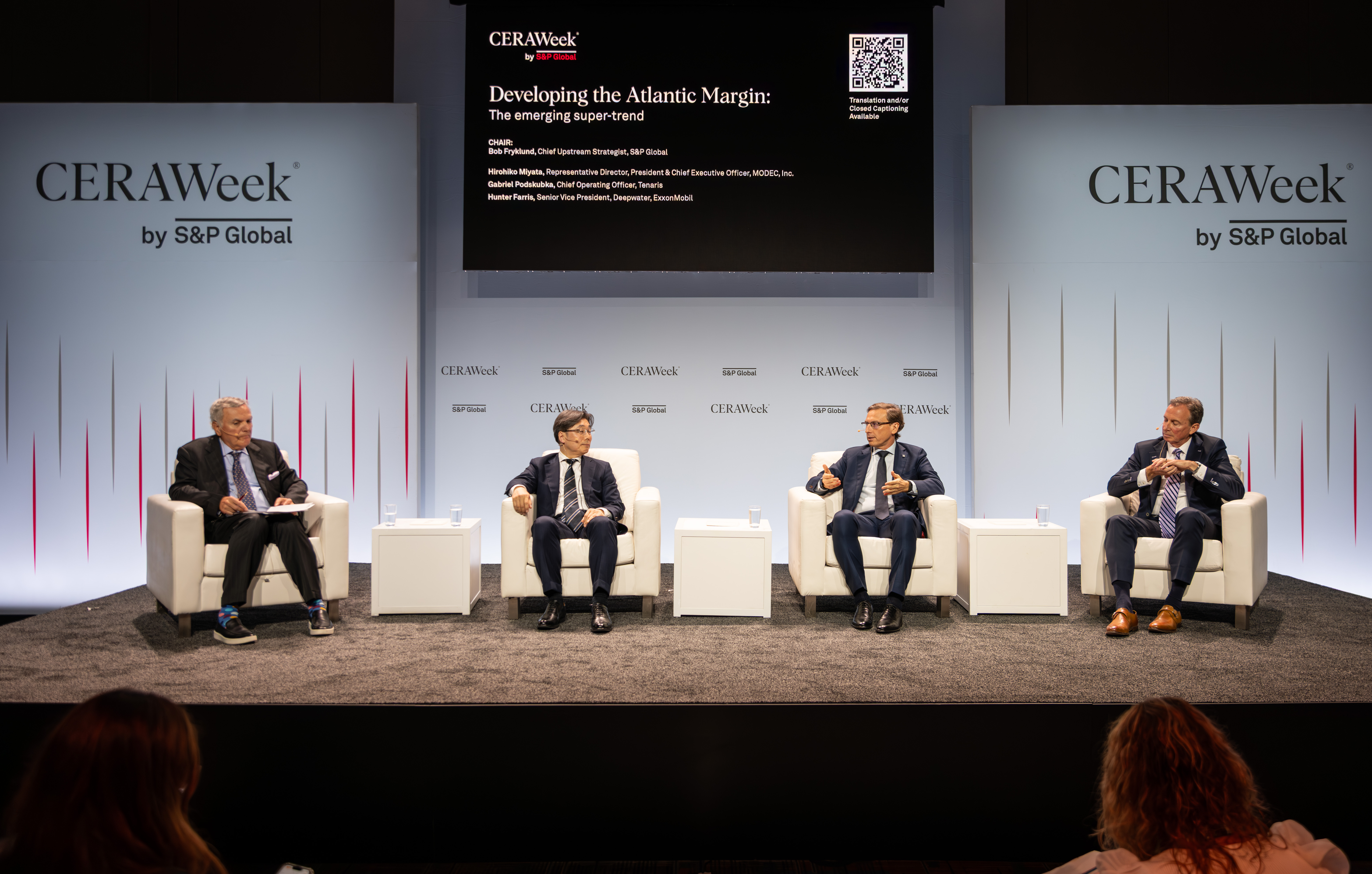
At CERAWeek in March 2026, Podskubka appeared alongside ExxonMobil’s Hunter Farris and MODEC’s Hirohiko Miyata, with S&P Global’s Bob Fryklund moderating. Their subject was the Atlantic Margin, including offshore developments around Guyana and Suriname. Podskubka focused on getting suppliers involved early and coordinating the supply chain as projects moved toward production.
That conversation joined two parts of his operating brief: new products for demanding conditions and services that keep equipment moving. He described customized steel grades and premium connections when existing products could not meet a project’s needs. The harder the operating environment, the more work there is before a pipe reaches the rig.
“For us, increasing complexity is a huge opportunity.”
Gabriel Podskubka · CERAWeek, March 2026
His offshore discussions have also covered coatings, corrosion-resistant materials and integrating pipe supply with related services. In a November 2025 interview about deepwater operations, he described the value of giving customers one accountable partner across several scopes of work. It is an argument for reducing the number of organizational handoffs a complex project has to manage.
The technical detail serves a straightforward commercial purpose. Customers are developing wells in difficult conditions and need products and services designed around those conditions. Podskubka’s account puts the supplier inside the planning and execution of that work, with responsibility extending beyond the factory gate.
A target needs somewhere to live
His public agenda also includes the factory’s own environmental performance. At ADIPEC in 2024, he discussed decarbonization as part of Tenaris’s business strategy, connecting leadership commitments with measures that could be followed at individual sites.
“You need a vision, measurable targets,” he said, before describing the need for leadership capable of turning the vision into reality. The company’s stated goal was to reduce its carbon emissions intensity per ton of steel by 30 percent by 2030. Intensity is the relevant word: the measure concerns emissions relative to output.
Lower carbon emissions intensity
per ton of steel by 2030
Podskubka linked the commitment to site-level indicators and communication about progress. Projects he discussed included the Consteel furnace in Argentina, solar generation in China, Italy and Romania, and wind power in Argentina. The list has the geographical spread of his career and the practical character of his operating responsibilities.
A long-term pledge can be printed in a few lines. Its execution involves equipment, energy supply, investment and decisions inside individual facilities. His ADIPEC remarks kept returning to those mechanisms. For an executive who had worked across industrial and commercial functions, environmental performance belonged in the machinery of the business.
The meeting he remembered
There is a more personal glimpse in his account of a visit to Argentina. The schedule included reviewing the commercial budget with Rocca, discussing the product research and development roadmap, and attending a plantload meeting at Siderca to examine the performance of the new Consteel furnace.
Then came a meeting with Global Trainees. In his account of those weeks, Podskubka singled out that encounter as a moment that stood out. The discussion covered the changing energy landscape, the challenges ahead, and the ingredients of Tenaris’s business, including research, services, its industrial network and its people.
There is a neat continuity in an engineer who entered the business in 1995 meeting another group just starting out. His own career supplied a concrete example of how far an early assignment might eventually lead. The trainees’ route, of course, was still theirs to make.
In an August 2026 account of an employee live event, questions reached him from Saudi Arabia, Nigeria, Romania, Brazil, Colombia and Argentina. They concerned culture, supply chains, growth and career advice. He described the question-and-answer session as the most rewarding part and stressed the value of explaining where the company stood and where it was heading. “That shared understanding is what builds trust.”
A succession measured in assignments
The May 2026 succession left Rocca as chairman and put Podskubka in the CEO role. Tenaris described it as the culmination of long-term leadership planning. The arrangement preserved Rocca’s board leadership while transferring executive responsibility to someone whose working life had developed inside the company.
Following the shareholder meetings on May 12, the board confirmed him as chief executive and re-elected Rocca as chairman. The two responsibilities were now held separately, with the same company experience connecting the outgoing CEO and his successor.
By October 2026, Podskubka was also listed among the strategic speakers for the following month’s ADIPEC in Abu Dhabi. The setting fits the international map of his career. So does the continuing business of explaining how technology, factories, customers and people connect.
Three decades after his arrival in marketing, his responsibility now encompasses the enterprise those connections sustain. A mill, a service yard, a well and a room full of trainees each reveal a different part of it. His career has given him a reason to enter all four.
Continue the conversation
- Gabriel Podskubka on LinkedIn ↗
- Tenaris: leadership and career ↗
- The CEO appointment ↗
- CERAWeek: the Atlantic Margin discussion ↗
- Offshore: the deepwater interview ↗
- Podskubka on employee questions ↗
- ADIPEC 2026 speaker biography ↗
- Tenaris on Instagram (company account) ↗
- Tenaris on X (company account) ↗
- Tenaris on Facebook (company account) ↗