A company announces a new value: courage. The word appears on slides, posters and perhaps a coffee mug. Everyone agrees that courage is good. Then a meeting turns awkward. A junior employee spots a dangerous assumption. The deadline is tight; the boss is enthusiastic. Does the employee speak? This is where the corporate value stops being typography and becomes a choice.
Alfa & Omega has made a business out of that moment. The Oslo consultancy works on strategy, organizational culture and internal communication, but its unit of interest is smaller: what people actually do. It packages the conversation into cards, maps, workbooks, digital voting and facilitated workshops. The firm’s own shorthand is blunt: “Culture is behavior.”
Established in 1983, Alfa & Omega sits in a curious part of the consulting market. It is downstream from the grand strategy decision and upstream from ordinary work. That middle is crowded with good intentions. A board approves a direction. Executives announce it. Employees recognize the vocabulary but cannot yet connect it to the next customer call, safety check or project tradeoff. Alfa & Omega builds the bridge.
The trouble begins with an agreeable adjective
Most culture work starts peacefully. People want the organization to be innovative, open, responsible and customer-focused. These are pleasant words, which is precisely the problem. Pleasant words conceal disagreement. One manager hears “decisive” and imagines speed. Another hears the same word and imagines recklessness.
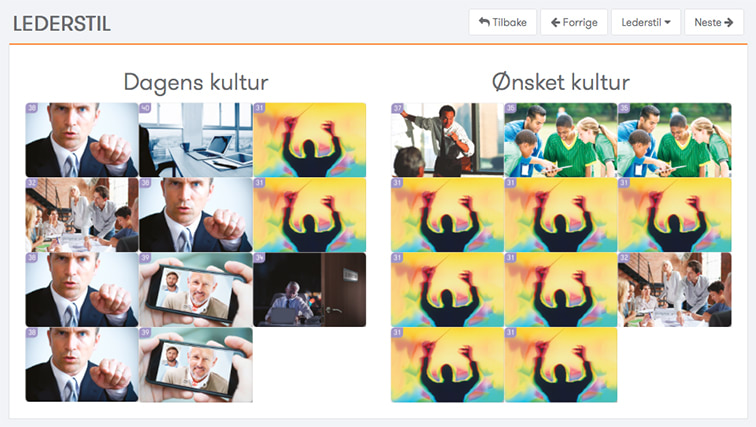
Kulturkabalen, Alfa & Omega’s best-explained tool, makes that disagreement visible. Participants use images and words to describe the culture they experience and the culture they need. They identify the gaps, propose actions and receive a digital report. The clever part is not the cards. It is that colleagues must place their private interpretations on a shared table.
Verdispillet performs a related trick with dilemmas. A client’s values and live challenges are turned into discussions about desired and undesired behavior. The firm used this approach in work described for GIEK, where values and ethical guidelines had to survive concrete choices rather than merely sound respectable.
“What is the value of ‘courage’ if employees do not dare?”
A workshop is a small machine
There is a mechanical quality to the portfolio. Full Effekt asks groups to rank goals and initiatives, then agree on sequence. Strategisk kart lays institutional history across strategic themes so that the past becomes material for decisions and onboarding. Vår arbeidshverdag turns responsibility and collegiality into recognizable situations. Endringskapasitet uses three work canvases and half a day to examine experience, motivation and risk before leaders write a change plan.
This is what the company actually sells: custom advisory work, facilitation, program design and tools that structure participation. The customer is usually not an individual employee shopping for software. It is a leadership or HR team facing a merger, new strategy, safety challenge, reorganization or large gathering. Pricing is bespoke, as the work is tailored to the organization and problem.
The methods also borrow from communication and theater. In a KLP leadership program, actors performed sketches about specific behavioral problems. For TINE, Alfa & Omega helped design leadership gatherings with presentations, dialogue and staged future scenarios. For an ABB office move, it helped plan topics and scripts for an internal podcast series. The medium changes; the aim does not: make the abstract recognizable enough to discuss.
The client list is a map of Norwegian complexity
The published cases span airports, pensions, rail maintenance, food production, engineering, professional associations and health services. These are not interchangeable settings. That variety explains why Alfa & Omega’s product is a repeatable process rather than a universal answer.
ABB
A safety-culture program combined workshops and interviews into a local improvement toolkit. The firm’s account reports more safety observations and fewer unwanted incidents.
Orkla Foods Norge
When Stabburet and Rieber & Søn came together, culture mapping fed a new framework of vision, values and strategy.
Mantena
A former sole rail-maintenance supplier entered a competitive market. Leadership tools and workshop results became input for culture work at individual facilities.
Avinor
Leadership work across 42 regional airports put tensions and conflicting goals into the room, then used Kulturkabalen to shorten the route from words to action.
What failed first in these stories was rarely intelligence. It was translation. A merged company had two proud histories but needed one working culture. A safety ambition needed local behavior. A new competitive reality required different instincts. The trigger that changed minds was usually external - a merger, a new market, digitization, new regulation or a visible performance risk. The workshop mattered because the old operating assumptions could no longer remain implicit.
The missing middle
The part worth stealing
A reader can copy the central discipline without copying the cards. Take one value and write a situation in which honoring it costs something. Ask a group to describe the current culture before asking for the desired one. Force priorities into an order rather than approving all of them. End with a named owner and a next action. These moves create friction, and friction is useful: it reveals where agreement was only cosmetic.
There are conditions attached. The tools depend on candor, a real decision to influence and follow-through after the session. If leaders have already chosen the answer, participation becomes theater. If employees cannot safely describe present behavior, the diagnosis will be polite and wrong. If nobody owns the actions, the instant report becomes another attractive artifact. Alfa & Omega’s method is strongest when leaders are willing to hear an inconvenient description and alter what happens next.
That is also the company’s distinction from a slide-heavy strategy house or a self-serve engagement platform. It does not promise that measurement alone will change the organization. It designs the room in which people interpret the measurement, argue over meaning and make choices. Competitors can bring broader global benches or more scalable software. Alfa & Omega’s bet is narrower and more human: change travels through conversation, provided the conversation has a shape.
From the beginning to the Monday after
The name Alfa & Omega suggests totality - beginning and end. The firm’s work is actually preoccupied with the overlooked interval between them. There is the beginning, when the strategy is announced. There is the end, when the organization behaves differently. Between the two are meetings, tradeoffs, jokes, silences and small acts of courage.
In 1996, the consultancy formed an idea board with people from academia, art, culture and business. That mix still makes sense. Organizational change needs analysis, but also staging, language and an eye for how humans notice things. A culture is not a sentence owned by headquarters. It is what happens when the room gets difficult.
Continue exploring