The trouble began with an employee benefit. In 2017, Alexandra Wright-Gladstein wanted to add a climate-friendly investment option to the 401(k) at Ayar Labs. She had helped start a company that used light to move data between computer chips. Surely the retirement menu could accommodate one more choice. The request took three years.
Three years is enough time for a workplace inconvenience to acquire its own mythology. People change jobs. Calendars fill up. The original question becomes something everyone vaguely remembers asking. Wright-Gladstein kept at it. Once an option finally arrived, she had another question: why had a seemingly ordinary request required so much persistence?
That question became Sphere, the company she founded in 2021 to make climate-friendly retirement investing easier to access. Her second business emerged from the administrative workings of her first. There is a certain comic efficiency to the arrangement. A company trying to improve computing’s energy efficiency had handed its founder a fresh climate problem in the benefits paperwork.
Her career makes more sense when followed through that question than through job titles. Semiconductors and investment funds sit far apart on a conference agenda. In her work, both involved a promising possibility held up by the system through which it had to travel.
A whole new company.Ayar Labs request began in 2017; Sphere founded in 2021.
A business degree with a laboratory habit
Wright-Gladstein, who also goes by Alex, traces her environmental interest to seventh grade, when she was 12. In college, she explored ways of working on the problem, including science, policy, and venture capital. Serial entrepreneurship began to look like a career with room for repeated attempts: find useful work, help it reach the world, then do it again.
At Tufts University she studied political science and economics, graduating in 2008. Her education gave her a way to think about institutions and incentives. It also put her on a route into technology that would depend on collaboration with people trained to invent it. The person building the business did not have to be the person designing the processor.
Her first job after college was at EnerNOC, where her work included energy efficiency and energy markets. Five years there preceded an MBA at MIT. Business school offered a particular attraction: access to researchers whose inventions might have climate applications. The degree would come with introductions. She intended to use them.
MIT’s Energy Ventures class gave that intention a practical form. While helping find technologies for the course, she surveyed energy-related research across campus. It was an unusually useful vantage point for a business student: a chance to look at what was being made before deciding what might become a company.
Among the people she met was professor Rajeev Ram. The research around optical communications caught her attention. She entered the conversation without a semiconductor background and relied on technical collaborators to learn it. A business school can teach the vocabulary of a market; spending time with its inventors adds the questions a pitch deck tends to omit.
A prize big enough to keep going
The computing problem was a mismatch. Processing capability had advanced faster than the ability to move information between chips. A computer could possess plenty of processing power and spend time waiting for data. Faster arithmetic was of limited help if the next piece of information was still stuck in traffic.
Ayar Labs grew around optical communication between chips. Light offered a route past the constraints of electrical connections. The research came through work at MIT, the University of California, Berkeley, and the University of Colorado Boulder. Building a company meant turning that research into something customers could put into their own systems.
data transfer bottleneckCHIP B
data carried by lightCHIP B
In May 2015, the team competed as OptiBit in the MIT Clean Energy Prize. Wright-Gladstein joined Mark Wade and Chen Sun in making the business case. The team won both grand prizes: $200,000 from Eversource and $75,000 from the Department of Energy, a total of $275,000.
The distinction mattered for a practical reason. Prize money could keep chip development moving during fundraising. A hardware company has bills before it has a finished product. An award can supply recognition, but it can also pay for the next attempt. For this team, the next attempt was the point.
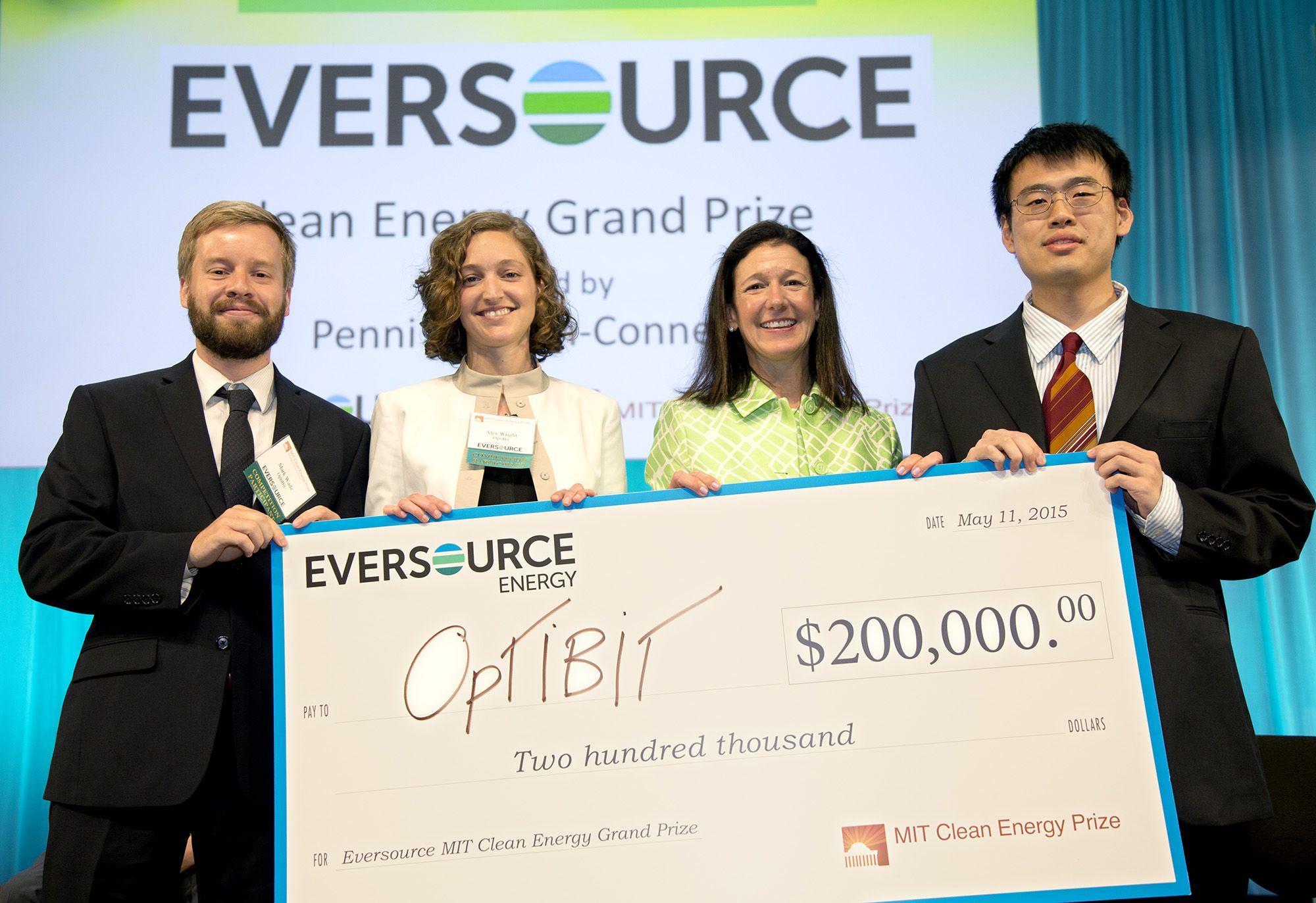
OptiBit became Ayar Labs. Wright-Gladstein became its founding CEO. There was another task beyond financing the research: persuading potential customers to think about computing differently. The company needed people inside large organizations who could imagine changing the way their systems moved data.
“Once we do find those people it’s really fun.”
Alexandra Wright-Gladstein, on finding receptive customers for Ayar Labs
The pleasure in that remark is specific. It comes after finding someone willing to consider an unfamiliar technical possibility. Wright-Gladstein’s role put her at the meeting point between researchers who understood what they had made and customers who needed to understand what they could do with it.
The founder who hired the next CEO
As Ayar Labs’ founding CEO, Wright-Gladstein raised its first $27 million in venture funding, along with government grants. She also recruited Charles Wuischpard, a semiconductor and supercomputing industry executive, to become CEO. By the start of 2019, her public title was chief strategy officer and co-founder.
That transition belongs in the story because starting a company and organizing its next stage are different jobs. Recruiting a successor is a consequential piece of company building. The founder who assembled the early business helped bring in someone with experience in the industry it was entering.
Her resolutions for 2019 included recruiting more women and diverse candidates, and spending more time explaining the environmental implications of Ayar’s technology. The two priorities show what she wanted to keep visible while the organization grew: who got to work on the technology, and why she had chosen to work on it.
She has named Sunrun co-founder Lynn Jurich as an inspiration. Jurich’s business made rooftop solar more accessible by changing how homeowners paid for it. The attraction is understandable. A technical possibility can remain out of reach until someone changes the commercial arrangement around it.
The people between a fund and a saver
At Sphere, Wright-Gladstein took on another arrangement. A workplace retirement plan does not give every employee an unrestricted shopping list of funds. Choices depend on the plan’s menu. A saver can want an option that the surrounding system has yet to make available.
Sphere’s work centers on getting climate-friendly investments into that system. Its flagship Sphere 500 Climate Fund offers broad U.S. large-company exposure while excluding fossil fuel companies and other screened categories. Shareholder voting is also part of its approach: the fund’s holdings come with decisions about how shares are voted.
For a founder, this creates several conversations at once. Employees may begin with climate concerns. Plan decision-makers need to evaluate an investment product. Platforms have approval processes. Each group can affect whether a fund eventually appears on a menu, and enthusiasm in one group cannot complete the work of another.
- 01Employee interestSomeone asks for another option.
- 02Plan decisionThe workplace evaluates its menu.
- 03Platform availabilityThe fund must be available to the plan.
- 04A choice for the saverAccess becomes something usable.
By August 2025, Wright-Gladstein was discussing Sphere’s availability on Fidelity and Schwab. Getting there had involved years of audits and platform approvals. In that conversation, she described $100 million in assets under management as a prospective threshold that could open access to larger corporate plans. It was a goal in the adoption process, rather than a claim that the company had already reached it.
Those are the details that give her second act its texture. Finance supplies a fresh assortment of acronyms, but the daily problem remains recognizable from hardware: a useful product must enter an existing organization’s way of doing things. Someone has to understand where the decision sits, what evidence it needs, and what happens next.
Still asking for another option
Wright-Gladstein also writes and speaks about the work outside formal sales conversations. Her essays have addressed retirement investing and discussing climate with friends and family. In 2024, she described Sphere as part of a wider movement and urged people to focus on the organizations where they worked.
That emphasis brings the story back to the original benefits request. The workplace gives the problem an address. An employee can raise a question, a team can discuss it, and an employer can consider a change. A broad climate concern acquires a decision that identifiable people can make.
In March 2026, she joined Beck Bamberger on Coffee with a Founder to talk about Sphere and the retirement-plan difficulty that prompted it. Years after starting her second company, she was still explaining the experience from which it grew. The frustration had become a way to make an unfamiliar business understandable.
Her two companies invite attention to the parts of a system people usually pass over. Data has to travel between processors. A retirement fund has to reach a plan menu. At each junction, there is room for delay, expense, and a choice someone assumed was fixed.
The seventh-grade environmental concern survived economics classes, energy-market work, business school, chip fundraising, and a new field of finance. Its expression changed as she encountered different problems. The most revealing turn came when she asked for an employee benefit, waited three years, and decided the next person should have an easier time.
Follow the conversation
COMPANIES, PUBLIC PROFILES & INTERVIEWS