A television news bulletin has a useful quality: it does not care about your technical difficulties. Nine o’clock arrives with or without a functioning disk. While running RAIDIX, Alexander Katashov used precisely this sort of customer problem to explain the value of reliable data storage. The mathematics could be ingenious. The news still had to go out.
It is a good place to begin with Katashov, a technology executive whose public career moves from storage software to oilfield diagnostics. In both businesses, the sale depends on an unromantic question: what will this allow someone to do? An engineer may admire an algorithm. A customer has a schedule, a budget and an operation that must continue.
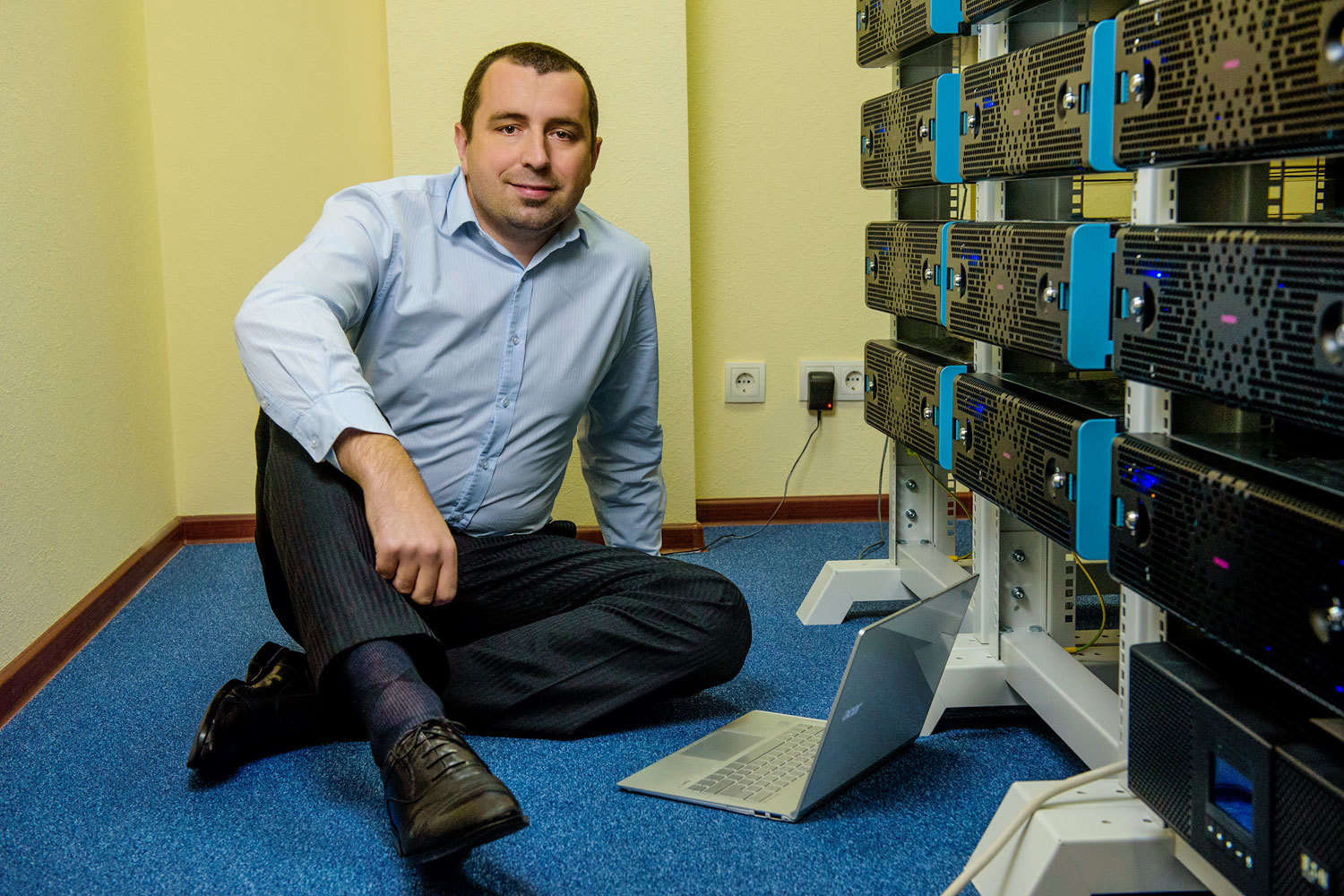
In a photograph from his RAIDIX years, he sits beside a rack of equipment with a laptop open on the floor. The machines have the visual charm of a filing cabinet that has taken up bodybuilding. They are also a reminder that much of the digital economy occupies actual rooms, needs electricity and occasionally requires someone to sit beside it.
His later work at GeoSplit concerns another physical system, this time largely out of sight. An oil well delivers fluids to the surface. Working out which underground interval supplied which part of that mixture is a more demanding assignment. Katashov’s commercial story follows the effort to make that hidden activity legible.
A deadline that does not negotiate
RAIDIX developed software for data-storage systems. Katashov was its chief executive during a period when the company was expanding its commercial reach. The job involved explaining why software mattered inside a purchase that could look, from the outside, like a collection of disks and metal boxes.
His example of the television deadline made the issue tangible. A disk failure can turn a routine job into a delay. Reliability, recovery and performance therefore belong in the same conversation as the customer’s working day. Technical features acquire meaning when an editor, an operator or a systems integrator can connect them to a task.
In 2016, RAIDIX brought in investment from Rostelecom’s venture operation. Katashov described the attraction of a technology partner alongside the financing: a connection that could support larger projects, including a move toward data centers. This was an executive talking about where the product could go and who could help it get there.
There is a distinction between building a system and arranging for another organization to depend on it. The second job requires a wider cast. It includes the people who integrate equipment, the people who sell it and the people who must answer when it stops working. That commercial setting helps explain the international partnerships in his record.
Tokyo, and the usefulness of a partner
On December 19, 2016, Katashov published an account of a Tokyo visit. He described signing a strategic-partnership memorandum with the head of Panasonic’s storage business division. The event took place at Japan’s Ministry of Internal Affairs and Communications, in the presence of Japanese and Russian ministers.
“Just finished my Tokyo visit with great result”
Alexander Katashov, December 2016
The short opening has the satisfaction of a trip that accomplished its purpose. The underlying project had a practical division of labor. RAIDIX’s software handled frequently accessed, or “hot,” data. Panasonic’s Freeze Ray optical-storage technology addressed archives of “cold” data, the material accessed less often but still worth keeping.
A June 2016 joint announcement had already described the proposed hybrid solution. The plan connected quick access with longer-term storage and a partner distribution network. The December memorandum added another public milestone to that collaboration. An agreement is a step in a business relationship; it also makes the relationship available for others to inspect.
Katashov’s account puts him in the role of a commercial intermediary between specialized technology and a much larger organization. That role would recur with a different vocabulary. Storage arrays gave way to well intervals. The question of getting a product into established industrial operations stayed with him.
A different kind of darkness
His departure from RAIDIX was reported in April 2017. By the time of his 2018 interviews about GeoSplit, the subject had changed from data storage to production logging. The physical distance had changed too: from equipment one could stand beside to processes taking place underground.
GeoSplit’s early history included laboratory development followed by oilfield trials. In a 2018 interview, Katashov described a small-laboratory phase from 2013 to 2015. The company’s experiments needed to become something that could be tested in an operating well. A laboratory can establish a promising idea; a field project gives that idea a less accommodating examination.
The timetable was consequential. In another 2018 account, he described two years spent arranging pilot projects and a further two carrying them out and recording the results. The neat word “pilot” conceals a great deal of calendar. A customer must agree, equipment must be placed and observations must accumulate.
For a commercial executive, that changes the rhythm of the job. The next convincing result may depend on a field schedule and a period of observation. Progress has to be explained to customers and investors while the technology is earning its evidence. Patience becomes part of the business model, whether or not it looks attractive in a presentation.
A well is more than its total
The problem behind GeoSplit is easier to grasp than its terminology suggests. Different intervals of a producing well can contribute differently to the combined flow. The total at the surface is useful, but it leaves another question: where did the components come from?
GeoSplit’s tracer approach places identifiable markers in selected parts of the well or its completion. Samples of produced fluid are collected at the surface and analyzed. Identifying the marker codes allows the team to evaluate the contributions associated with those locations. The return journey of the fluid carries information about its origin.
Simplified process diagram. It shows the measurement sequence, not results from a particular well.
This gives Katashov a concrete product to explain. The output is information about the well’s behavior, which can support decisions about its operation. The commercial promise rests on whether those measurements arrive in a form that the operator can use.
GeoSplit’s digital-platform work extends that chain into data storage, visualization and modeling. A 2021 technical article describes a platform combining well documentation, engineering parameters and production-logging information. A measurement still needs a place to live and a method of interpretation. Here, Katashov’s earlier industry starts to feel a little closer.
The slow route to twenty wells
GeoSplit’s 2019 funding announcement supplies a dated snapshot of its commercial progress. Katashov said the company was monitoring twenty wells by the end of 2017 and that the number exceeded fifty by the end of 2018. These were stages in an early rollout, with individual wells providing the unit of progress.
Historical figures from the 2019 funding announcement. They describe that period.
The announced five-million-dollar round was led by UCP, with Rusnano Sistema SICAR participating after its earlier investment. Katashov’s stated priorities included gas markers, digital solutions and an export program. The list shows several kinds of work proceeding together: further development of the technology, broader application and entry into additional markets.
China was already part of the international chapter. The announcement described a two-million-dollar diagnostics contract signed in 2018 for the Changqing field, developed by CNPC. In September 2023, GeoSplit’s Chinese news page reported Katashov’s visit to Dongying’s Economic and Technological Development Zone. The dated events give substance to the international ambition.
The laboratory joins the boardroom
Katashov’s name also appears among the authors of a paper prepared for the Offshore Technology Conference in Houston in May 2022. Its subject was tracer-based evaluation of fracture-port productivity and the contributions of near and far fracture zones. The case involved a horizontal well with ten fracturing intervals.
The study followed changes in interval productivity over months of observation. Co-authorship places the executive inside a specific technical conversation, alongside colleagues including Anna Belova and Nadir Husein. Credit belongs to the group. The useful detail is that the commercial story can be connected to a named study with a defined operating setting.
Technical scrutiny was another part of the work. GeoSplit announced that its method had been recommended by the Expert and Technical Council of Russia’s State Commission on Mineral Reserves. Katashov described laboratory tests, field tests and independent evaluation as part of the company’s approach to the professional community.
In June 2021, he received the Expert of the Year award in Science and Innovation for the GeoSplit project. The ceremony took place in St. Petersburg. The recognition attached a person’s name to a collective effort involving marker research and digital models of oil and gas assets.
Getting the information home
His education spans the Physics and Technology department at St. Petersburg State Polytechnic University and an Executive MBA at Vlerick Business School. The combination fits the work visible in his career: understanding a technical proposition and arranging the conditions under which another organization might adopt it.
Read the two chapters together and the continuity becomes clearer. Storage software makes information available when someone needs it. Oilfield tracers help obtain information from a place where observation is difficult. Each system depends on a chain of equipment, analysis and people doing their part.
Katashov’s stated ambition in 2018 was for GeoSplit’s technology to find broad adoption and become an industry standard. That is an ambition with a demanding test. A standard must become ordinary enough to use repeatedly. The work between a laboratory experiment and that kind of acceptance is the territory his documented career occupies.
The television bulletin provides a fitting final measure. Somewhere, a customer needs to finish a task. The technology earns its place when the information arrives in time, in a usable form, and the customer can get on with the work.