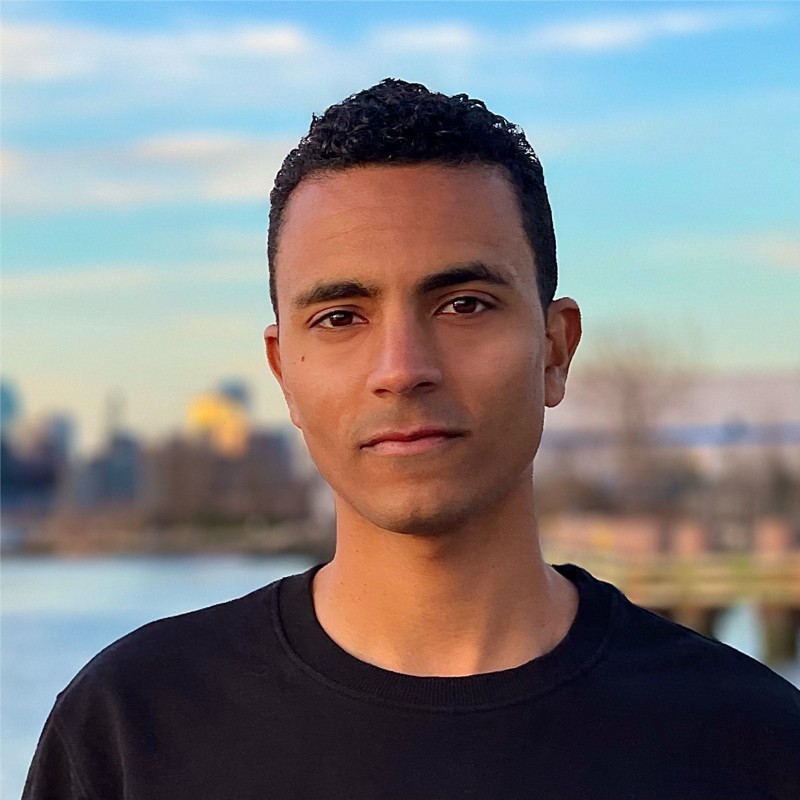
The man who decided the busy signal was a bug worth fixing.
Call a fully booked restaurant on a Friday night and you usually get one of two things: a phone that rings into the void, or a host who is too busy seating a four-top to pick up. Alex Sambvani looked at that dead air and saw a business. Slang.ai, the company he co-founded and runs as CEO, now answers the phone for more than 2,000 restaurant locations - and it has taken over 25 million of those calls so far.
Sambvani is a Stanford-trained mechanical engineer who studied applied math and computer science on the side, then collected a Harvard MBA. On paper that reads like a track to private equity, and for three years it was - he spent 2012 to 2015 as an analyst at Credit Suisse. But the through-line of his life isn't finance. It's two things he has loved since he was a kid: food and machines that do clever things.
He grew up cooking next to his grandmother. He also competed in a global robotics competition. Most people pick a lane. Sambvani built a company that is, quite literally, both: software engineering pointed straight at the restaurant industry.
The pivot point was Spotify. After his MBA he joined the streaming company's data science team in 2017, where he worked on personalized voice AI and shipped features that reached more than 100 million people. There he met Gabriel Duncan, who would become his co-founder and Slang's CTO. The two of them entered a company hackathon and built a personality-forward voice app. It won - out of more than a hundred ideas.
The hackathon project was the tell. Voice AI was about to get genuinely good, and most of the useful applications were sitting outside Spotify, in the small and mid-sized businesses that get buried in phone calls. In 2019 Sambvani and Duncan left to start Slang.ai in New York. They picked the hardest, warmest, least forgiving customer they could find: restaurants.
Restaurants are a brutal proving ground for a phone product. The calls are constant and they all matter - a reservation, a private-dining inquiry, a question about the gluten-free menu, a regular trying to change a booking for eight. Staff are stretched thin precisely when the phone rings most. As Sambvani puts it, a missed call is rarely just lost revenue.
Slang.ai's answer is a voice agent built specifically for hospitality, one that can take reservations, route the late-night event inquiry, and - when the dining room is full - offer a table at a sister location instead of letting the caller hang up. Restaurants on the platform capture roughly double the revenue from phone interactions, the company says. Sambvani frames the goal in language any good host would recognize: an "AI Superhost" that treats every caller the way the best maître d' treats a guest at the door.
The market noticed. Slang.ai emerged from stealth in 2023 with a $20 million Series A from a roster that included Homebrew, Underscore VC, Wing VC, Stage 2 Capital and others. The angel list is where it gets fun: chef Tom Colicchio, Behance founder Scott Belsky, and executives from Snap and Zoom all put money in. For a founder whose first ambition was the kitchen, having a Top Chef judge on the cap table is a tidy bit of symmetry.
In early 2026 the company announced a $36 million Series B led by U.S. Venture Partners, pushing total funding to around $68 million. The plan from here, in Sambvani's telling, runs in three directions: deeper personalization, proactive guest engagement (the AI reaching out, not just answering), and better operational visibility so owners can actually see what's happening on their phones.
For all the talk of automation, Sambvani is careful about where the line sits. His pitch isn't that the robot replaces the host. It's that the robot picks up at 11:47pm so the host can spend the dinner rush actually hosting. The technology, he likes to say, should make the human parts of hospitality more human, not less.
He has not abandoned the kitchen, either. He still cooks - pasta carbonara is his go-to for friends and family. Which means the founder building AI for restaurants is, on the weekends, exactly the kind of person his product is built to serve: someone who cares a lot about a good meal and a phone that gets answered.
What "answer the phone" actually means.
It is easy to wave a hand at "voice AI for restaurants" and miss how specific the work is. A restaurant phone line is a tangle of small, high-stakes errands. Someone wants a table for two at 8pm. Someone else is calling about a private-dining buyout for forty people next month. A regular needs to push a reservation back an hour. A first-timer wants to know whether there's parking. Each of those is a different conversation, and getting any of them wrong costs a customer.
Slang.ai's agents are built to handle that range - reservations, modifications and cancellations, confirmations, event and private-dining inquiries, and the long tail of guest questions - and to do it in a brand voice the restaurant chooses rather than a flat robotic monotone. The cleverest move is what happens when the answer is "no." When a restaurant is fully committed, the system can offer a table at a sister location instead of letting the caller give up, and it can qualify a late-night event inquiry so a real person follows up with the right lead. Sambvani's word for the whole thing is "Superhost" - the AI as the tireless front-of-house presence that never lets the phone go to voicemail.
The scale tells the story. Slang.ai has processed more than 25 million guest calls from over 10 million unique guests across 2,000-plus locations, and the company reports that restaurants on the platform capture roughly double the revenue from their phone channel. The customer list reads like a tour of modern dining: Slutty Vegan, Planta, Nikki Beach Miami, the Palm House Hospitality Group, and others across full-service and multi-location groups. It is not a thin slice of early adopters - it is a working cross-section of the industry.
None of this came from nowhere. At Spotify, Sambvani worked alongside voice AI engineers who had cut their teeth on Amazon Alexa - people who understood, viscerally, how hard it is to make a machine sound like it is actually listening. That pedigree shows up in the product's obsession with feeling human. The bet underneath Slang.ai is not that diners want to talk to a computer. It is that diners want their call answered, immediately, by something that gets the job done and doesn't make them feel like they're shouting into a menu tree.
That is also why the roadmap leans toward warmth rather than pure automation. The Series B money is pointed at deeper personalization (the AI remembering a guest's preferences), proactive engagement (reaching out rather than only reacting), and operational visibility so owners can finally see call volume, peak times, and what guests are actually asking for. For an industry that has run on gut feel and a paper reservation book, turning the phone into a stream of analytics is its own quiet revolution.
Step back and the shape of Sambvani's career makes sense. Engineering at Stanford. The financial rigor of three years in private equity. The data-science craft and voice-AI exposure at Spotify. The business framing of a Harvard MBA. And underneath all of it, a kid who loved cooking enough to once want it as a career. Slang.ai isn't a detour from any of that. It's the one company that needed every piece.
Four lines that explain the bet.
The carbonara clause
His childhood ambition was to be a chef. He competed in a global robotics contest. The company he ended up building is the exact midpoint of those two kid-selves - and one of his angel investors, Tom Colicchio, is an actual celebrity chef. Few origin stories close the loop this neatly.