An airline ticket presents a small philosophical problem: buy it now, or wait and spend the afternoon wondering whether waiting was foolish. Alex Mans began building FLYR around that question. The early business forecast airfares so travelers could judge when to purchase. Over time, he moved to the other side of the transaction, developing software for the airlines setting those prices. The passenger’s uncertainty became an opening into the airline’s own.
There is a pleasing awkwardness to that career path. A founder who first tried to help customers navigate the fare moved toward helping carriers run their commercial operations. It required changing the buyer, the sales conversation and the scale of the responsibility. Today, his work reaches beyond forecasting into the records and systems through which an airline sells and manages a journey. The ticket was a useful place to begin. It was a rather small place to stop.
Mans grew up in the Netherlands and taught himself to write software around age ten. He was building startups after high school, and his public professional profile dates his software and hardware business building to 2007. Aviation and artificial intelligence were interests he wanted to bring together. In 2013, he moved to Silicon Valley and started working on the business that became FLYR. The childhood skill had acquired a destination.
An ocean between the idea and the market
The move to America had a commercial logic. Mans saw travel as a business of large volumes and narrow margins. Europe offered customers, but also a fragmented market with different languages and regulatory requirements. The United States offered a large market and large potential clients. For a young founder thinking about scale, those differences mattered before a single additional feature was written.
The early technology could let a traveler hold a fare for a small payment, with the company covering the difference if the price subsequently rose. Forecasting therefore had a consequence beyond a reassuring arrow on a screen. It supported a financial promise. Predicting what might happen to a ticket and accepting exposure to that prediction are different levels of commitment.
An invitation from Plug and Play followed a video of Mans at the Launch Festival. That sequence gives his relocation story a suitably contemporary detail: a presentation could travel before the presenter returned. The Bay Area also offered experienced founders and access to capital. His choice was about putting a technical idea within reach of people who could help it become a business.
The customer changes seats
FLYR’s consumer beginnings are essential to understanding the later company. A fare forecasting tool meets a traveler at one decision. An airline revenue system becomes part of a continuing operation. By February 2022, Mans was describing a business that had pivoted to serving airlines more than three years earlier. The company had attracted attention from Amadeus and JetBlue Technology Ventures along the way.
That switch brought a different buying process. In a March 2024 startup conversation, Mans discussed the importance of personal relationships with airline executives in winning contracts, alongside the appeal of recurring revenue from enterprise customers. A useful prediction could open the conversation. A lasting relationship had to carry the implementation, the scrutiny and the next set of needs.
His own job changed too. Mans began as FLYR’s chief technology officer in 2013 and became CEO in 2020. In describing his responsibilities later, he emphasized strategic direction, working with leadership and investors, and spending time with customers to understand their needs. The work of a technical founder had expanded to include deciding which problems deserved the team’s time. Software remained central; so did explaining why an airline should trust it.
A forecast has to earn its keep
In September 2021, FLYR announced a $150 million Series C led by WestCap. Its explanation for the financing was practical: expand the product offering, delivery capacity and customer teams, and support acquisitions. Investors included Silver Lake Waterman, WndrCo and existing backers. The list also included JetBlue Technology Ventures, connecting the business to an airline investment organization rather than only general technology capital.
The scale of the ambition was becoming visible. FLYR said it expected to manage more than $14 billion in customer revenue by the end of that year. That was revenue passing through its customers’ businesses, an important distinction from FLYR’s own sales. For Mans, the figure illustrated the weight of decisions being placed on the software. A fare prediction was now part of an institution’s financial machinery.
By June 2023, he said the company had grown from 30 people in 2020 to 700. He described its forecasting as working upward from individual flights, including demand, cancellations and no-shows. Such detail could inform where a carrier flies, how frequently, and with what equipment. He also described revenue management broadening toward profit and net contribution, with costs entering the calculation. Selling more seats is an incomplete answer when the expense of carrying them changes the result.
The DJ and the data team
Mans has described an early enthusiasm for putting on a show: as a child, he DJed for his family and brought equipment to an end-of-year primary-school party. The speakers were less enthusiastic about the larger assignment. He recalled blowing up equipment. It is an unusually literal introduction to the limits of scaling.
He has also recalled hiring Cole Wrightson, the company’s first employee, at his kitchen table. The attraction was Wrightson’s ability to learn and grow into what the business would need. That is a revealing criterion for a company whose own job description kept changing. A founder hiring for a fixed future might have had to replace the person every time he revised the plan.
His account of leadership revolves around giving people the means, information and ownership to do their jobs. He sees the leader’s role as choosing distant targets and enabling the team to reach them. The technical background helps explain his interest in the work; the childhood performances help explain why he is willing to stand in front of a room and talk about it.
More data, fewer disconnected decisions
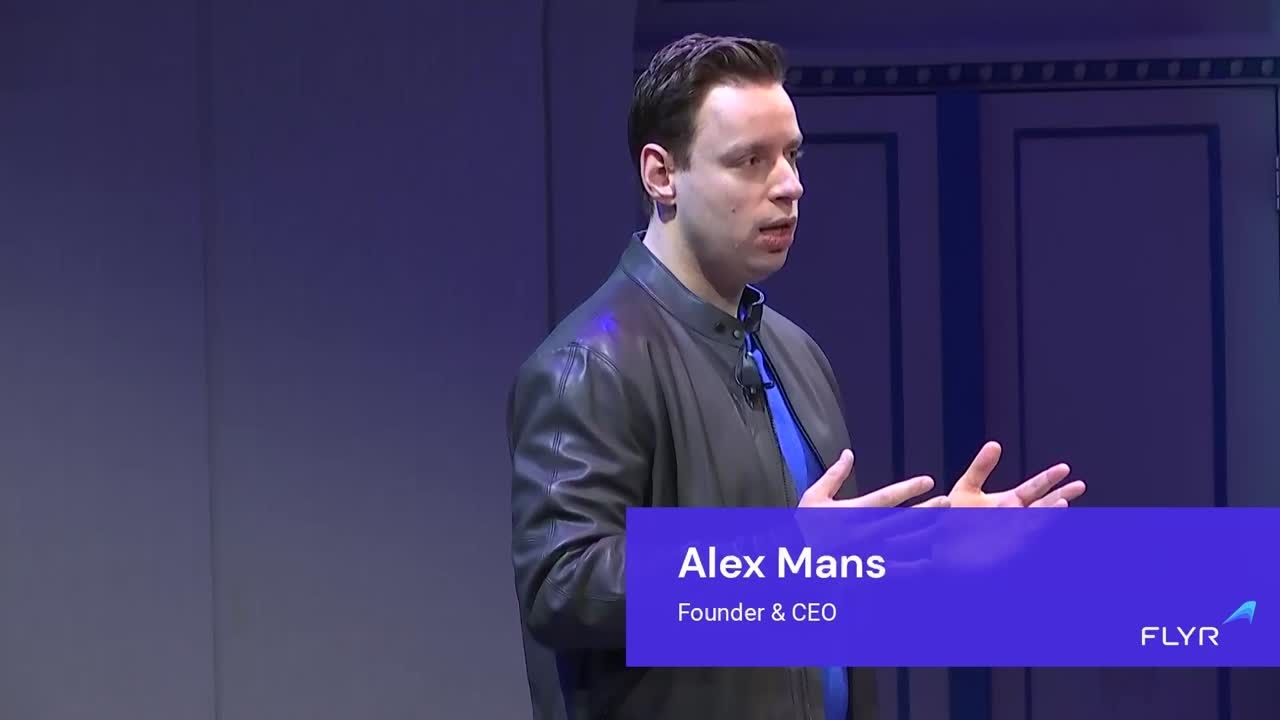
At the 2022 Skift Aviation Forum, Mans focused on an unglamorous obstacle: commercial information scattered across an airline. Booking data, events, holidays and promotions needed to be brought together so departments could work from a common picture. The attraction of AI lay in finding useful signals and making them accessible to the people making decisions. Accumulating information alone would not finish the job.
That emphasis gives his public argument a recognizable shape. The algorithm is part of a system that includes data, employees and the decisions they make together. Network planning, marketing and pricing influence one another. If each department sees a different account of demand, improving one calculation leaves the wider organization arguing over the inputs.
In a 2023 World Aviation Festival interview, he separated fundamental AI research, interfaces built on existing models, and practical applications to business problems. FLYR’s pitch sat in that third territory. He also discussed how outdated systems could contribute to passenger disruption. It was an argument rooted in what the technology allows a company to do, with the traveler experiencing the consequences at the other end.
The airline becomes a shop
In August 2024, FLYR announced $295 million in financing: $225 million of Series D equity and $70 million of credit. WestCap led the equity round, with participation including BlackRock, Streamlined Ventures and an Abu Dhabi Investment Authority subsidiary. Avianca, already a customer, also participated. The financing accompanied a reported 290 percent increase in annualized recurring revenue, a company growth measure rather than a claim about Mans’s personal wealth.
By May 2025, he was discussing airline retailing beyond bags and seats and an annual business investment of more than $100 million, much of it directed toward research and development. FLYR had launched its Offer & Order system the previous September. Its expansion into hospitality also followed the 2022 acquisition of Pace Revenue. The original forecasting problem had grown into a broader question about what travel businesses could offer.
Mans’s prescription for existing airlines was gradual. In November 2025, he recommended deploying new systems in parallel and migrating over time, with incremental commercial gains helping fund the transition. An airline already operating flights cannot treat its booking system as an empty workshop. A new carrier offers a different opportunity: decide how the machinery should work before inheriting all the old machinery’s habits.
A new order meets an old reservation
Riyadh Air became that opportunity. On May 20, 2026, FLYR announced the carrier’s launch on its Offer & Order platform. The promise was a journey held together as one order, rather than a collection of separate travel products. A shopping cart could retain trips and searches, while offers could be adapted and bundled. Further developments, including collaborative planning and additional travel services, were described as future capabilities.
For Mans, this put a long-running argument into an operating setting. The work also involved IBM and other technology providers. Designing the commercial platform required those pieces to cooperate. The claim that an airline could become a more flexible retailer depended on the less photogenic work of connecting the systems underneath it.
In September 2026, FLYR described another step: Riyadh Air selling and servicing Saudia-operated flights while Saudia continued using its existing passenger service system. FLYR translated between the modern order and legacy reservation records. Changes had to travel in both directions. The new airline could adopt a new structure while its partner continued working through the infrastructure it already had.
This is a fitting destination for Mans’s story so far. He began with a person trying to decide whether to buy a ticket. He now leads a business trying to make that ticket, its accompanying products and subsequent changes work across organizations. The larger problem still contains the smaller one: a traveler wants a journey to behave sensibly.
Still looking out of the window
After a 19-hour flight from JFK to Singapore in 2024, Mans took the stage to discuss the systems that hold airline innovation back. His interests could hardly have been more directly arranged: hours inside an aircraft, followed by a conversation about the business behind it. He spoke about modernizing infrastructure while keeping connections to existing systems, and about airlines becoming more capable travel retailers.
His attachment to aviation survives the databases. “The experience of flight…it’s magic,” he said. That affection makes the long technical argument easier to understand. He wants to change an industry whose basic act still delights him. There are worse reasons to spend years discussing reservation records.
“The experience of flight…it’s magic.”
Alex Mans · Singapore, 2024
The move from the Netherlands has also left a connection in the other direction. Mans is listed among DutchTechX’s founding supporters, a community linking Dutch entrepreneurs and their networks abroad. The founder who went looking for a market and experienced peers now appears among the people supporting that exchange. His story continues through customers, colleagues and the systems they are building together. For all the attention paid to AI, much of the work still depends on people agreeing to take the next step.