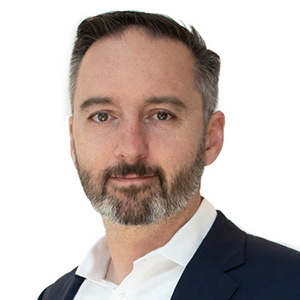
He read the genome for twenty years. Now he wants to rewrite the code that runs it.
There is a man in South San Francisco who believes most disease is a software bug - and that the fix has been sitting in our cells the whole time, waiting for someone with the right read/write tools to find it.
That man is Alex Aravanis. In January 2024 he stepped out of the wings with Moonwalk Biosciences, a company he co-founded to do something the gene-editing field had mostly skipped: change which genes turn on and off without cutting a single strand of DNA. He raised $57 million to try. His scientific co-founder is Feng Zhang, one of the people who taught the world to cut DNA in the first place.
The irony is the point. Aravanis isn't here to break the code. He's here to debug it.
Your DNA almost never changes. Yet a skin cell and a neuron carry the exact same DNA and behave nothing alike. The difference is the epigenome - a layer of chemical marks, methyl groups and the like, that decides which genes are switched on in which cell. Aravanis likes the metaphor so much he built his company around it.
Moonwalk's platform comes in two halves, named with an engineer's bluntness. EpiRead maps the methylome of a cell at single-cell, whole-genome resolution - a high-definition photograph of which switches are flipped. EpiWrite goes in and flips them on purpose, several at once, without ever cutting the DNA underneath.
Cut DNA and the change is permanent and risky. Rewrite the epigenome and the change can be precise, multiplexed, and - this is the wild part - potentially reversible. That's the bet: treat disease at its root by reprogramming cell state, not by editing the source code line that can never be un-edited.
Single-cell, whole-genome methylome mapping. Find which switches are on.
Multiplexed epigenetic editing. Flip the switches - no DNA cutting.
Result: a discovery engine and a therapeutic path, both aimed at controlling cell state instead of rewriting genes.
When Aravanis sat down with Peter Attia in February 2024, the conversation didn't stop at cancer. It drifted toward something stranger: aging itself. Methylation patterns shift as we get older in ways so predictable that scientists use them as a clock. The obvious next question, the one Aravanis is happy to entertain out loud, is whether that clock can be wound back.
Cellular reprogramming - coaxing an old cell's epigenome toward a younger configuration - is one of the most provocative ideas in biology. It is also exactly the kind of multiplexed, reversible epigenetic control Moonwalk is built to do. He is careful not to oversell it. But the throughline from cancer detection to aging research is the same throughline that runs through his whole career: read the signal precisely, then learn to change it.
1. Read. Map the methylome at single-cell resolution. See which switches are on in a healthy cell versus a diseased one.
2. Understand. Use AI to predict which epigenetic changes drive a cell from one state to another.
3. Rewrite. Make those changes - several at once, no DNA cutting - and move the cell to a healthier state.
Epigenetics is the software of the genome.
Most founders collect a degree. Aravanis collected a workshop. An undergraduate in electrical engineering, computer science and physics at UC Berkeley. Then a master's and a PhD in electrical engineering at Stanford. Then, because apparently the engineering wasn't enough, an MD from Stanford too.
It reads like indecision. It was actually assembly. Genomics is the place where signal processing, machine learning, chemistry and clinical medicine collide, and Aravanis had quietly stocked every one of those shelves before he needed them.
During a postdoc at Stanford in the early 2000s, he became friends with a graduate student named Feng Zhang. Neither was famous yet. Zhang would go on to help invent CRISPR. Aravanis would go on to help turn a vial of blood into a cancer detector. Roughly two decades after they met, the two would sit down and co-found a company together.
Before any of that, he ran engineering at a diagnostics startup, Pria, and served as chief science officer at Sapphire Energy. The pattern was already set: take a hard physical problem, bring engineering discipline to biology, ship something real.
At GRAIL, Aravanis led the research and engineering behind a multi-cancer early detection test - combining high-intensity sequencing, data science and machine learning, including neural networks, to read cancer's signal in cell-free DNA. His team ran one of the largest clinical study programs genomic medicine had ever seen.
As Chief Technology Officer of Illumina, he sat at the controls of the company that makes the machines most of genomics runs on. It is one of the most powerful technical seats in the field. He left it - to start a preclinical company built on an idea most of the industry had skipped past.
Don't break the code. Debug it.
Broad Institute of MIT and Harvard. CRISPR pioneer. HHMI investigator. The grad student Aravanis befriended at Stanford, now his co-founder.
Co-founder. Helps lead the technical engine behind EpiRead and EpiWrite.
Co-founder and chief operating officer, turning platform science into a company.
The $57M came from a roster that reads like a who's-who of deep-tech and bio investing: Alpha Wave Ventures (lead), ARCH Venture Partners, Future Ventures, GV, Khosla Ventures and YK Bioventures. In May 2024, Moonwalk presented its first platform data at ASGCT - single-cell methylome mapping and targeted methylation, finally shown in public.
A profile is just a résumé until you find the part that makes you smile. Here are the ones that do.
Aravanis's stated aim is to make epigenetic editing a real category of precision medicine: map the epigenome of cellular states at single-cell resolution, then edit it on purpose to treat disease at the root - reversibly, durably, and without altering the genetic code a patient was born with. It is an audacious target. He has spent his whole career building the exact toolkit it would take.
Whether the epigenome turns out to be as editable as software is the multi-billion-dollar question. But if you were going to bet on someone to find out, you'd want an engineer who also went to medical school, who has shipped clinical tests before, and who has a CRISPR pioneer on speed dial. That's the person reading this page.
There's a reason the word "modality-agnostic" keeps coming up around Moonwalk. Aravanis isn't wedded to one delivery method or one disease. The platform is the product first - a way to ask which epigenetic switches matter, then a way to flip them. Find the right switches in one disease and the same toolkit points at the next. It is the same logic that made sequencing platforms so powerful: build the instrument, and the applications keep arriving.
It is worth sitting with how unusual his path is. Plenty of people run research at a genomics giant. Plenty of people co-found a buzzy diagnostics company. Very few do both, walk away from the corner office, and stake a new venture on a contrarian idea their own co-founder's famous invention sort of competes with. Aravanis has spent twenty years learning to read biology at higher and higher resolution. Moonwalk is the moment he stops reading and starts writing.