In late 2012, Alec Whitters owned a new smartphone and a box of dental-board flashcards. The phone was small, connected and capable of holding a minor civilization's worth of information. The cards were expensive, numerous and determined to occupy physical space. Whitters, then deep into the University of Iowa's dental program, looked from one to the other and asked a question with the dangerous simplicity of a loose thread: why could he not study from his phone?
He first took the polite route. He called publishing companies and asked them to make an app. They declined the idea. So a student with no app-building background began gathering people who had what he lacked: classmates who understood the material, teachers who could shape it and friends who could help turn it into a product. He was taking 25 credits that semester. Evidently, his calendar had not been consulted.
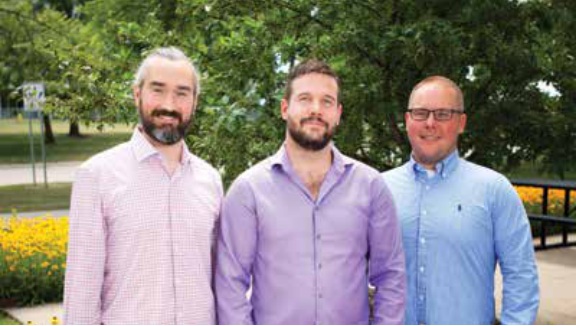
The project became Higher Learning Technologies, or HLT, co-founded with Adam Keune and Ben O'Connor. The three had been friends since their teenage years at Xavier High School in Cedar Rapids. Their origin story contains no garage, unless one counts the cluttered old apartment Keune later recalled. It contains something more useful: a customer who knew the problem intimately and two partners who had known him long enough to recognize when an obsession might be worth following.
A career exits through the side door
Whitters had spent roughly six years moving toward dentistry. He had grown up in Cedar Rapids imagining he would become a doctor or dentist, and his parents understandably preferred that a nearly completed professional path remain completed. But the flashcard problem had changed scale in his mind. On travel in East Africa, he had noticed how common smartphones were even where other infrastructure was scarce. A study tool built for a phone might travel farther than any clinic he could personally operate.
He left the dental program to work on HLT full time. In November 2012, only months after committing to the company, the team released Dental Boards Mastery. Whitters later described the launch as terrifying. The app was crude by his own account, but people bought it around the world. That distinction matters. A polished product can conceal weak demand; an awkward product that strangers insist on using is more talkative.
“I didn't come from a tech background. I had an idea, and I wanted to execute. I had no idea where to get started.”Alec Whitters, reflecting on HLT's early days
The second move was nursing. In May 2013, HLT released an app for the nursing licensure exam, and it quickly became a top-grossing education app. The little dental niche had done its job. It did not need to be the entire market. It needed to be the wedge - the place where the founders knew enough to build, listen and improve without pretending to understand every kind of learner at once.
The route from cardboard to scale
Dental app
Nursing app
40 apps
27M served
Learn fast, then put it in the building
The early company had an obvious vulnerability: its founders understood the customer better than the code. Whitters sought advice on engineering, legal questions, marketing and fundraising. He later credited those conversations with exposing blind spots and pushing HLT to build an in-house technical team. This was not networking as decorative coffee. It was networking as borrowed competence, used until the company could hire its own.
There were bruises. Whitters said the company lost thousands of dollars when a programmer was dishonest, at a time when the business could barely afford the lesson. Looking back, he also wished the founding team had written down expectations and compensation earlier. The candor is more revealing than a victory lap. His preferred operating posture was to surface problems before they became elegant disasters.
That preference shaped his product advice. He urged founders to expose an idea quickly, attend pitch competitions, talk to customers and release a prototype before it felt ready. Feedback, in this view, is not applause collected after the work. It is raw material for deciding what the work should become.
HLT began with one exam Whitters personally needed to pass.
An imperfect release created better information than private certainty.
Mentors helped the team see legal, technical and hiring blind spots.
Roles, expectations and compensation become harder when postponed.
Whitters's own idea process was similarly methodical. He said he would sometimes write out 30 possible solutions to a problem, deliberately expanding the field before narrowing it to one or two. Once a direction emerged, his role was to spread context, explain objectives, write strategic plans and remove roadblocks for the people doing the hands-on work. The founder as omniscient magician is excellent cinema. The founder as context distributor is better management.
Iowa stays in the frame
HLT grew from Coralville, inside the University of Iowa Research Park and near the entrepreneurial center that helped its founders. The company announced a $1 million seed round in early 2014, then a $5.5 million Series A that November. It grew its team, moved from mobile toward synchronized desktop products and expanded across dental, nursing, medical and other professional exams.
The geography complicates the familiar startup map. Whitters did not have to pretend Coralville was Palo Alto. Iowa offered high-school friendships, university collaborators, early investors and mentors who could be called when the company was wobbling. HLT's users did not care which airport the engineers flew from. They cared whether the practice questions helped them pass.
The funding story also shows what changed after the first download. The 2014 Series A was meant to support desktop access, new fields of study and a larger team. Mobile remained the opening argument, but the company followed learners across devices instead of treating the phone as a religion. Practice questions could sync in real time. Material could be updated without waiting for another edition of a textbook. Search, feedback and customized plans turned static pages into a system that responded to the person studying.
By early 2017, Forbes reported more than 3.3 million downloads across 40 apps and named Whitters, then 29, to its 30 Under 30 Education list. In 2021, the University of Iowa's John Pappajohn Entrepreneurial Center honored Whitters, Keune and O'Connor as Young Alumni Entrepreneurs of the Year. The company now presents itself as HLT Mastery and says its 40-plus products have served more than 27 million students in 192 countries, with more than 2 billion practice questions answered. In April 2026, it announced inclusion on TIME and Statista's list of America's Top EdTech Companies.
“I often will write out 30 different ways to solve a problem first to expand my thinking.”Alec Whitters on generating options before choosing
The student never quite left
The most consistent trait in Whitters's public comments is not audacity. It is study. He described spending at least 10 hours each week learning through books, videos, mentors and the daily practice of doing the job. He recommended The Lean Startup and The Startup Owner's Manual early in his entrepreneurial education. He planned daily objectives, set goals before meetings and kept notes for future conversations with teammates.
This makes the career change less contradictory than it first appears. He left a school, not learning. The dental student redirected his study habits toward product, fundraising, hiring and organizational design. He even imagined an app that would prompt people to record one lesson at the end of each day, then allow those lessons to be shared. The instinct behind HLT - capture knowledge, make it portable, return to it when useful - had followed him into management.
His routine was not presented as flawless. He admitted that working out in the morning happened inconsistently, that his days changed as the company grew and that he often stayed at the office until nine or ten at night. The interesting part was the scaffolding: decide the day's priorities before beginning, decide the goal of a meeting before entering it and keep a steady stream of books and advisers nearby. Ambition had a checklist.
There was wanderlust too. Whitters has said he wants to visit every country in the world. It is a romantic ambition with an oddly operational mirror: build software that reaches those countries first. During the company's early years, he watched downloads arrive from places the team had never marketed to. The smartphone had made distribution global before the founders felt global themselves.
A box of flashcards did not contain a grand theory of education. It contained friction. Whitters noticed it because he had to carry it, pay for it and study from it. He then did the improbable administrative work of turning irritation into a team, a product and a company. Fourteen years later, HLT is still in Iowa, the cards are on screens, and millions of students have taken the same small object from their pockets to prepare for a very large day.
Continue exploring