Aldo Piaggio keeps a remarkably precise museum of rejection. Its largest exhibit contains 2,000 restaurants and coffee shops that declined PoloTab's first product. There are no velvet ropes, only the implied mileage of Piaggio and co-founder Andres Richardson walking Mexico City's streets, asking operators to try an idea that almost nobody wanted.
At the time, the young company had the credentials startup folklore recommends. Three engineers who had met at the University of Michigan were building together. Y Combinator had selected them for its Winter 2023 batch. General Catalyst's Apex program had offered another useful network. Yet the graph remained flat. By mid-2023, PoloTab had roughly $100 in monthly recurring revenue. Twenty months of work had produced a business barely large enough to pick up a modest dinner check.
Piaggio's account of this period is valuable because he does not lacquer it. He remembers “countless noes,” competitors arriving as users, expensive integration proposals, and the dawning recognition that access did not create growth by osmosis. The founders had built a dynamic-menu product for restaurants. Their conversations kept showing them a larger operational problem. The approach was wrong. The collected insight was not.
“We knew we possessed insights no one else did. Our approach was off, but the wedge had to be there.”Aldo Piaggio
Roommates, then co-founders
The company began with friendship before it had a market. Piaggio, a Honduran student, met Andres Richardson and Juan Chomali at Michigan in 2018. His shorthand for the progression is almost a romantic comedy: another Spanish speaker on campus, then friend, roommate, best friend and co-founder. He also recalls a few “dumb ideas” and jokes that Richardson and Chomali excluded him from their trading algorithms. Four years later, all three graduated as engineers.
Their skills overlapped without being identical. Piaggio studied industrial and operations engineering with a minor in economics, passed CFA Level I, and had been designing since his teens. Richardson brought industrial engineering and consulting experience. Chomali, a mechanical engineer and economist, had coded since childhood. PoloTab was born on May 26, 2022, one month after graduation and one month before Piaggio and Chomali began jobs at Goldman Sachs.
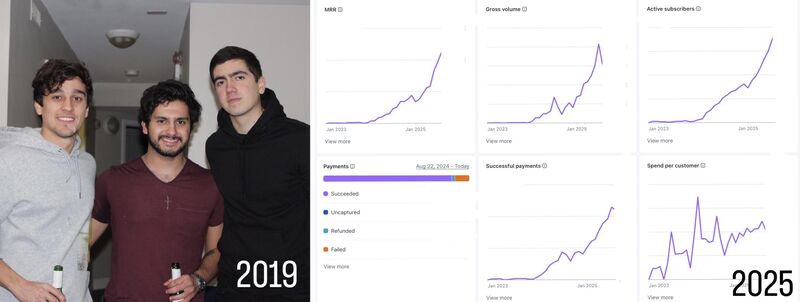
For the next six months, Piaggio described their schedule as “8-to-10s at GS, 10-to-2ams at Polo.” One job carried institutional polish; the other carried rejection. They loved the arrangement, he says. The charming part is the enthusiasm. The instructive part is that long hours did not rescue a weak proposition. Work gave the team more attempts. It still had to learn what to attempt.
A compressed history of an uncompressed struggle
The counter writes the brief
In August 2023, the founders decided to design and build a point-of-sale system from scratch. Piaggio was afraid of becoming “just another player.” Restaurant software was not an empty category waiting for three recent graduates to discover it. But crowded markets can remain crowded with frustration. The team's rejection list had shown where existing systems demanded too much translation, too many disconnected tools and too little sympathy for the rush at the counter.
They launched the new POS on November 4. Their first coffee shop customer became a round-the-clock office for two weeks. It is hard to imagine a better test bench. A restaurant does not care how elegant a workflow appeared in a quiet product meeting. Orders arrive together. A cashier needs to learn quickly. The kitchen must read the ticket. The internet may fail. Someone splits a bill while a delivery tablet chirps. Every abstraction eventually meets a hungry person.
By year-end, PoloTab had reached $200 in monthly recurring revenue. That number was still small, but it had doubled after the rebuild and, more important, the product was finally pointed at the right layer. Owning the POS gave PoloTab a place to connect the rest of restaurant operations. Inventory, recipes, kitchen displays, delivery platforms, reports, invoicing, customer data and payments could speak through one system.
The flat line had a bend
Revenue figures publicly shared by Piaggio2023 MRR shown here on an annualized basis
The lesson is less “persist forever” than “stay close enough to know what persistence is buying.” Piaggio and his partners did not worship the first product. They protected the observation underneath it: restaurant operators wanted less fragmentation and more control. When evidence made the old approach indefensible, they changed the approach.
Taste, with a wiring diagram
Piaggio calls himself a designer as readily as an engineer or former banker. The combination explains PoloTab's particular ambition. He likes the tidy surface and the machinery beneath it. His stated pleasures include coffee, cigars and LPs, three objects whose devotees can turn tiny differences into long conversations. He is also the third generation of a family involved in food and beverage since 1972. Restaurant technology, in his telling, is not merely a software vertical. It is familiar territory with stubborn operational seams.
The current system reflects that appetite for integration. PoloTab says a venue can install its POS in 15 minutes, run kitchen tickets without paper, connect Uber Eats, Rappi and DiDi, control inventory and transfers, issue invoices, and read multi-branch reports. Its handheld PoloMini brings ordering and integrated payments to the table or counter. The company emphasizes that core operations keep working without internet, a mundane feature until the moment the connection drops at lunch.
Those figures belong to different moments in a quickly changing company. PoloTab's site currently advertises more than 900 cafés and restaurants in over 70 Mexican cities, processing 22.8 million orders a year. Piaggio reported that Q2 2026 added 261 locations and $770,000 in contracted annual recurring revenue. Annualized card volume crossed $70 million, with more than 5.5 million annualized transactions. He also announced a $1.5 million pre-Series A and welcomed Derek Domino, an early Toast sales leader, as an adviser and investor.
Growth has changed the questions. In the early days, the puzzle was whether anyone would pay. By 2025, the team had launched integrated payments through PoloPay and expanded its product set. Piaggio later shared an internal study of 75 customers comparing periods before and after they switched terminals. The company reported increases in daily tips, staff retention, revenue, average ticket and orders processed. The important note is his reason for asking: revenue growth alone did not prove the product improved a restaurant's life.
“If we can extend a restaurant's life. That's the whole point.”Aldo Piaggio, recalling an early fundraising answer
The 1,000-page Lego set
Piaggio now compares building PoloTab to assembling a giant Lego set from a 1,000-page manual. The joke contains a control instinct: he believes the team has long known the next pieces in its pipeline. It also contains an engineer's respect for dependencies. Payments are more useful when attached to orders. Orders improve inventory records. Inventory and sales data improve reporting. The pieces become defensible when they click together.
His stated destination is larger than a point of sale. He wants PoloTab to become the financial and data backbone for food and beverage. That phrase can sound bloodless beside a cappuccino, but the underlying aim is concrete. A better system gives an operator fewer reconciliations, a server faster closes, a kitchen cleaner tickets and an owner a clearer view of where money goes. Software earns its place by removing small daily indignities.
There is also a quiet continuity in that destination. Piaggio grew up adjacent to a family food-and-beverage tradition, trained to map systems as an industrial engineer, learned to read companies in investment banking, and spent years teaching himself design. PoloTab asks all four habits to sit at the same table. The family context supplies respect for the operator. Engineering traces the dependencies. Finance follows the transaction. Design decides whether any of it feels tolerable during a rush. His résumé looks eclectic only until the restaurant becomes the unit of analysis.
Piaggio's story remains young, and its most useful chapter is still the awkward one. Three friends graduate. Two begin banking jobs. The startup shift starts when the workday ends. Restaurants decline, then decline again. A famous accelerator opens doors, but no network volunteers to sell the product. Finally, the founders admit that their answer is wrong while insisting the problem is real.
There is a neat temptation to call the 2,000 noes a toll paid for the later graph. That gives rejection too much wisdom. A no teaches nothing unless someone asks why, notices the repeated friction and changes the work. Piaggio kept the archive close enough to edit the product. The coffee shop became an office. The counter became a specification. The flat line bent because the founders did.