The numbers tell a compact story. In 2013, Akshat Bubna represented India at the International Olympiad in Informatics and finished with bronze. A year later, in Taipei, he placed 16th among 311 contestants and took gold. Each contest asked young programmers to solve difficult problems with code under a clock. The record shows a leap in rank. Bubna's own explanation of what the competitions taught him is less theatrical: begin with a solution that works, then improve it, piece by piece.
It is tempting to treat a medal as a prediction of every future success. Life seldom makes such tidy promises. What the contests did give Bubna, by his account, was a durable way to approach difficult work. He has said they taught him that most problems are solvable. He also learned to look for progress before perfection. That habit would travel from student competitions to one of the more intricate corners of modern software: getting computers ready, quickly and reliably, whenever an AI application asks for them.
16th of 311 contestants
and CTO
Series C
The medal and the method
Bubna studied Mathematics and Computer Science at MIT from 2014 to 2017. The dates place his university years immediately after that gold medal. His public career then runs through Scale AI, where he worked as a software engineer and later a staff engineer from 2018 to 2021. Scale's business brought machine learning teams and difficult data work into close contact with the realities of production systems. Bubna has said he kept seeing the same infrastructure problems there.
This was the less photogenic side of the AI boom. A team might have a model and a compelling use for it, but turning that model into a reliable service still meant juggling containers, schedulers, storage, and fleets of machines. Bursts of demand could arrive without the courtesy of a calendar invitation. A system tuned for a conventional web service could become an awkward fit for jobs that needed specialized hardware one minute and none the next.
“Programming competitions teach you that most problems are solvable.”Akshat Bubna
Bubna met Erik Bernhardsson through an investor. Bernhardsson was already thinking about a new runtime, prompted by a deceptively modest question: why were workflow orchestration products so hard to use? Bubna had his own experience of old tools stretched around new work. They did not meet around a grand declaration that AI would remake every industry. They met around the friction developers encountered trying to run things.
A better place for code to run
Modal began in 2021 with a broad idea: make it easier to ship applications involving data and machine learning. The founders chose a deeper route than placing a friendlier interface on existing tools. Modal built its own file system, container runtime, scheduler, and image builder. Each is an unglamorous answer to a question a developer should not have to ask every morning. Where will this code run? How quickly can it start? What happens when demand changes by a factor of a thousand?
At first, Bubna said, the team saw a new runtime as a useful primitive for tasks such as data processing and job queues. They also saw that the primitive could support more specific products. Inference - running a trained model to produce an answer - was already on their list, though the examples then included computer vision and more conventional machine learning. Modal added GPUs roughly a year before ChatGPT appeared. Bubna later said the team did not anticipate how consequential that addition would become.
That early choice matters because AI work does not arrive in a neat, even line. A music service may launch a feature and suddenly need far more GPUs; a video model may demand a different setup; a research run may need a great deal of compute for a short window. Bubna describes the common problem as the shape of demand. The trick is to make capacity appear when needed, then let it go when the work is done. Paying for idle hardware is a poor punch line for any engineer.
Modal eventually served custom model inference for companies working in audio, video, robotics, and computational biology. Its product range expanded to training, batch jobs, notebooks, and sandboxes. The founders' 2025 Series B announcement described a platform that pooled compute across the world and started containers in under a second. Those claims rest on a large amount of engineering underneath a small amount of code. From the user's side, that imbalance is the point.
The friends who knew the same machinery
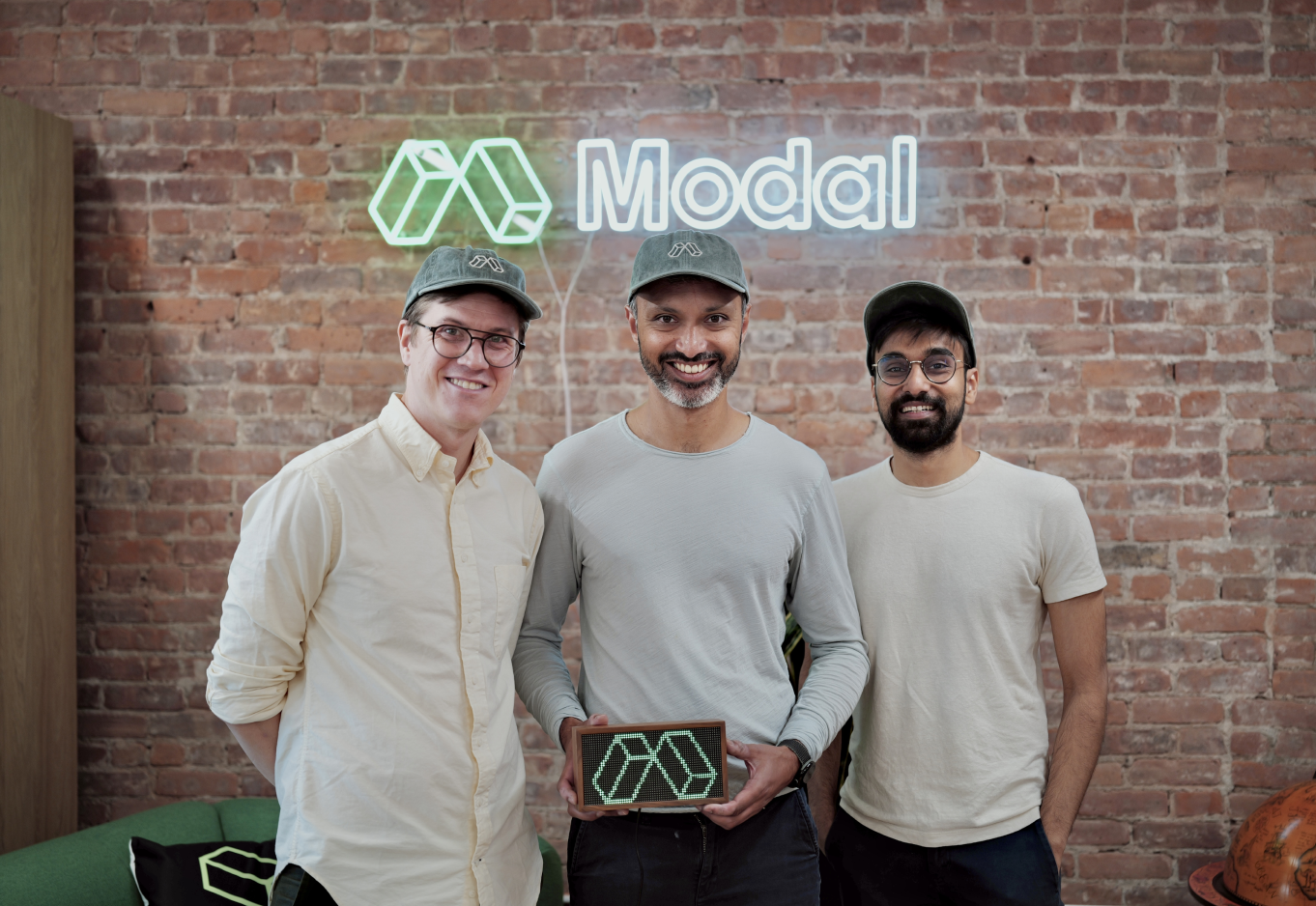
As Modal grew, Bubna and Bernhardsson found kindred builders in New York. In 2024, Modal welcomed the team behind Tidbyt, the programmable display company. The stated reason was the founders' experience with container infrastructure, some of it forged in or near the same Spotify circles as members of Modal's team. The acquisition made for a cheerfully odd photograph: the two Modal founders with Tidbyt founder Rohan Singh, all standing together while the company explained that the plan did not involve putting data-center GPUs inside a tiny screen.
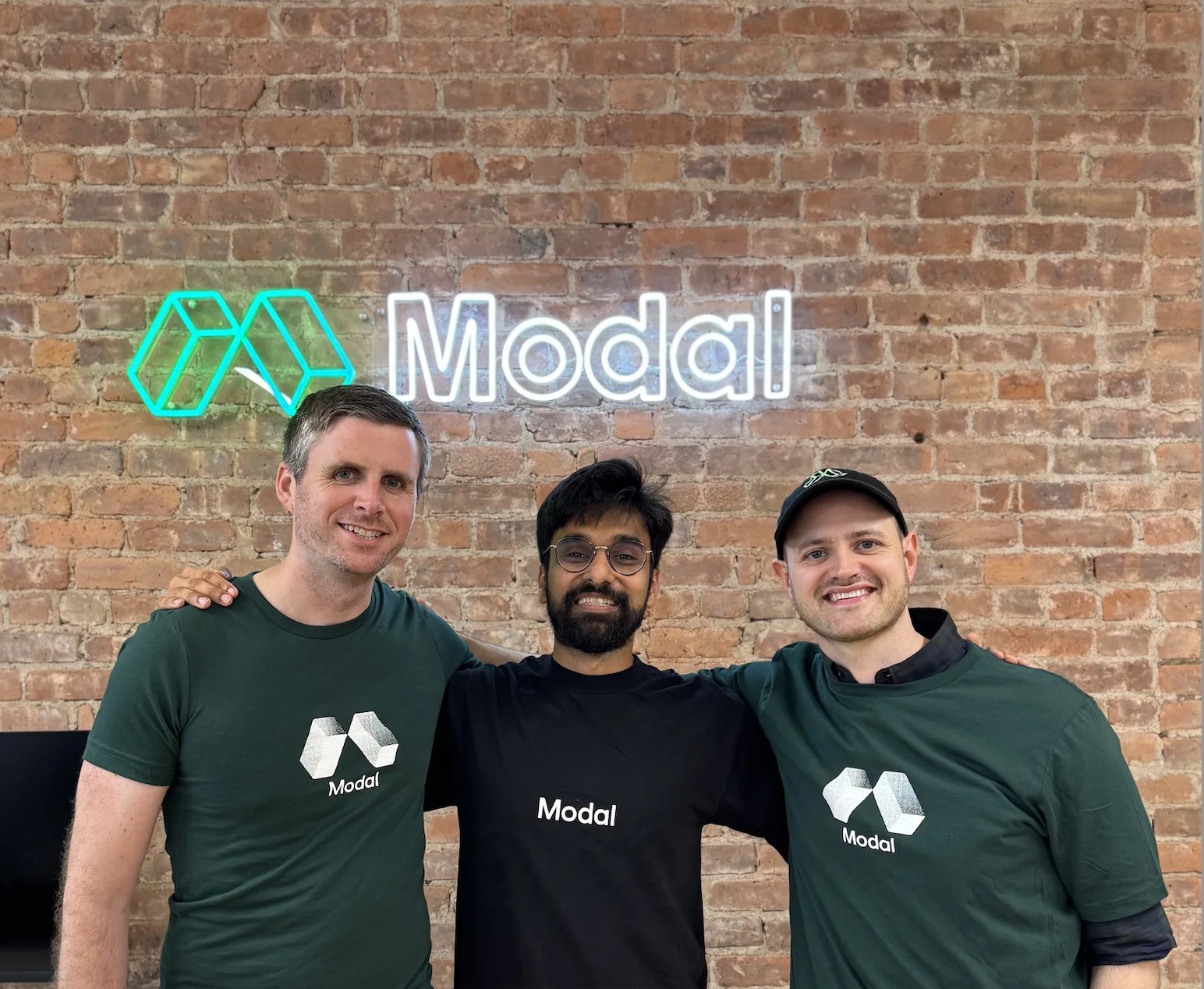
The following year, Jamsocket joined Modal. Its co-founders, Paul Butler and Taylor Baldwin, had worked on real-time backends and a service for running Python code. Modal's announcement recalled earlier conversations in which the teams compared notes on gVisor, the container runtime they both used. That is an unusually specific origin for a business relationship, and a revealing one. Bubna's network in this story is a network of people interested in the same stubborn technical seams.
By September 2025, Modal announced an $87 million Series B and a valuation of $1.1 billion. The round attracted attention, but the co-founders' account kept returning to practical problems: global GPU capacity, variable demand, large models, and the need to deploy changes quickly. It also put a number on an old engineering frustration. If a developer has to become an infrastructure specialist before trying an idea, some ideas never get tried.
When the user is an agent
The next turn arrived through a product Modal had begun building early. In 2023, the company saw users running AI-generated code and started developing isolated sandboxes for it. The bet took time to find its audience. In its May 2026 Series C announcement, Modal said more than one billion sandboxes had been launched on the platform. Sandboxes had become an important part of how AI agents run code without being given the keys to an entire system.
Bubna's vocabulary shifted with the use case. He has described moving the SDK team's attention from developer experience to agent experience. The phrase is easy to wave around and hard to engineer. An agent needs to write code, launch an environment, see the result, inspect a failure, make a change, and try again. Every missing piece of context becomes a new failure mode. A human might puzzle through a dashboard or an unwieldy configuration file. A software agent works best when the process is explicit and programmatic.
That creates a neat loop in Bubna's story. The student who learned to improve a working solution incrementally is now helping build a runtime for systems that do the same thing at machine speed. The analogy has limits: a coding contest and a production cloud carry very different consequences. Yet the shared rhythm is real enough. Try, observe, revise. Good tools make each step legible.
Bronze, then gold, at the International Olympiad in Informatics.
Engineering work at Scale AI reveals recurring infrastructure problems.
Bubna and Bernhardsson build Modal around a new runtime.
Early sandboxes grow into a central part of Modal's agent platform.
The company reported a $355 million Series C in May 2026, a $4.65 billion valuation, fivefold growth since the previous September, and more than $300 million in annualized revenue. Those are company figures, and they describe Modal's commercial momentum rather than any individual's fortune. Bubna's public response to the round pointed to the people doing the work. It was a fitting note from someone whose career has been built around hard problems that require a whole team to make them look simple.
The next small problem
In a 2026 conversation about the future of AI infrastructure, Bubna described a capacity pool spanning 17 cloud providers. He talked about GPU snapshotting to speed cold starts, sandboxes for code execution, and workloads that can call for enormous numbers of isolated environments. The details are formidable. His recurring question remains plain: can someone use the system without first learning all of the machinery below it?
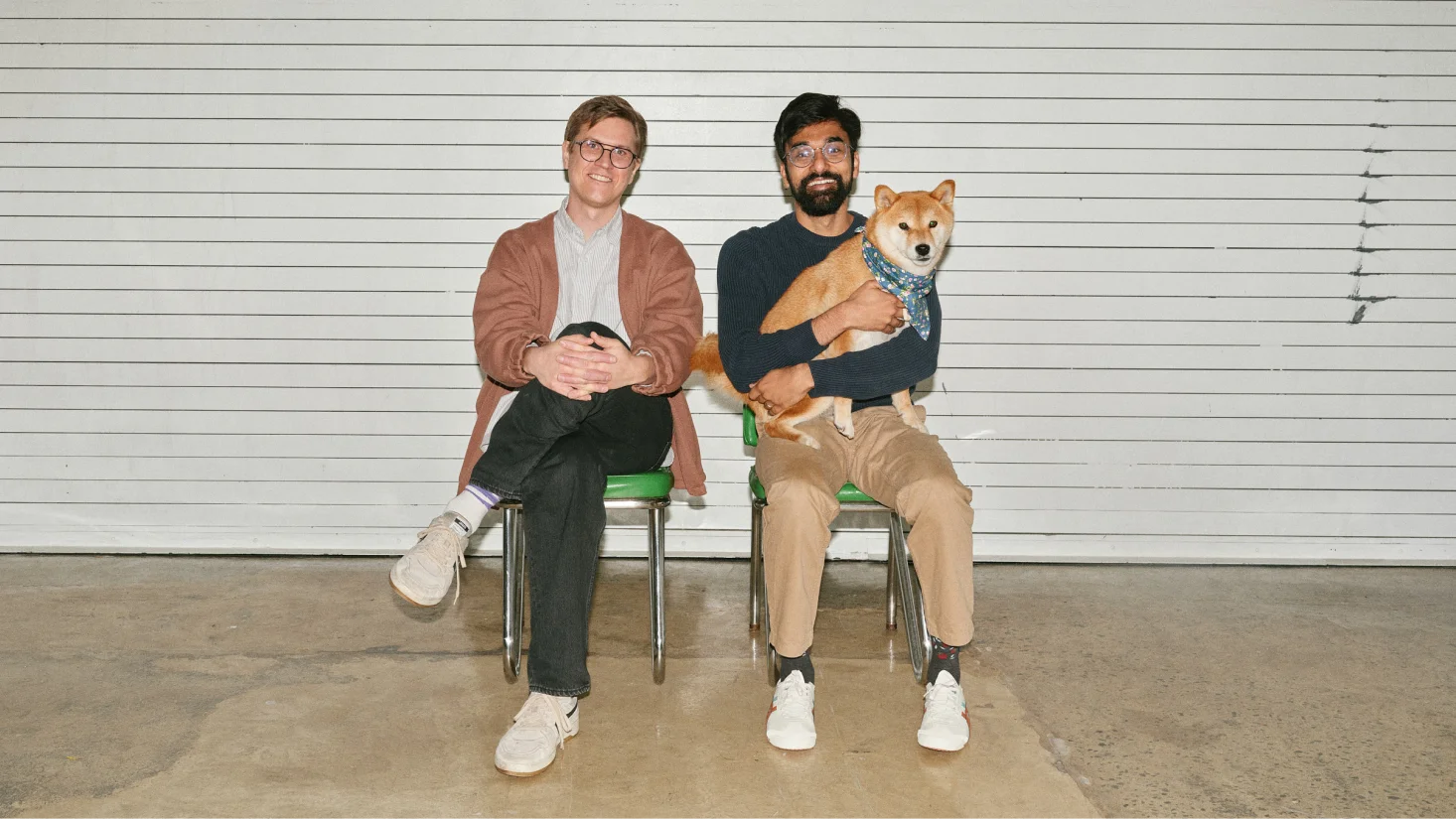
Modal's company portrait offers a gentler final image. Bernhardsson sits on one chair; Bubna sits on another, holding Mugi, his dog. It is a long way from the scoreboard in Taipei and an equally long way from a rack of GPUs. The photograph does not explain the cloud. It does show the person making choices about it. Bubna's stated method has survived the change of scale: find a working answer, improve it, then look for the next problem that can be made smaller.