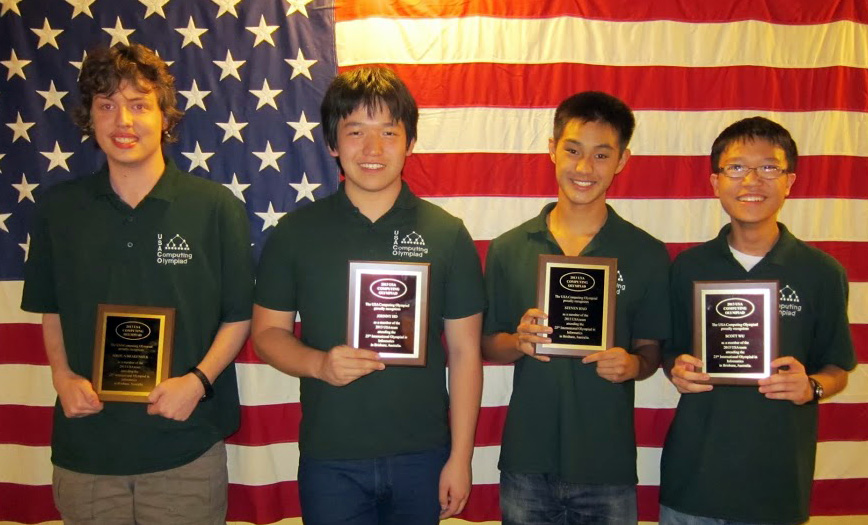
Four teenagers stand before an American flag, each holding a plaque. The picture was taken after the 2013 International Olympiad in Informatics in Brisbane. Steven Hao is third from the left. Scott Wu stands at the far right. At the time, the image documented a strong showing by the U.S. team: two gold medals and two silver. A decade later, it acquired another caption. Hao and Wu would become cofounders of Cognition, the company behind the AI coding agent Devin.
Hao’s medal in Brisbane was silver. In 2014, he returned to the competition and won gold, finishing sixth among 311 contestants. Contest programming rewards a particular blend of imagination and precision. A problem arrives with fixed rules, a clock starts, and the code must produce correct answers under severe constraints. There is no investor deck and no customer meeting. The judge has the last word.
That clean little world makes a tempting origin story for an AI company. Yet the interesting part of Hao’s career lies in what the contest leaves out. Production software has users, old decisions, unexplained failures and alarms that sound after the person who wrote the code has gone home. A solution can pass every known test and still be wrong for the job. Cognition’s CTO now works on that messier problem: giving an AI system enough context to do engineering work that continues after the first patch.
Before the agent, the algorithm
The 2013 team report identifies Hao as a junior at Lynbrook High School in California. Its director described a week that mixed two full contest days with trips around Brisbane and time spent meeting competitors from other countries. One challenge asked students to classify works of art by style. It is a charming detail for a future AI founder: the task sounded like something a modern machine learning demo might attempt, but the contestants had to build algorithms within the rules of a timed programming competition.
Hao went on to the Massachusetts Institute of Technology, where he studied computer science and mathematics from 2014 to 2018. His GitHub profile still offers a glimpse of what he likes to make. Among the pinned projects are a web version of the card game Set and a crossword site. Neither needs a grand statement of purpose. They are simply the sort of things a person builds because a puzzle could be more playable, or because a familiar game can be made to run in a browser.
After MIT, Hao joined Scale AI as an early engineer. A later conference biography says he worked across its product suite, including sensor fusion for autonomous vehicles and machine learning. This was a different sort of problem from an Olympiad task. Data products live amid changing customer needs, imperfect inputs and practical constraints. The work taught a kind of engineering that a medal cannot measure: how to make a system useful to somebody else.
There was also a circle of people. Hao, Wu and Walden Yan had competed in the same world of algorithmic contests; all three had won IOI gold. Hao and Wu had already appeared together in that 2013 team photograph. In a later interview, Wu recalled exploring ideas with Hao and fellow programmer Andrew He before Cognition took shape. One account of their friendship is almost absurdly on brand: Hao handed Wu a shortlisted Putnam mathematics problem and challenged him to solve it with pen and paper. Wu reportedly reasoned through it aloud in about 90 seconds. A founder anecdote, yes, but also a portrait of friends for whom a hard problem can double as conversation.
“We don’t just delegate tasks, we delegate responsibilities.”Steven Hao, speaking in 2026
The problem changes shape
Cognition was formed in 2023 by Hao, Wu and Yan. The company introduced Devin publicly in March 2024 with a demonstration of an AI system that could plan, write and test software. The announcement landed amid a wider rush to put language models into developer tools. Editors could suggest the next line. Chat windows could explain code. Agents began taking longer assignments. Cognition’s question was how much of a software engineer’s work could be handed to one system at a time.
Hao’s account of that question has become more specific. At a June 2026 developer talk, he described a progression from autocomplete to chat to agents. Then he pushed past a one-off ticket. Devin, in his telling, can review a change, test a feature, deploy it and watch what happens. If an alert fires, an agent can inspect logs and recent commits and try to work out whether the alarm reflects a new fault or something already understood.
The distinction matters because code is an unusually compact record of an unusually large promise. A ten-line fix can alter how a product behaves for thousands of people. Finishing the ten lines is one task; knowing whether the fix helped is another. Hao’s talk included a simple imagined instruction attached to a monitoring dashboard: keep these numbers green, and respond if they turn red. It is close to the way a human engineer receives responsibility for a service. It is also a demanding test for an AI system, because the right response depends on history and context, not merely syntax.
Cognition uses Devin in its own engineering process, according to Hao. That creates a useful feedback loop: the company’s employees meet the tool as customers would, with deadlines, old code and changing requirements. He said the small engineering team could do more because of that use. His claims about productivity are company claims, and a polished demonstration never tells the whole story of a deployment. The more revealing point is operational. A tool asked to own work should be used where its builders can see what happens when ownership gets awkward.
A specification that remembers
Hao used the second half of his 2026 talk to make a prediction: English could become the source of truth for software. He compared the idea to higher-level programming tools that describe what a developer wants and let a system keep the lower-level output in sync. In this version, a person changes the description of a product and an agent works out what must change in the code.
It is an appealing sketch, especially to anyone who has watched a specification drift away from the thing it supposedly specifies. Hao did not present it as a solved problem. He named several difficulties. The system would need to be stable. It would need to remember history rather than regenerate an entire codebase whenever a sentence changed. And the useful specification might be implicit, drawn from months of conversation and decisions, rather than a tidy document someone sits down to write.
This is where the contest programmer’s gift meets its limit. An algorithmic problem gives you the rules up front. A company gives you partial explanations, people who disagree, and decisions whose reasons have faded. If an agent is to work from human language, it must handle the language as a record of intent rather than a string of instructions to obey in isolation. The hard part is less about producing code on command than preserving the meaning of the command when the world around it changes.
Hao’s little public web projects offer a more grounded view of the idea. In May 2026, he said he had built an AI security incident tracker because it had become hard to follow a wave of software supply-chain incidents. Devin, he wrote, updates the site daily. The project is modest beside Cognition’s enterprise ambitions, but its shape is instructive. A news tracker has to be maintained. A page that was accurate yesterday needs new information today. The task renews itself.
He has also posted about Devin’s early rough edges with unusual candor for a founder promoting a product. The first experience was often confusing and frustrating, he wrote, and he felt personally embarrassed when the system made mistakes. He said feedback and continued work improved it. That admission is more useful than a claim of inevitability. Anyone selling a tool that takes responsibility for software has to live with what happens when the tool gets things wrong.
The long clock
The financial numbers around Cognition have grown quickly. Forbes listed Hao’s estimated net worth at $5.8 billion in September 2026, after reporting a company financing at a $48 billion valuation. Such figures describe an investor’s estimate of a private company and a founder’s stake, not cash in a bank account. They also make an odd companion to that 2013 photograph: four young programmers grinning with plaques, none of them able to see exactly where the next decade would lead.
Hao’s visible public story is relatively spare. It runs from Lynbrook High School to the U.S. IOI team, MIT, Scale AI and Cognition. The connections are specific, the medals are real, and his technical position is plain enough in his own talks. What gives the story its shape is the change in the clock. In Brisbane, the judge returned a score after the code ran. At Cognition, the judge is a live system that keeps running after everyone leaves the room.
Hao wants the agent to stay in that room. It should know why a feature was built, watch what happens after release and be able to answer when the dashboard turns red. The ambition is larger than winning a contest, and less easy to score. There is no final submission button for software that people continue to use. For a programmer raised on hard problems, that may be the most interesting problem of all.