The Story
The hardest problem in genetic medicine is not the medicine.
It is getting the medicine to the place that needs it. Akin Akinc has built his whole career on that sentence.
Today Akin Akinc runs Aera Therapeutics, a company in Cambridge, Massachusetts that is trying to do something most of biology has treated as impossible. It wants to deliver genetic medicines using nanoparticles built from human proteins - shells the body already knows how to make, derived from ancient retroelements written into our own genome. The science came out of the lab of Feng Zhang, the CRISPR pioneer at the Broad Institute. The job of turning that science into actual drugs went to Akinc.
He is a chemical engineer, not a physician or a pure biologist, and that distinction matters. Engineers think in systems and constraints. They ask how a thing moves from one place to another, what breaks along the way, and how to manufacture it ten thousand times without variation. For most of the genetic-medicine era, the molecules got all the attention - the siRNA, the mRNA, the gene editor. The delivery got the shrug. Akinc spent two decades on the shrug.
The greatest unmet need today in terms of the genetic medicine space is delivery.
Akin Akinc · BioPharma Dive
Twenty years inside the delivery problem
Before Aera there was Alnylam Pharmaceuticals, and at Alnylam there was a question that sounded simple and turned out to be a career: how do you get a fragile piece of RNA past the bloodstream, into the right organ, and inside the cell without the body destroying it first? Akinc co-led the interdisciplinary teams working on that. The breakthrough was the lipid nanoparticle - a tiny fatty bubble that wraps the cargo and smuggles it into the liver. That work produced ONPATTRO, the first RNAi therapeutic the world ever approved. A field that had spent years as a promising idea suddenly had a drug on the shelf.
He did not stop at the science. Akinc ran programs as a general manager, the person accountable for whether a drug actually reaches patients. He took Givlaari from Phase 3 through FDA approval in 2019 and out across markets. He carried the fitusiran hemophilia program from discovery all the way to Phase 3; it is now sold by Sanofi as Qfitlia. He served as Senior Vice President and Head of Oncology. The arc is unusual: a person who can sit in the lab arguing about nanoparticle chemistry and then sit in a launch meeting arguing about commercial strategy, and be credible in both rooms.
New therapeutic modalities have exploded. But the pace of advancement of delivery technologies has not kept up.
Akin Akinc · GV interview
The call he could not turn down
By 2022, Akinc had every reason to stay put. Instead he became a first-time CEO. Feng Zhang had a delivery technology and needed an operator who understood, in his bones, why delivery was the whole game. The two halves fit. Akinc looked at the gap between what genetic medicines could theoretically do and what they actually reached - mostly the liver, and not much else - and saw the unfinished work of his entire career staring back.
His description of the decision is plain. He called it an opportunity he could not pass up. What he signed up for is harder than a single drug. Aera is a platform company first, which is a patient way to build and an unglamorous one. Rather than rush a lead therapy to the clinic, the team is widening the toolbox - figuring out which tissues the protein nanoparticles can reach that lipid nanoparticles and viral vectors cannot. The central nervous system. The heart. The lungs. The places genetic medicine has mostly failed to go.
We're less interested in doing a different way of solving a problem that's already been solved. Ultimately, what we're after is a genetic medicine.
Akin Akinc · BioPharma Dive
An engineer's company
Read enough of what Akinc says and a method appears. Find a problem that profoundly changes patient outcomes. Surround it with a board that has built companies before. Partner with a scientific founder who can see where the research is going next. It is not a flashy philosophy. It is the philosophy of a person who has watched promising biology die in the gap between idea and execution, and who decided to spend his life narrowing that gap.
The bet Aera is making is almost poetic. The body spent millions of years learning to package and ship genetic material - that is partly what retroelements in our DNA do. Aera is borrowing that machinery, the protein PEG10 chief among it, and pointing it at disease. If lipid nanoparticles were the first answer to delivery, Akinc is wagering that the next one was inside us the whole time. He helped invent the first answer. Now he would like to make it look quaint.
It is a long game, and he knows it. The company has not named a lead program or set a clinical timeline. That restraint is the point. Akinc has seen what happens when biotech mistakes motion for progress. He is building the courier first, and trusting that the cargo will follow.
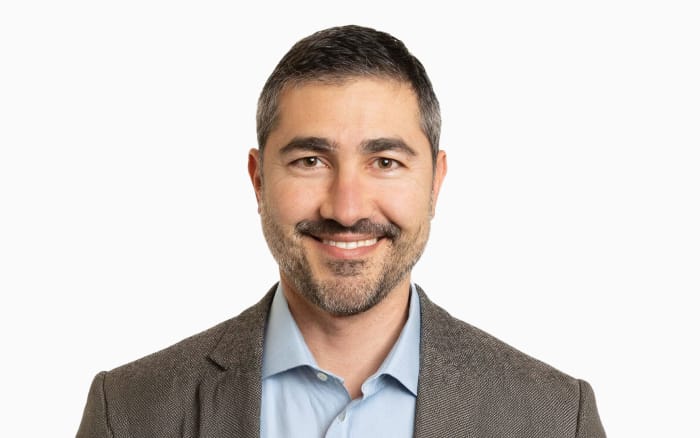 The courier in chief. He spent two decades on the part of the drug nobody puts on the poster.