In a freshman rhetoric class at Bellarmine College Preparatory, Adarsh Hiremath met Brendan Foody. The school’s debate team would give them a common language, and a third friend, Surya Midha, would become Hiremath’s competitive partner. Years later, the three would found Mercor. It is tempting to draw a straight line from argument to enterprise, as if every high school extracurricular came with a term sheet. Their path was less tidy. It passed through a São Paulo hackathon, college dorm rooms, Indian engineering talent, and a meeting with the people building a new AI lab. But debate taught Hiremath something useful for every stop along the way: a confident answer is only as good as the method used to test it.
He was not the loudest child in the room. In an interview published by Mercor investor Felicis, Hiremath recalled that his parents pushed him toward debate in middle school because they worried he was too quiet. He and Midha went on to become a formidable policy debate pair, the first team to win all three major national tournaments in the same year. Bellarmine records also place Hiremath among the program’s later coaches. The unlikely detail is the quietness. Policy debate rewards speed and fluency, but it also rewards a person willing to read closely, spot a weak premise and return with a better case.
A partnership before there was a company
Hiremath, Midha and Foody graduated into different college lives. Hiremath studied computer science and mathematics at Harvard and expected that research might be his future. Public projects on his GitHub include a client-server chat system, a reverse image search tool for secondhand goods, and a project for Harvard dining. The list has the plain charm of a young engineer learning by making things: practical problems, varied technologies, no grand thesis required.
Foody, meanwhile, kept finding businesses to try. Hiremath has credited Foody with drawing him into startups. They had worked together on software interfaces for startups before Mercor. In the summer of 2023, the three friends developed a more promising idea during a three-week hackathon in São Paulo. Skilled engineers in India were looking for work; American startups needed engineers. Their first business connected the two sides, placing developers on projects by the hour. Some early customers were friends at Harvard. It sounds small because it was small, and because it began with a customer rather than a manifesto.
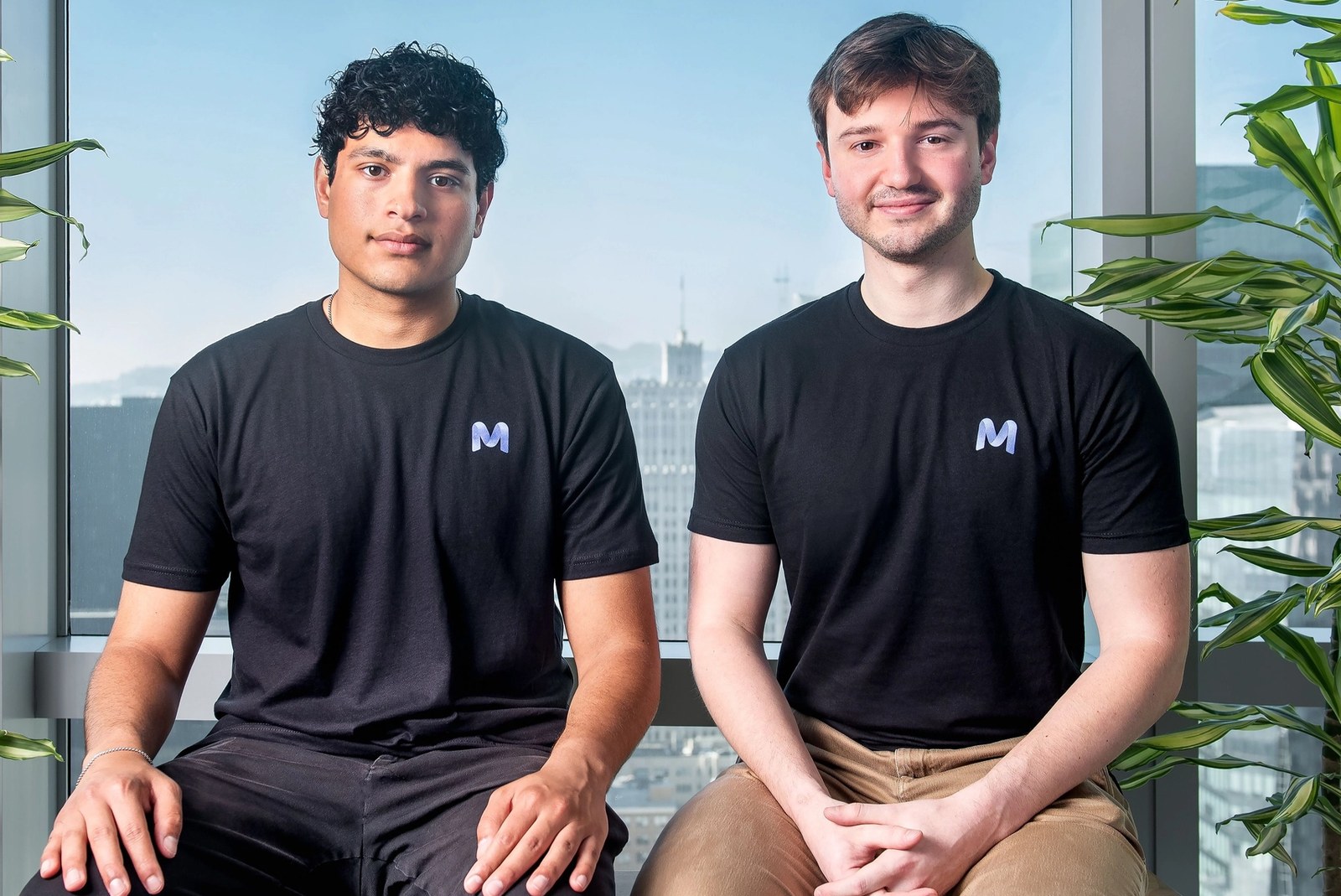
The more engineers they placed, the more work appeared before an introduction could happen. Who was qualified? Who could explain their work? Which project suited which person? Mercor automated résumé review, interviews and matching. Its interview tool could speak to applicants about their backgrounds and projects; search could draw on resumes, portfolios and interview transcripts. The technology did not remove the question of judgment. It made that question the product. By the time Mercor formally announced its platform and a $3.6 million funding round in January 2024, the company said its talent pool reached 100,000 users across 25 countries.
The meeting that widened the problem
In August 2023, when the founders were still college sophomores, a customer introduced them to members of xAI’s founding team. Two days after a Zoom call, they met in person at Tesla’s Bay Area offices. Mercor’s ability to find engineers who were strong at coding and mathematics caught attention. xAI was early in its own development, but the meeting revealed a growing need that had little to do with conventional recruiting. AI labs would need people to create examples, assess outputs and supply knowledge that could not simply be scraped from the internet.
The founders had stumbled upon an industrial version of their debate problem. If a model writes a legal analysis, a person has to know whether its reasoning survives contact with the law. If it writes code, someone must be able to read the code and understand the task. A broad pool of workers is useful; a pool of workers who can actually judge specialist work is another matter. Hiremath put it directly: the human data market needed a talent assessment offering. Mercor already had a system for finding, vetting and onboarding people. The customer had changed, but the assessment challenge was familiar.
Hiremath took a leave of absence from Harvard as the company grew. Foody did likewise at Georgetown. Mercor worked first through an established data provider, hiring more than 1,000 engineers for AI work, before moving toward direct relationships with labs. The platform had to process enormous numbers of applications and interviews while maintaining a workable standard for expertise. Hiremath later described the challenge of sourcing, vetting, screening and onboarding so many people through a cloud network. There is no romance in a failed onboarding process, however elegant the pitch.
An expert on the other side of the screen
Mercor’s roster expanded beyond engineers. The company now connects AI projects with specialists in fields such as law, finance and consulting, among others. A subject expert may help write a task, describe what success looks like, grade a model’s response or build an environment in which an agent can practice. This work sits upstream of the polished demonstration. When an AI assistant seems to know how a professional would handle a real problem, someone has supplied the problem and decided what counts as a credible answer.
Hiremath has become especially interested in evaluations, often shortened to “evals”: structured tests of whether a model can do a given task and why it succeeds or fails. In his account, evals are a piece of infrastructure, not merely a scorecard. He argues that they help developers and businesses see where systems perform well, where they break, and what expert work would improve them. It is a position consistent with the debater’s old habit of exposing the hidden assumption. A model can deliver a smooth answer; the harder thing is specifying what would make the answer right.
The scale of the operation is now far removed from that original group of Indian developers. Felicis reported in July 2026 that Mercor had a network of more than five million vetted experts and was paying more than $4 million a day to contributors. The same account said Mercor reached a $2 billion annualized revenue run rate in June. Those are company and investor figures, and a run rate is an extrapolation from current activity rather than a full year of booked revenue. Still, they convey how quickly the founders’ hiring workflow became a large market for specialist judgment.
The financial headlines have their own momentum. In October 2025, investors valued Mercor at $10 billion after a $350 million funding round. Forbes estimated that the three 22-year-old founders had become the world’s youngest self-made billionaires, based largely on their private-company stakes. Hiremath’s reaction was more revealing than the ranking: if he had not been working on Mercor, he observed, he would only recently have graduated from college. The remark puts the compressed chronology back into human scale. A life stage that usually holds a first job had become a responsibility for a company with millions of people in its orbit.
The second half of Mercor
His title changed as the business widened. Early company material calls Hiremath co-founder and CTO. A March 2026 Mercor essay bears the title co-CEO, and the July Felicis profile confirms that he and Foody share the role. The split of work is legible: Foody has concentrated on AI lab relationships and customers; Hiremath leads engineering and product and builds the enterprise business. The former researcher’s instinct has found a commercial setting, where abstract questions about measuring intelligence become concrete product decisions.
In the enterprise essay, Hiremath describes a familiar trap. Teams decide what an AI agent should do, write prompts, adjust settings and hope it works. His proposal begins by understanding tasks and measuring performance, then improving the agent against those measures. The logic sounds almost stubbornly ordinary. Before asking a system to do a job, define the job; before calling it successful, test the result. Mercor’s expansion into simulated work environments, including its 2026 acquisition of Deeptune, follows the same approach. An agent needs somewhere to practice, a task to complete and a way to be judged.
This is also where the story becomes less comfortable, and more interesting. A company built to find talented workers now helps teach software to perform some of their tasks. The founders argue that more capable AI will create demand for skilled people to train, test and guide it, while changing the work those people do. The balance will not be decided by a slogan. It will be decided in contracts, pay, evaluations and the everyday experience of experts on the platform. Hiremath’s own theory puts people at the center of technical progress. It also gives his company a particular responsibility to treat their expertise as more than fuel.
What the quiet student kept
There is a pleasing symmetry in Hiremath’s journey, though symmetry should not make it look inevitable. His parents sent a quiet child into debate. He learned to argue with a partner and to value evidence under pressure. At Harvard he made software, then left school to build a business with the people who knew him from the debate room. Their first customers needed engineers. Their later customers needed something harder to describe: qualified people who could show an AI system what good work looks like.
Hiremath’s public comments circle one question. How do you identify the person who really knows? A résumé can be polished. A model answer can be fluent. Even a business can look impressive on a funding chart. The useful work begins when somebody designs a test that can distinguish appearance from ability. That question has followed him from tournament rounds to hiring calls to evaluations for AI agents. The scale has changed; the intellectual habit has stayed remarkably recognizable. Somewhere inside Mercor’s vast network is the old debate pairing: two people, an argument, and the insistence that a claim should earn its way into the room.