BREAKING Adam Margolin co-founds Flashpoint Therapeutics $10M SEED led by Beta Lab to pioneer nanotech medicines 9 TUMOR MODELS near-curative in preclinical data Built the #3 genetics dept in the country at Mount Sinai From Wharton math kid to spherical nucleic acids "A founder needs to be a stupid frog sometimes" BREAKING Adam Margolin co-founds Flashpoint Therapeutics $10M SEED led by Beta Lab to pioneer nanotech medicines 9 TUMOR MODELS near-curative in preclinical data Built the #3 genetics dept in the country at Mount Sinai From Wharton math kid to spherical nucleic acids "A founder needs to be a stupid frog sometimes"
Founder Dossier · Structural Nanomedicine

Adam Margolin

He read twenty research papers over a weekend and decided to bet the next decade of his life on a ball of DNA the size of a virus.

CO-FOUNDER, FLASHPOINT THERAPEUTICS  /  PhD, COMPUTATIONAL BIOLOGY

Adam Margolin

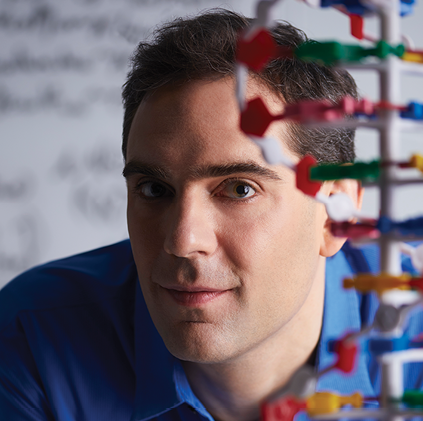
The look of a man who has run a 700-person department and still chose to start over with a pipette.

35×
CO-DELIVERY TO IMMUNE CELLS
80×
STRONGER IMMUNE ACTIVATION
9
TUMOR MODELS, NEAR-CURATIVE
$10M
SEED, LED BY BETA LAB
“For the past 20 years, my career decisions have been driven by a mission to best contribute to curing cancer.” ADAM MARGOLIN
The wrong-way-round origin

Most biotech founders go science first, business second. He did it backwards.

Out of high school he went to Wharton and then to Wall Street, for a reason he states without ceremony: “that’s what a kid who likes math does.” The plan was finance. The detour was DNA. As sequencing technology started to explode, he found himself applying the same analytical machinery he’d aimed at markets to a stranger question - which cancer drugs would actually work.

That curiosity became a 20-year academic career, and a quietly remarkable climb. Founding Director of Computational Biology at Oregon Health & Science University. Director of Computational Biology at Sage Bionetworks. Then, in 2018, Mount Sinai recruited him to lead a new $200 million precision-medicine program - making him Chair of Genetics and Genomic Sciences, Director of the Icahn Institute, and Senior Associate Dean for Precision Medicine.

Under him the department grew from roughly 500 people to 700, added more than $20 million in annual revenue, and rose to the third-ranked genetics department in the country. Then he left it to start a company from scratch.

HIS PHILOSOPHY

Two frogs fall into a pail of boiling milk.

The smart frog sizes up the situation, sees no way out, and drowns. The stupid frog refuses to understand it is doomed and just keeps kicking - until it churns the milk into butter, climbs onto the lump, and hops free.

“A founder needs to be a stupid frog sometimes.”

A Zen-monastery parable he tells to explain why founders survive on stubbornness, not cleverness.
How the medicine works

Same ingredients. Different architecture. Opposite result.

01 / STRUCTURE

The spherical nucleic acid

A nanoscale ball that arranges nucleic acids and payloads on its surface with controlled stoichiometry - the geometry, not just the chemistry, does the work.

02 / CO-DELIVERY

Everything, at once

RNA, DNA, peptides and small molecules ride together into the same cell, instead of scattering and arriving out of sync the way free drugs do.

03 / ACTIVATION

Synchronized firing

Kinetically tuned release triggers a coordinated, multi-pathway immune response - turning ineffective components into a coherent anti-tumor attack.

Co-delivery into immune cells35×
Immune activation strength80×
Tumor killing vs. conventional6.5×

Figures from Flashpoint preclinical data versus conventional formulations. Bar lengths are illustrative, scaled for comparison.

The career with no five-year plan

“All of those choices were the right ones at each time.”

EARLY

Wharton, then Wall Street - because that’s what a kid who likes math does.

2000s

Pivots to computational biology, applying financial-grade analytics to predicting effective cancer drugs.

ACADEMIA

Founding Director of Computational Biology at Oregon Health & Science University; later Director of Computational Biology at Sage Bionetworks.

2018

Recruited by Mount Sinai to lead a $200M precision-medicine push - Chair of Genetics, Director of the Icahn Institute, Senior Associate Dean.

2021

Joins Khosla Ventures as Venture Partner; leads platform company creation and runs cancer cell-therapy company NextVivo as CEO.

2021–23

Co-founds Flashpoint Therapeutics with Chad Mirkin and Michelle Teplensky; becomes founding CEO.

OCT 2023

Closes $10M seed led by Beta Lab to advance the structural nanomedicine pipeline.

2025

Hands the CEO role to Barry Labinger; stays on as co-founder and keeper of the mission.

“I would sacrifice specific areas of experience for culture fit any day.”
ADAM MARGOLIN, ON HOW HE HIRES
The weekend that started a company

He didn’t fall for nanotech. He audited it.

When Margolin decided to explore nanotechnology as a route to curing cancer, he reached out to Chad Mirkin, who runs the International Institute for Nanotechnology at Northwestern and had spent roughly a decade laying the groundwork for exactly such a company. Margolin didn’t take the vision on faith. He went looking for the data.

By his account, he worked through about twenty of Mirkin’s publications before he’d commit. His conclusion was the kind a former department chair would reach: “An immense amount of rigorous data supported the conclusions.” Only then did he bet his career on it - the analyst in him satisfied before the founder in him jumped.

The values on the sticky note

A culture small enough to memorize.

Margolin runs on a compact set of operating principles: always put the patient first, simplify, focus, share openly, value contributions over politics, work synergistically, and deliver results. He treats them as load-bearing, not decorative.

His view on what should never change is unusually clear for a founder: “All of our tactics will change and evolve, but our core mission and culture will not change.” Strategy is negotiable. The reason for the company is not.

The orbit

Who he built it with

Chad Mirkin
SCIENTIFIC CO-FOUNDER · Director, International Institute for Nanotechnology, Northwestern
Michelle Teplensky
SCIENTIFIC CO-FOUNDER · Assistant Professor of Chemical Engineering, Boston University
Barry Labinger
CEO, FLASHPOINT (FROM 2025) · biotech operating veteran
Beta Lab & CS Venture Opportunities
SEED INVESTORS · Riyadh-based deep tech firm; fund led by Russell Carson
Things worth knowing

The footnotes that explain the man

01

He has no conscious memory of his mother, who died of cancer when he was three - yet he names that loss as the north star of a 20-year mission.

02

His resume runs backwards from the standard biotech founder: business school and finance first, hardcore science second.

03

The platform’s core technology came out of a decade of work in Chad Mirkin’s Northwestern lab before Margolin turned it into a company.

04

His stated 2026 goal isn’t a valuation or a milestone. It’s to know the name of one cancer patient living because of a drug they made.

“By 2026, I want to know the name of a cancer patient who is living because of a cancer drug we have made for them.”
ADAM MARGOLIN, ON WHAT WINNING LOOKS LIKE