Founder · Scientist · San Carlos, CA
Adam
Freund.
He spent a career learning how cells go wrong. Then he started a company to delete the ones that do.
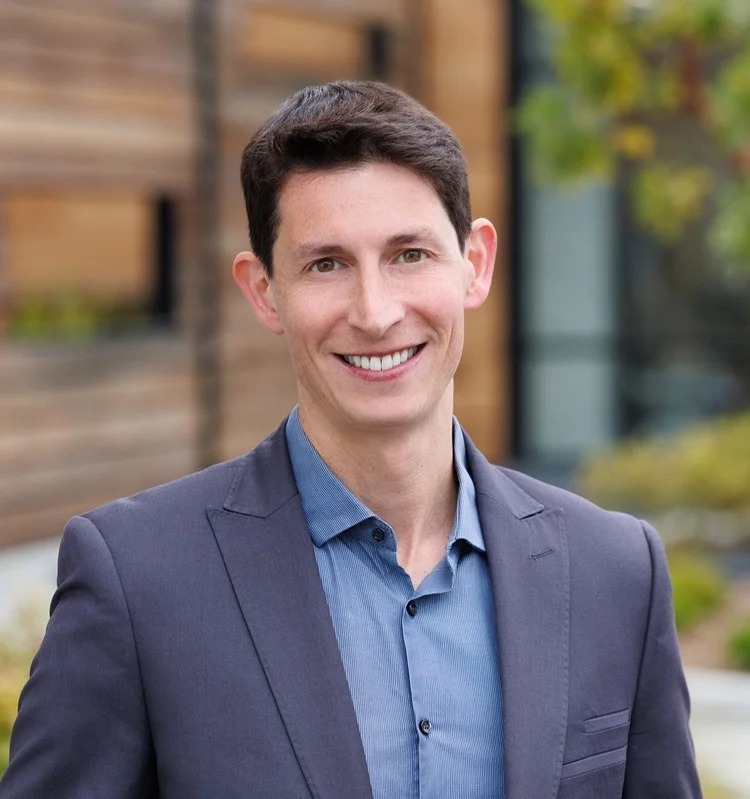
Founder & CEO, Arda Therapeutics. The deck-and-a-thesis era is over.
He spent a career learning how cells go wrong. Then he started a company to delete the ones that do.
Most drugs work like a thermostat. They nudge a single protein up or down and hope the tissue behaves. Adam Freund thinks that playbook has run out of easy wins - "the low-hanging fruit has been picked," as he puts it. So he built Arda Therapeutics around a different verb: not modulate, but eliminate.
The idea is almost rude in its simplicity. In a diseased tissue, a small population of cells has gone wrong. They drive the fibrosis, the inflammation, the slow damage of aging. Find those specific cells, mark them, and remove them - while leaving the healthy neighbors untouched. Freund calls cells "the functional units of disease," and he means it as a strategy, not a slogan.
It is a bet that only became fundable in the last few years. Single-cell sequencing now lets researchers build what Freund describes as cellular catalogs of disease at unprecedented resolution. Where biologists once sorted cells with a handful of crude markers, they can now read a tissue cell by cell and ask a sharper question: which exact cell is the problem, and what is written on its surface that an antibody could grab?
More people have said no to me in the last 18 months than in the rest of my life combined.
Freund's undergraduate degree from Stanford is in materials science and engineering - the study of why things break and how to make them last. He carried that instinct into a Berkeley PhD, where he worked with Judith Campisi on cellular senescence: the worn-out cells that linger in aging tissue and quietly cause trouble. That is where he first met the idea that would later become a company. If certain cells are the problem, what happens if you take them out?
A postdoc at Stanford followed, on telomerase biochemistry and the machinery of aging. Then, in 2014, he joined Calico Life Sciences - the secretive, Alphabet-backed longevity lab. He stayed seven years, helping the company grow from roughly fifteen people to more than two hundred, leading multiple R&D teams, and starting Calico's most advanced anti-aging program: a first-in-class biologic aimed at a validated aging pathway. He learned how to turn high-dimensional data into a picture of an organism's state, and how to push a program toward the clinic.
And then he left. In late 2021 he walked out as a solo founder with a pitch deck and a thesis, and not much else. No academic spin-out wrapped in data. No venture-creation firm holding his hand. Just an idea and the uncomfortable job of convincing strangers it would work.
Single-cell sequencing maps a diseased tissue cell by cell, isolating the small pathogenic population that drives the damage.
Computational biology hunts for surface markers unique to those cells - the tag an antibody can recognize and almost nothing healthy shares.
Biologics, mostly antibodies, deliver cytotoxic activity to the marked cells. The bad ones go; the healthy tissue stays.
It borrows the immunotherapy toolkit that cancer research spent a decade sharpening, and points it at fibrotic and autoimmune disease first. Freund is candid about the limits: conditions "mostly of cell degeneration," like sarcopenia or neurodegeneration, are the wrong target - you cannot fix a shortage of cells by removing more.
Cells are the functional units of disease.
The best way for every person at a small startup to succeed, professionally and financially, is for the company to succeed.
Freund is unusually honest about how brutal the founder transition was. His early deck, he admits, held mostly literature examples and a few basic computational analyses. Investors looked at it and asked the obvious thing: "Why do you think any of this is going to work?" The rejections piled up faster than anything in his academic career.
His read on what actually happens in those rooms is sharp. "Most people, when you tell them about your idea," he says, "they're not judging the scientific merits. What they're really doing is watching you and saying, does this person have credibility?" Fundraising, he warns other founders, is hard - and then hiring is harder still.
It worked. In October 2024, Arda announced a $43M Series A led by a16z Bio + Health, with Eli Lilly, GV, Two Sigma Ventures, RV Invest and a long list of others joining - bringing total funding to roughly $50.5M. The company brought on Scott Turner, formerly of Pliant Therapeutics, as Chief Scientific Officer, and pointed the money at moving its lead programs toward the clinic, starting with pulmonary fibrosis.
Most longevity pitches promise to put the brakes on time. Freund argues the opposite is often more tractable in a clinic. If a drug reverses an aspect of aging, you can watch the treated group improve while the control group holds steady - a far cleaner readout than waiting years to prove something decayed a little less. He pushes back on the assumption that reversal is the harder feat, reaching for a car-maintenance analogy to make the case.
He is also clear-eyed about the field he came from. Senescent cells were a beautiful idea, he notes, but the story "has been mostly characterized through in vitro cell culture experiments and has not translated super well to the in vivo setting." It is the kind of admission you rarely hear from someone selling a thesis - and exactly the kind that makes the thesis more believable.
Freund treats company-building with the same rigor he brings to a protocol. His first hire was Remi-Martin Laberge, a colleague from his graduate-school days who had spent eight years at Unity Biotechnology working on the elimination of senescent cells - exactly the domain Arda needed. The two now run the science together as co-founders.
He talks openly about designing incentive structures from day one, keeping the science transparent rather than needlessly secret, and aligning each person's success with the company's. His pitch to early employees is contrarian on its face: join right after a raise, not later. The risk feels higher, he argues, but the equity and the impact are better, and the earliest people shape what the place becomes.
None of this happened in isolation. Freund credits a web of founder communities - the On Deck Longevity Biotech Fellowship, the a16z Bio + Health network, Village Global, Longevity SF - for the unglamorous help that keeps a solo founder upright: which lawyer to call, how to structure benefits, and the quiet reassurance that the isolation of year one is survivable.
His Stanford degree is in materials science - the study of why things break. He never really left that question; he just started asking it about cells instead of metals.
He'd rather watch a treated group climb than a control group decline slowly. The clinical readout is cleaner, and patients feel it.
He'll tell you the senescent-cell story hasn't translated well from the dish to the body. Rare candor from someone with a thesis to sell.
Put it together and you get a particular kind of founder: trained in three disciplines, seven years deep in one of the most ambitious longevity labs ever built, and willing to bet the rest of his career on a single, almost stubbornly simple sentence about what disease really is. The hard part, he'll remind you, was never the biology. It was getting enough people to say yes.
Sources: ardatx.com, The Bioinformatics CRO Podcast, Longevity.Technology, Lifeboat Foundation, TheOrg, Google Scholar.