Junk mail is an unlikely place to look for the beginnings of a monetary idea. Yet in 1997, Adam Back was working on a peculiarly satisfying response to it: make the sender’s computer sweat. A message would arrive carrying evidence that its sender had spent some computational effort. The recipient could check that evidence quickly. The nuisance would acquire a cost.
He called the system Hashcash. There was no exchange rate to watch, no coin to collect, no invitation to become rich before lunch. It was a kind of digital postage, paid for with computation. Eleven years later, Satoshi Nakamoto’s Bitcoin paper would point to it while explaining how a network could establish a shared history without a central timekeeper.
Back’s name sits inside that paper, attached to a working idea. The connection has made him a familiar figure in Bitcoin history. It also offers a more interesting route into his life than the usual hunt for a mysterious inventor: follow the problem he was trying to solve, and watch how often it changes its clothes.
A postage stamp made of computation
Hashcash exploited a useful imbalance. Finding a suitable hash required repeated attempts; checking a successful result was straightforward. A sender could afford the effort for ordinary correspondence. Someone trying to send vast quantities would face a growing computational bill. The proposal aimed at abuse of resources that otherwise cost very little to consume.
That distinction matters. Hashcash did not contain Bitcoin’s ledger, monetary policy, or network agreement. Back’s 2002 paper gathered the mechanism’s applications and refinements. Its usefulness lay in a small, portable property: effort could leave behind evidence that other computers could inspect.
A little friction, in the right place.
The computer before the currency
Born in London in 1970, Back began with a Sinclair ZX81. He taught himself BASIC and explored software by taking it apart. The attraction of a computer was partly that its apparent rules could be investigated. A game presented a finished surface; underneath it was something a sufficiently curious owner could examine.
At the University of Exeter, he pursued a doctorate in computer science, completing it in 1995. His research concerned parallel computing and distributed systems. During those years, encryption, electronic cash, and remailers became absorbing interests. These were practical questions about what people could do online, and what information they would have to surrender to do it.
His professional life moved through applied cryptography and security architecture. At Zero-Knowledge Systems, he worked in a company developing privacy technologies. He also co-founded Pi Corporation, which EMC acquired, and became chief security officer of EMC’s consumer division. The later Bitcoin executive had already spent years dealing with the awkward distance between a security promise and software that must keep it.
A footnote gets a second life
In August 2008, Nakamoto contacted Back about work that would become Bitcoin. Back was part of an existing electronic-cash conversation that included Wei Dai, Nick Szabo, and Hal Finney. Their projects and proposals explored different parts of a stubborn problem: how to make digital money work without allowing the same units to be spent twice.
Bitcoin combined components into a system. Its white paper describes a chain of transaction records secured by proof of work, with participants following the chain representing the greatest accumulated work. It explicitly invokes a system similar to Back’s Hashcash. The old email stamp had become one ingredient in a mechanism for ordering a public monetary history.
The change of setting is the remarkable part. An anti-abuse tool could help a network make agreement expensive to overturn. Bitcoin’s contribution included the machinery around that tool: incentives, transaction rules, and a way for participants to converge on a history. A borrowed component can be essential without being the entire invention.
- 1997Hashcash makes resource abuse costly.
- 2008Bitcoin’s paper cites Hashcash.
- 2014Back co-founds Blockstream.
- 2016He becomes its chief executive.
Three words on a whiteboard
At the beginning of 2014, Austin Hill travelled to Malta to spend a week planning with Back. Hill later recalled the first words they put on a whiteboard: “Can’t be evil.” Hill had recruited Back to Zero-Knowledge Systems years earlier after reading his Hashcash work. There was a professional relationship behind the slogan.
The words set a demanding engineering ambition. A service can promise good behaviour and still retain the power to behave badly. Removing that power requires decisions about architecture, permissions, and the user’s ability to leave. A whiteboard makes such a proposition look pleasantly short. Software gives it homework.
Blockstream emerged in 2014 with a group of co-founders and an initial focus on extending Bitcoin. Back’s own statement of intent emphasised decentralisation, security, user control, and permissionless innovation. Those commitments gave the company a commercial puzzle: build services around a system whose appeal included resistance to powerful intermediaries.
Back and eight collaborators published the pegged-sidechains paper that October. It proposed moving assets between blockchains so people could explore different capabilities using assets they already held. Conservative handling of Bitcoin’s shared foundation could coexist with experiments elsewhere. Each experiment would still need scrutiny of its own assumptions.
The argument about who gets a vote
That preference for caution became politically consequential during Bitcoin’s block-size disputes. More space in blocks promised room for more transactions. Back warned about the effects of very large blocks on mining incentives and centralisation. A seemingly numerical question became an argument about who could afford to participate.
To a user waiting for a payment, capacity can look like the obvious priority. To someone running network software, the resources required to verify transactions also matter. The disagreement involved competing judgements about adoption, cost, and control. Back’s position placed considerable weight on preserving decentralisation while developing additional layers.
He became Blockstream’s CEO in October 2016, succeeding Austin Hill. The job put a cryptographer into the ordinary business of coordinating people, products, and investment. His public arguments remained technical, but their consequences reached users and companies who might never read a cryptography paper.
There is a distinction running through this work between operating a business and operating the currency itself. Blockstream can hire engineers, publish software, and sell products. Bitcoin’s participants still have their own decisions to make about which software to run. For a company committed to the network, persuasion is part of the job description. A chief executive’s title does not settle a protocol dispute. That makes Back’s position an unusual one: he leads an organisation with commercial responsibilities while arguing for a system whose rules should resist pressure from organisations. The difficulty is built into the assignment, and it gives his technical disagreements a consequence beyond the conference stage.
Privacy, with the arithmetic intact
Back’s research interests extended beyond proof of work. He co-authored the Confidential Assets paper with Andrew Poelstra, Mark Friedenbach, Gregory Maxwell, and Pieter Wuille. It addressed a tension in public ledgers: everyone must be able to verify the accounting, while publishing payment information can expose more about users than they intended.
The work describes cryptographic techniques that conceal transaction amounts while preserving checks that money is not created or destroyed improperly. Confidential Assets extends the approach to different asset types. Privacy becomes an accounting problem as well as a personal preference: how much can remain hidden while the arithmetic remains checkable?
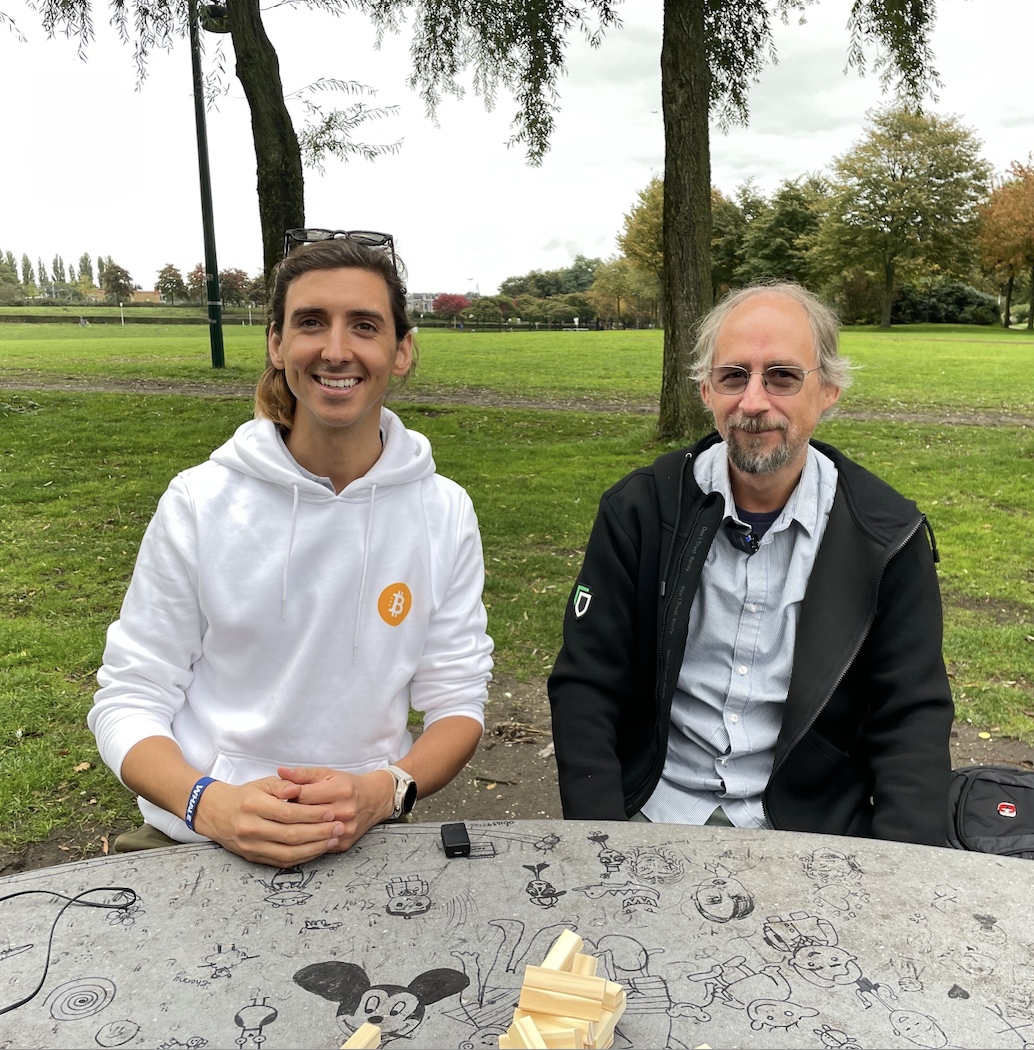
His taste for unusual engineering venues also reaches orbit. Blockstream Satellite broadcasts Bitcoin data, offering another route for receiving the blockchain. During a 2022 Amsterdam conversation over Jenga, Back explained the privacy appeal of a broadcast: reception need not announce itself to the sender. He also allowed a less solemn justification: “One, because it’s cool, and you can.”
The bank arrives at the cypherpunk meeting
By 2025, Back was discussing institutions’ appetite for Bitcoin products, a considerable change from the caution he remembered when Blockstream began. His position accommodated both institutional participation and people holding their own keys. The practical question was how those forms of ownership would coexist.
“We are a Bitcoin mission company,” he said. It is a concise description of a business serving customers whose preferences can differ sharply. A financial institution wants products that fit its operations. An individual may want fewer intermediaries between themselves and their money. The same network can attract both, while leaving plenty to argue about.
“We are a Bitcoin mission company.”
Adam Back / 2025 interview
Verification has to survive the bad days
The engineering obligation became particularly concrete in September 2026. Blockstream’s assessment of a Liquid Network incident described an attacker exploiting a rangeproof-verification cache vulnerability, creating approximately 4,000 unbacked LBTC. Liquid is a separate network built with Elements; the incident concerned that system rather than Bitcoin’s base ledger.
The September 23 assessment described replaying transactions with the cache disabled, checking results independently, and restoring valid history. It reported that 3,400 BTC attributable to unauthorised transactions had been returned, with approximately 602 BTC still subject to recovery efforts. Recovery remained ongoing at publication. Those are dated findings, rather than a declaration that every consequence had been resolved.
On October 13, Blockstream announced the return of multisig account creation in its app, including Bitcoin accounts with a third key held by the user for recovery. The concern with what happens when an intermediary is unavailable remains visible in the product details.
Back’s career began with an unwanted message and a request for evidence. It now includes a company whose systems must face the same demand from other people. That is the enduring interest in his story: an idea about verification becomes a working product, then an obligation. The whiteboard can be wiped clean. The people using the software still need an answer.