People stayed longer than they had to. That was the detail Abdulmajeed Al-Babtain chose to remember about a suhoor inside a Mnzil building with the Amazon team. People cooked, ate together and lingered. In a business usually counted in beds, buildings and corporate contracts, the founder was describing the success of an evening by how reluctant anyone seemed to leave.
It is an unusually domestic test for a venture-backed company. An occupied bed is easy to count. A room people enjoy spending time in asks a more demanding question. Al-Babtain, who uses Majeed Albabtain professionally online, has been putting that question near the centre of Mnzil, the Saudi workforce housing company he co-founded in 2024 with Abdulrahman Al-Shaya.
The distinction matters because a worker experiences accommodation for far longer than the moment a booking is made. A sale has an ending. Living somewhere continues the next morning. The room, the journey to work and the meal after a shift all become part of the same promise. Keeping it requires a company to remain interested after the contract is signed.
The ambition he admits he started with
Al-Babtain has been candid about an earlier version of his motivation. In his announcement of Mnzil’s Series A, he acknowledged that chasing status and valuation had been part of the original appeal. He then described a shift toward the daily experience of workers and the responsibility of improving it. The admission gives his story something a polished founder biography often sands away: a change of mind.
There is a certain relief in that. Entrepreneurs are frequently expected to have understood their life’s purpose before they understood the business. Al-Babtain allows for an untidier sequence. Build something, encounter the people affected by it, revise what the work means. The company can become more consequential to its founder as he learns what running it actually involves.
His public biography has some of the same informality. He describes himself as a dropout and introduces himself with an admission of embarrassment and occasional error. The humour is economical. He has left himself room to be corrected, a useful allowance for someone whose working life includes other people’s accommodation. In that setting, certainty is considerably less useful than noticing when something needs fixing.
A university startup fair’s description places Mnzil’s beginnings while its founders were still computer college students. Its founding question was practical: how could worker housing become easier for companies? That gives the venture a concrete starting point, before the financing announcements and expansion plans. An employer needs accommodation; somebody has to make the arrangements work.
A company with several sets of keys
Mnzil’s services span housing, transportation, catering and the operation of owners’ properties. Its website describes furnished accommodation, upkeep and shuttles fitted to shift schedules. The business proposition is consolidation: an employer can hand over a collection of related tasks rather than manage each through a separate provider. The resident encounters those tasks as one day, regardless of how many suppliers sit behind it.
This makes the founder’s job broader than finding an available room. He is dealing with a sequence. Accommodation has to connect to a workplace. Transport has to connect to a shift. A property owner’s expectations have to connect to the needs of a company and its workers. Each connection is another place where an otherwise sensible plan can lose a small but essential detail.
A place to live↗02
A ride to work↗03
A meal together
By the November 2025 financing announcement, Mnzil was operating across more than 13 Saudi cities, with over 60 equipped buildings and more than 100 corporate clients. SMASCO, EFSIM, Barq and SIXT were among the named customers. Those numbers describe geographic and operational spread as much as commercial traction. A building in another city creates another daily obligation.
The $11.7 million Series A was led by Founders Fund, with continued participation from COTU Ventures. It marked Founders Fund’s first lead investment in Saudi Arabia. For Al-Babtain, this brought an international investor into a business grounded in very local particulars. The customer might recognise a fund’s name. The resident still needs the building to work.
The bus has a vote
In a later reflection on operations, Al-Babtain chose a bus delay to explain what scale had taught him. “A delayed bus affects an entire shift,” he wrote. He described small inefficiencies accumulating and a determination to bring decisions closer to execution. Mnzil had built much of its machinery internally so the people creating systems could understand the conditions in which those systems were used.
That is a revealing choice of example. A late bus does not respect the elegance of a dashboard. It arrives when it arrives. For a company joining accommodation to employment, the journey is part of the service, and the consequences travel beyond the passenger. The founder’s example puts time alongside property as something his business has to manage carefully.
“A delayed bus affects an entire shift.”Majeed Albabtain
He also reported 41-fold year-on-year growth, a 42 percent gross margin, profitability and eight figures in booked revenue, following a second external financial audit. These are figures he shared publicly about Mnzil. Booked revenue, in particular, deserves its own label; it should not be casually read as cash already collected. The operational lesson remains more tangible than the numerical flourish.
Growth increases the number of people who can feel a small failure. That gives process an oddly personal importance. A decision about a route or a reservation can reach someone who has never met the founder. In Al-Babtain’s telling, building internally is a way of keeping the decision attached to that reality. The software has to remain acquainted with the bus.
He kept the renovation in the family
The same preference appeared when Mnzil renovated its own office. Al-Babtain described choosing an in-house approach and credited designer Yousef Albasri and the operations team. He invited people nearby to drop in for coffee. The gesture is modest, but the connection is clear: a company selling the quality of a living environment had taken an interest in the environment its own staff occupied.
An office renovation could have been a decorative aside. Here it fits an emerging pattern of responsibility kept close to the people doing the work. Systems, property operations and even the workspace become opportunities to learn directly. There is also something appealingly ordinary about the invitation. After all the ambitious language that accompanies startup growth, someone still has to put the coffee on.
At the resident suhoor, the detail that stayed with Al-Babtain was similarly ungrand. People had prepared their own food and remained together. He was paying attention to a place being used for something beyond its minimum function. A shared room becomes more interesting when the people in it can make an evening of their own.
From finding buildings to shaping them
Mnzil’s next step brought the physical supply of housing further into its plans. The company announced its first development project in Riyadh with more than 22,000 square metres of built-up area. It connected the decision directly to a shortage of suitable buildings. The planned complex included residential, recreational and educational facilities, extending the scope of what the company intended to provide.
This changes the questions a founder must answer. Managing existing accommodation means working with a building’s inherited decisions. Developing accommodation creates an opportunity to make those decisions earlier: how the space is arranged, what people can do there, and how it relates to employment. It also means ambition has to pass through design and delivery before anybody can move in.
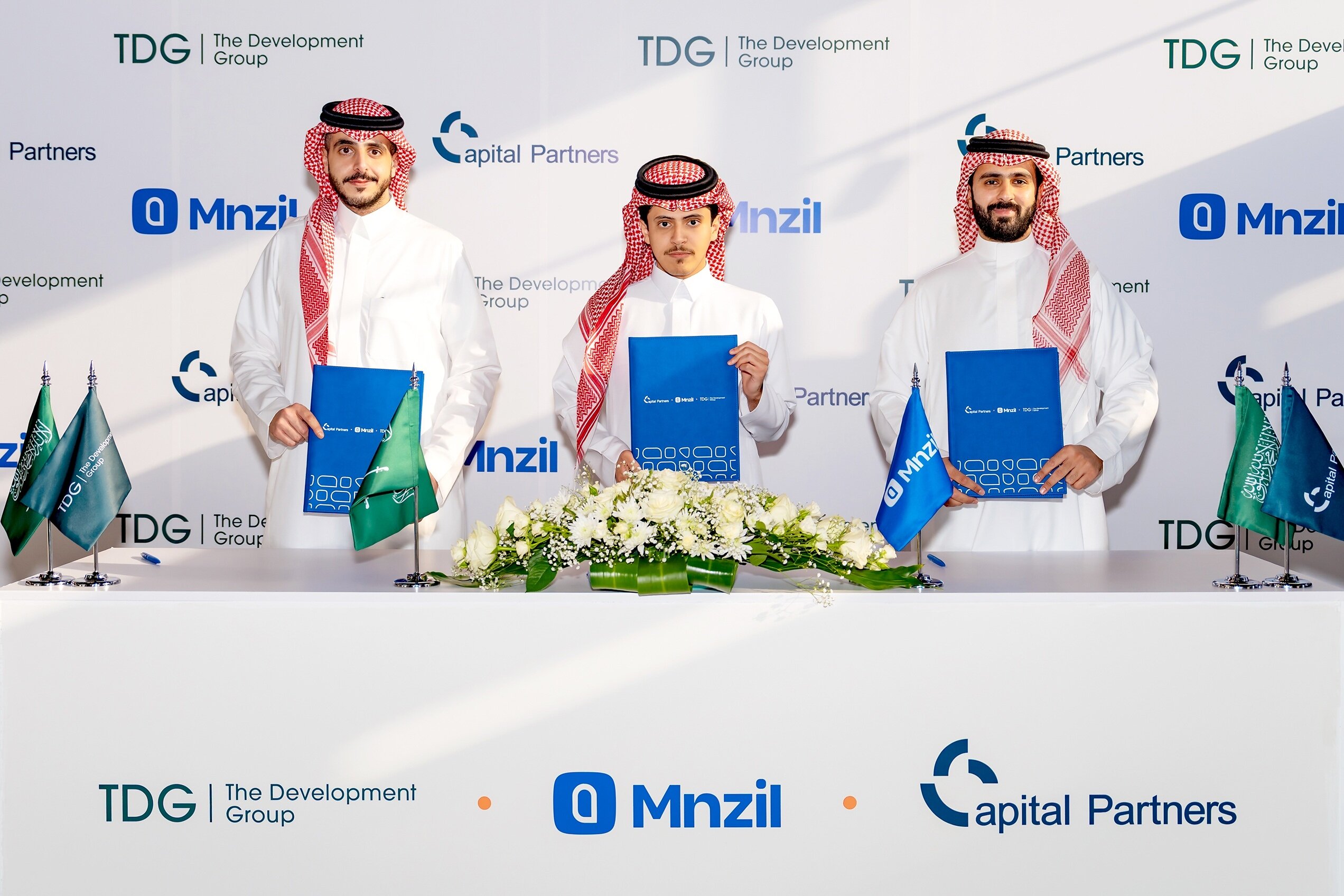
On October 5, 2026, Mnzil, The Development Group and Capital Partners announced a fund targeting SAR 1 billion in investment and accommodation for up to 50,000 workers. Mnzil would be the exclusive operator; TDG would handle site selection, design and development; Capital Partners would manage the fund. Development was expected to begin in the fourth quarter of 2026.
The division of work gives Al-Babtain partners with distinct responsibilities. It also turns the idea of a better evening into a question that can be considered before construction. Where people gather, how far they travel, and what they can do outside their rooms become part of an operating brief. The photograph records a signing. The useful test comes when the buildings have residents.
The hours that belong to someone else
Al-Babtain’s public accounts keep returning to the relationship between a system and the person living inside it. The funding story explains how Mnzil can grow. The bus explains how growth can fail. The meal explains what the service might feel like when it succeeds. Together, they offer a more specific portrait than the title of founder and CEO can manage by itself.
His story also leaves room for an ambition that develops with experience. He has acknowledged wanting the familiar rewards of entrepreneurship. Now his examples are increasingly about execution, shared spaces and everyday routines. The interesting question is how faithfully those concerns can travel as the business adds more places, more partners and more people to its care.
For a housing company, the hours after work are the product people actually live with. The room must earn its place in somebody’s day. Al-Babtain has given himself a test that cannot be completed at a signing ceremony or on a funding announcement. Somewhere, people finish eating. They can go back to their rooms. They stay a little longer.