The interesting thing about a conversation is how often it refuses to behave. Somebody interrupts. Somebody says “mm-hmm” before the other person has finished. Two voices occupy the same second. To a tidy transcription system, these moments can look like clutter. To Abaka AI, they are part of the merchandise.
Its full-duplex speech offering records speakers on separate, synchronized tracks, preserving the overlap. A human host listens live and can have a flawed passage recorded again. The tiny mess of ordinary conversation becomes something a voice model can learn from. Teaching a machine to sound natural begins with deciding which untidy details to keep.
- What it sells: datasets, collection, annotation, evaluation, and specialist talent.
- What connects them: Abaka Forge, its multimodal production platform.
- What buyers should test: whether the examples, reviewers, and acceptance rules match the intended task.
A factory for examples
Abaka occupies the space between information that exists and information a model can use. A photograph needs boundaries around objects. A driving sequence needs labels that remain consistent as objects move. A language model may need two competing answers ranked by someone qualified to judge them. These are different products, even when the industry bundles them under “data.”
The company offers ready-made collections alongside custom work. Its catalog spans text, audio, images, video, 3D, reasoning, and agent data. Customers can bring their own material for cleaning and labeling, commission fresh collection, or hire vetted professionals to work inside their existing tools. That last option matters: changing suppliers need not require moving the whole workshop.
Forge supplies the organizing machinery. It supports images, text, video, reinforcement learning from human feedback, and 3D or 4D point clouds. Collection, cleaning, annotation, and production sit within the same system. Automation handles suitable repetitive work; people still have to resolve the judgments that make the output meaningful.
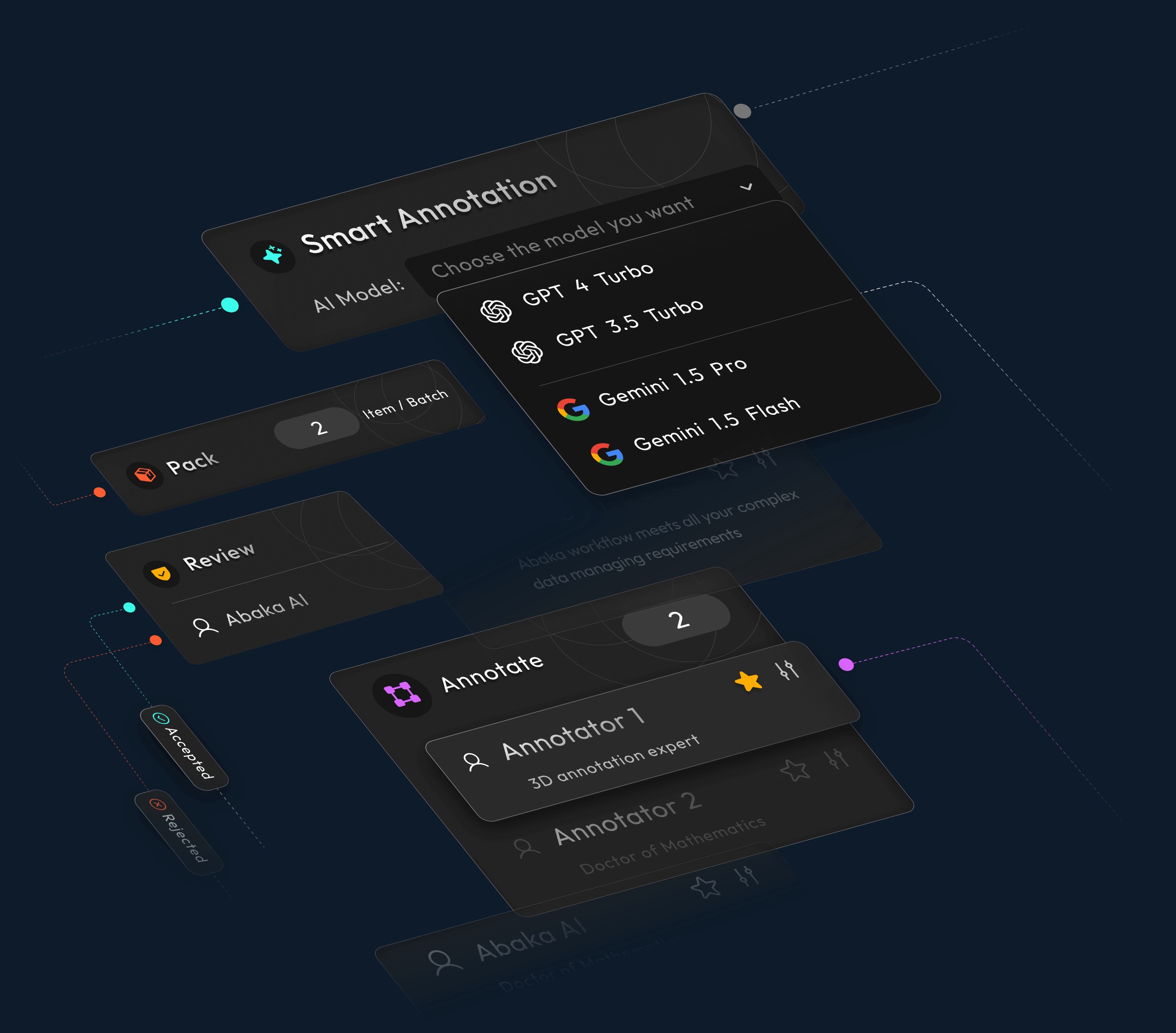
Abaka says it has served more than 1,000 technology companies and research institutions. Its target markets include generative AI, automotive AI, and embodied AI. Treat that customer count as the company’s account of its reach. The practical buyer is the team whose engineers need usable training material without building every collection and review operation themselves.
The price of a judgment
A rate card makes this business easier to understand. Abaka lists stock images from one cent each, Lean4 math formalizations from $15 each, and defensive-coding evaluations from $15. Dense-captioning annotation starts at $6 an hour. These are advertised starting prices, with different units and different deliverables, rather than interchangeable measures of value.
The business combines dataset sales, service engagements, embedded people, and platform credits. A buyer’s real question is how much review and rework a usable example requires. Counting files alone leaves that question unanswered.
First, agree on what counts
One anonymous case study describes a frontier-model lab whose internal labeling could not keep pace with weekly releases. Guidelines changed; judgments drifted. What failed first was the consistency of the production process. More people applying an unstable rule would have multiplied the disagreement.
Abaka says it introduced written scoring rules, specialist reviewers, reference examples, escalation, and weekly guideline versions. The lab approved the pilot within three weeks, according to the account. That approval was the decision point for moving into regular deliveries. The company reports a 40 percent reduction in review backlog; the anonymous example is useful as a workflow description, with results that remain company-reported.
“Your data is exclusively yours - it will never be repurposed, resold, or shared.”Abaka AI’s published confidentiality commitment
There is a method here that other teams can copy. Begin with a sample containing difficult cases. Have reviewers apply the same instructions. Inspect disagreements. Revise the instructions, preserve the version, and only then increase volume. Abaka’s provider guidance recommends representative pilots and controlled updates, including relabeling affected portions when an ontology changes. The purchase should expose uncertainty early.
Give the agent somewhere to fail
An agent introduces another problem. A plausible answer does not establish that the work happened. Abaka’s reinforcement-learning environments simulate enterprise systems, including messaging, commerce, and recruiting workflows. Actions change system state; resets let the task run again. Teams can evaluate both decisions and verifiable execution without experimenting on production data.
Its AB-Terminal Bench work makes the distinction concrete. Tasks include a runnable environment, instructions, tests, and a reference solution. In one published example, checks cover output structure, valid numbers, accuracy, and reproducibility. A convincing-looking file can fail because its rows are wrong or its generating script cannot reproduce it. The company describes adding a planning step for tests because test generation was particularly prone to mistakes.
The robot version of this problem is physical. Abaka groups its offering into human demonstrations, robot capture and teleoperation, and world context. The required evidence extends beyond a picture of an object to movement, pose, and the surroundings in which an action occurs. Different mistakes demand different observations.
A supplier with boundaries
Abaka competes for work that buyers might give to annotation providers such as Scale AI, Labelbox, or Sama, or keep in-house. Its pitch combines tooling with delivery and domain expertise. It also promises not to build competing models or reuse client data. For a lab protecting proprietary examples, the supplier’s boundaries can matter alongside its speed.
There is a public research side, too. Abaka’s VeriGUI work links to open code and data, while its team page identifies research leadership tied to the 2077AI foundation. Open research and confidential customer production serve different audiences, but both put attention on how examples are constructed and checked.
The fit depends on the task. A simulation that misses the real workflow will reward the wrong behavior. A rubric that reviewers cannot agree on will turn scale into expensive inconsistency. The useful question to bring Abaka is specific: here is the behavior we need, here are the difficult cases, and here is how we will know the data helped. That is where the conversation gets interesting.