Somewhere inside a company drive is a very good slide. It has the approved diagram, the right typography and the version of the story everybody finally agreed upon. It is also lost. Someone will rebuild it from memory, another person will change the spacing, and by Friday a single company will look like four organizations sharing a password. Zarina Clark has spent much of her career designing a way out of this ordinary mess.
Clark is a brand designer and creative strategist, but those titles only describe the visible layer. Her more revealing work is structural. At CertifyOS, a healthcare technology company, she built reusable components, templates, brand rules, request workflows and a searchable body of past work. The result is a creative function that can remember what it has already learned. This may lack the glamour of the blank canvas. The blank canvas, however, is often where deadlines go to die.
Her current résumé lists her as Marketing Manager, Design & Marketing Operations, a role she took in March 2026 after joining CertifyOS as a graphic designer in January 2023 and moving through marketing coordination. Her portfolio uses a more elemental description: founding designer. Both describe the same arc. She arrived early, when design was a stream of requests, and stayed long enough to build the stream a riverbed.
Chapter oneThe girl who started with sixty chapters
The first artifact in Clark's story was made of words. At fourteen, she has written, she filled pages with characters and plots until a book reached sixty chapters. It was not a passing sketch. She worked on it for months. The anecdote matters because it explains the continuity in a career that otherwise seems unusually broad: identity, illustration, packaging, websites, events, marketing operations and now AI-assisted tools. Before she arranged visual systems, she was arranging worlds.
Clark studied business, management and marketing at Pasadena City College and design and visual communications at College of the Canyons. By 2015 she was running an independent design practice, which continued for seven years. The client list eventually included Microsoft, Nestlé, Häagen-Dazs, Hershey and the American Cancer Society. In parallel, she spent more than three years leading design for Urban Sprout, carrying a restaurant group's identity from concept through packaging, digital work and print.
That route produced a designer with little patience for the ceremonial boundaries between disciplines. Clark calls herself “a jack of all trades who goes deep where it counts.” It is an unfashionably cheerful defense of range. For her, a logo is the beginning of a language; the packaging, site, campaign and internal tools are where one discovers whether the language can hold a conversation.
“I use modern tools to move faster and skip the busywork, but the decisions that shape a brand are still made by hand.”Zarina Clark
Chapter twoBuilding the machine without becoming one
At CertifyOS, the requests came from everywhere. Marketing needed campaigns and social assets. Sales needed decks attached to large deals. Product needed interface support. Customer Success needed a Knowledge Center that clients could navigate and trust. The usual answer would be more specialists. Clark made a different bet: perhaps a connected system could absorb growth before headcount did.
She documented type, color, spacing and component patterns. High-volume work received templates. A deck, a landing page, an event banner and a social campaign could begin from the same underlying logic rather than four empty files. She also formalized the less photogenic parts of creative labor: request intake, HubSpot and Jira workflows, and service expectations. Taste got an operating manual.
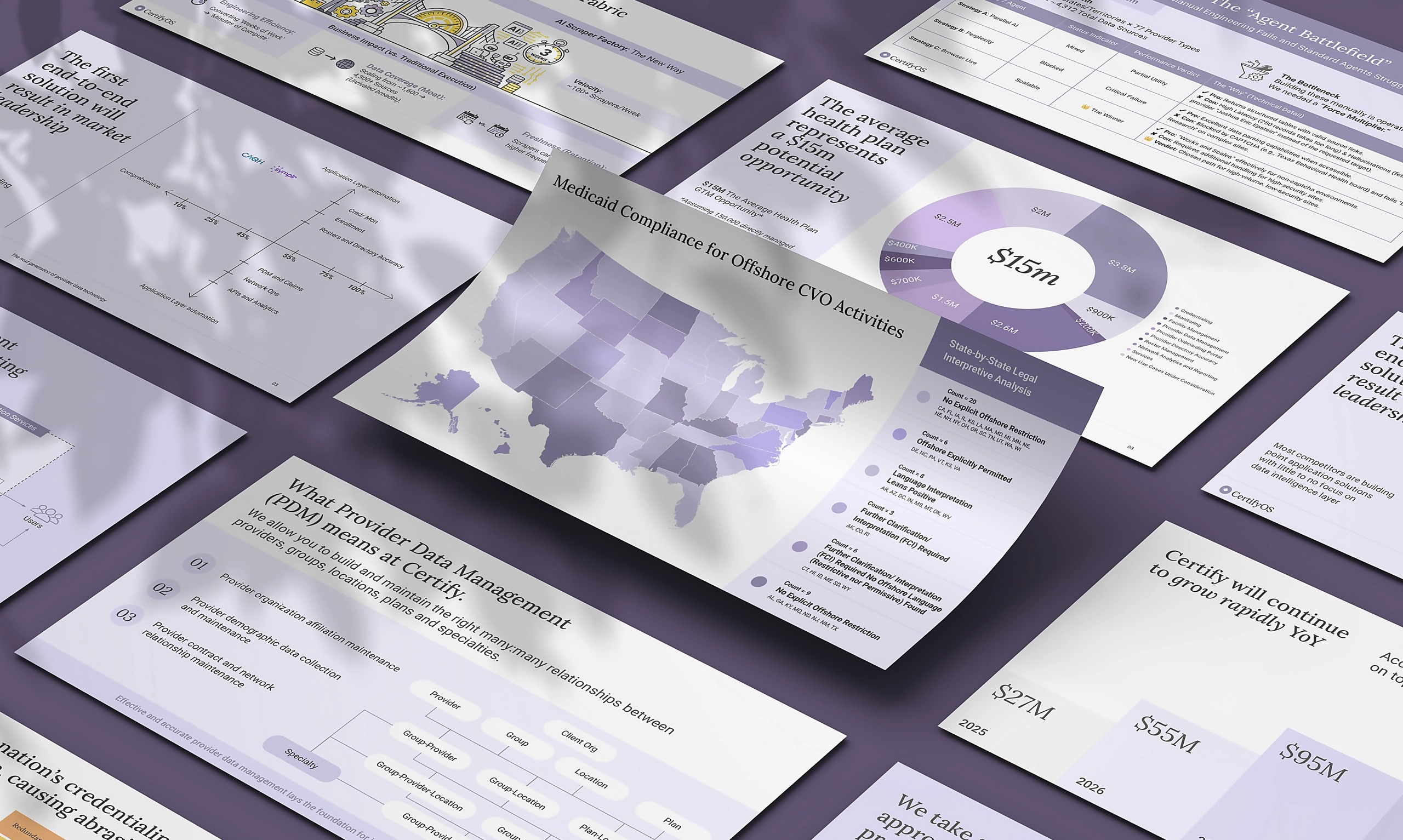
The measurable change was sharp. Her portfolio reports more than 150 creative assets shipped in 2025, two vendor projects brought in-house and typical turnaround reduced from three or four weeks to under one. Her résumé estimates that the in-house work saved $15,000 to $20,000 a year. During her first thirty days, a testimonial on the case study says, she produced the company's first magazine, its first infographic, a large NAMSS booth, a website refresh and weekly social work, while turning decks around in less than 48 hours.
From queue to current
Portfolio-reported typical creative turnaround at CertifyOS.Those numbers tempt a story about individual velocity. Clark's own account points elsewhere. She describes the output as a consequence of leverage: a component reused, a request clarified at the door, a good slide retrieved rather than rebuilt. Speed is less a personality trait than a property of the system.
Chapter threeThe human hand stays on the wheel
Artificial intelligence appears throughout Clark's recent work, though rarely as spectacle. She uses it for ideation, first drafts, prototyping and repetitive production. Her rule is plain: the machine may remove grunt work, but the decisions remain hers. On her site she promises “an AI-assisted workflow that moves faster,” followed by the more important clause: she supplies the taste, strategy and human hand.
In September 2026 she began publishing a new set of field notes about tools built from this philosophy. One is a Brand Studio, created because years of decks and diagrams were available but difficult to find. It treats the archive as the company's creative memory. Another joins a marketing calendar to an asset library and a performance view, so the plan does not forget the work after publication. A third, ClockSprout, turns client projects into plants and logged time into water. It came, Clark says, from a 3 a.m. idea.
ClockSprout is the odd little project that makes the serious ones easier to understand. Clark likes systems, but she does not seem interested in making people feel like rows in one. Even timekeeping can be given a garden. Her affection for literal gardening helps the metaphor: when she is away from the screen, she says she is often outside, working with her hands and “designing spaces that grow.”
Chapter fourA sticker, a stage and a bag of treats
The same method travels well beyond software. For WanderLodge, a Lake Arrowhead souvenir shop, Clark avoided the single-clever-logo trap and designed the whole shop as a system. She drew from heritage outdoor brands, created original illustrations and extended the identity across more than forty products. Collectible stickers, the smallest and cheapest objects in the range, became responsible for more than half the shop's profit, according to her case study. The brand grew from one storefront into a label stocked by other local businesses.
For Happy Treat, a new dog-treat brand, she confronted a different shelf. Loud packages were everywhere, so she chose a calmer identity built to work across canisters and pouches. Her published scorecard lists two product lines, one core idea and zero redesigns needed to add products. Zero is a fine design metric. It means tomorrow was considered before it became expensive.
Blueprint, a three-day gathering for senior health-plan leaders, demanded an atmosphere rather than a package. Clark made the invitation, registration, stage, programs and small environmental details speak in one restrained editorial voice. Her portfolio says the room held 58 leaders, represented $28.7 million in pipeline, produced $3 million in net-new opportunities and received a 9.7 out of 10 attendee rating. She describes the assignment as designing memory: the objects people photograph, keep and recognize when the next invitation arrives.
Begins a seven-year independent design practice.
Starts leading restaurant-group branding and packaging at Urban Sprout.
Joins CertifyOS and begins building the company's creative foundation.
Moves into design and marketing operations leadership and publishes new creative-tool experiments.
Chapter fiveRange, held together
There is a modest audacity in covering strategy, identity, packaging and web “from one seat.” Agencies are built on the opposite proposition: expertise divided neatly among rooms. Clark's defense is continuity. If one person can follow the idea from positioning to pixel, fewer things are lost in translation. The risk, of course, is that range becomes a cabinet of unrelated tricks. Her answer is to make the system, not the trick, the unit of work.
Her colleagues notice the temperament behind it. Public recommendations describe a positive collaborator who can translate dense technical material into something clean and digestible, stretch beyond a graphic-design brief, and keep communicating while the work moves. Clark's own description is shorter: collaborative, honest and hands-on. She moves quickly toward prototypes so clients can react to something tangible rather than admire a cloud of jargon.
Away from corporate systems, the picture loosens. She bakes and speaks of dessert as design with flavors. She styles food photography, keeps a studio playlist and explores voice acting. She gardens. These interests are not proof of a grand theory, nor do they need to be. They reveal a designer who likes materials, moods and transformation, whether the ingredients are type and color or flour and fruit.
The sixty-chapter manuscript and the searchable slide library sit at opposite ends of Clark's story, yet they rhyme. Both ask how separate pieces become a world. The work at CertifyOS adds a grown-up complication: how does that world continue when requests multiply, tools change and nobody remembers the filename? Clark's answer is equal parts designer and operator. Give the work rules. Give the team a memory. Leave the human hand on the wheel.