In 2010, Zain Mustafa went to Makli with a friend who was documenting the site. He had returned to Pakistan after years abroad. Here was an architectural inheritance close to home, and here was the uncomfortable discovery that proximity had done very little to make it familiar. The visit delighted him. The neglect angered him. Both reactions proved useful.
Makli helped give a direction to a question he had encountered while teaching: how could young designers know so little about the histories beneath their own feet? A contemporary education had supplied references from elsewhere. The nearby material needed an introduction. Mustafa began making one, taking people out to buildings and landscapes where the conversation could acquire some stone, dust and perspective.
That work became Cube Edutours and, later, the Indus River Valley Institute, which he founded and leads. The itinerary has expanded. So has the definition of a classroom. A heritage site, a boat, a craft workshop and a game-design camp can all become places to ask how knowledge survives, who carries it, and who gets invited to learn.
The designer who kept teaching
Mustafa was born in Karachi in 1971. His education took him to New York, where he completed a BFA in Environmental Design at Parsons School of Design in 1993, concentrating on architecture. A full scholarship took him to Columbia University for graduate work in education, with a focus on new technologies in architectural teaching. Design and teaching were already sharing a desk.
From 1995 to 2000, he taught at the Indus Valley School of Art and Architecture in Karachi while working in interiors, installation art and fashion. He returned to New York in 2000 and moved to Dubai in 2003. His working geography also included Santa Fe and Tokyo. It was a career with several addresses and an unusually crowded stationery cupboard.
In Dubai, his interests included the possibility of a contemporary Middle Eastern design language. He spoke about that subject ahead of the 2010 Hotel Show. His practice ranged across hospitality, retail, residences and commercial spaces. The question of how a place might develop its own design references was present before heritage education became his public calling.
Back in Pakistan, his portfolio included National Incubation Center Karachi and the TAO restaurant. The projects occupied very different social worlds. An innovation centre brings people together to work; a restaurant arranges an evening. Both require an architect to think beyond an attractive plan and consider what people will actually do when they arrive.
His teaching carried that attention into a different setting. A visit to a historical building also has to be designed: what comes first, what needs explaining, when to speak and when to let someone look. The itinerary becomes part of the lesson. Even a good question needs somewhere to stand.
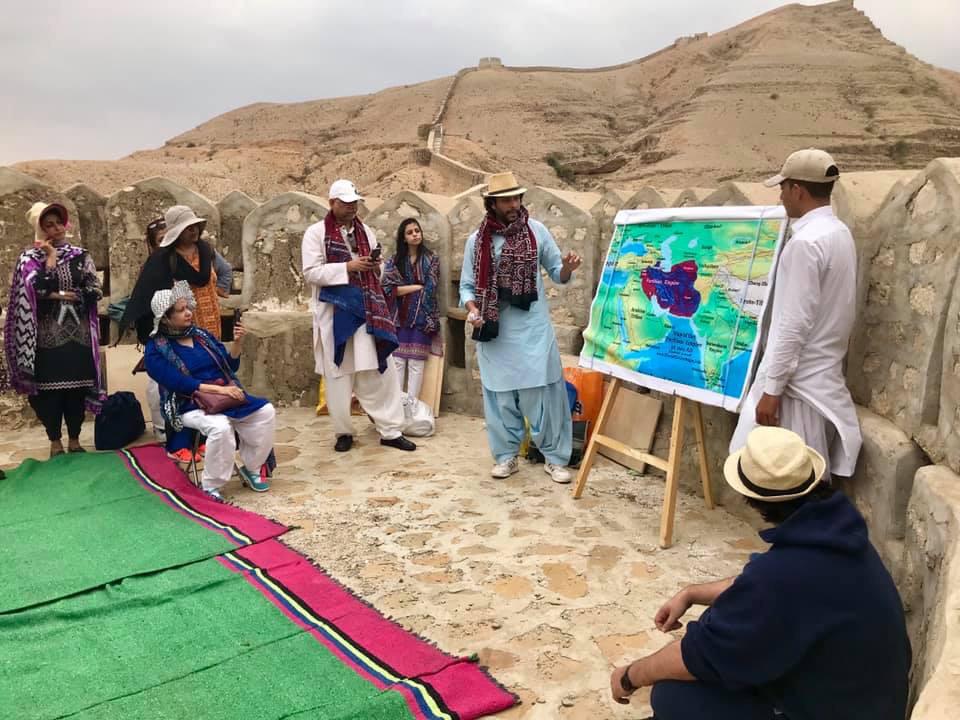
Bring a map. Leave room for questions.
Cube’s account of its tours describes a combination of historical maps, prepared material and pop-up classrooms. The destinations range from Makli and Ranikot to Mohenjodaro, the Nagarparkar temples, shrines, northern forts and old cities. Local music, food, craft and storytelling enter the programme because the building belongs to a larger cultural setting.
These are generous subjects for an architect. A wall can prompt questions about materials and construction. A route can open a discussion about trade. A carved detail can lead toward the people who commissioned it and the people who made it. Time spent looking gives each question a chance to become more specific.
The preparation matters. Mustafa has described providing books and maps and discussing the history of design before arriving at a site. Visitors get a way into what might otherwise be an overwhelming field of monuments. The practical ambition is straightforward: make an encounter intelligible without removing the pleasure of discovery.
“Anyone who has a thirst for knowledge can join us.”
Zain Mustafa
The audience widened beyond architecture students to school groups, adults, diplomats and other visitors. That changes the teacher’s task. A room full of specialists shares shorthand. A group drawn from different ages and professions needs several entrances into the same subject. Drawing, listening, walking and conversation allow different kinds of attention to count.
A 2022 Hunza itinerary made the mixture tangible: history talks, guidebooks, charcoal sketching, a meal in a local home and folk music. The activities ask people to spend time with a place in different ways. A sketch requires patience. A meal introduces a host. A map gives the journey somewhere to sit in the mind.
At the lake, the lesson changes hands
At Manchar Lake in Sindh, the relationship between heritage and the people living with it becomes especially concrete. The Mohanna community’s houseboats carry a history of making and use. Preserving that inheritance brings questions about livelihoods into the same conversation as questions about design.
On September 6 and 7, 2024, IRVI and NED University’s Heritage Cell jointly organized workshops at Jhangara, where the houseboat cluster relocates during the monsoon. Eighteen members of the fishing community participated alongside fourteen third-year architecture students. Mustafa and Abdullah Quadir introduced tourism and its possibilities. Other sessions covered cooking, crafts and social media.
The programme also included boat-repair instruction led by Professor Anila Naeem. Architecture students documented tools, carving patterns and the parts of traditional boats. Craftspeople supplied knowledge the students had come to learn. In this classroom, expertise did not arrive exclusively with the university contingent.
Two days at Jhangara, September 2024. A shared workshop in heritage, tourism and making.
IRVI’s sustainable tourism proposal connected this work to a possible alternative income stream and the preservation of cultural heritage. A proposal is a beginning; its ambitions still require practical arrangements. Training a host, explaining a craft and helping someone tell their own story are specific tasks. They make the larger idea easier to examine.
The episode also puts Mustafa among colleagues with distinct skills: Naeem in heritage and boat restoration, Hamza Azim in cooking, Amneh Sheikh Farooqui in crafts, and Quadir in media. The work has room for an architect precisely because it also has room for other people. Nobody can teach the whole lake.
Taxila gets a different kind of visitor
The 2025 Taxila project introduced another set of tools. Under the UNESCO World Heritage Volunteers Programme, the project brief combined heritage preservation with AI and game design. Scheduled for September 5 to 15, it proposed research, documentation, storytelling workshops and work toward an immersive game prototype.
There were familiar elements too: sketching, photography, engagement with local custodians, and learning from craftspeople and conservation specialists. The digital ambition depended on attention to an actual place. Before anyone could make an experience for a player, there was a site to investigate.
Mustafa curated the Taxila Gamification Project through IRVI. A participant’s reflection published in January 2026 described a ten-day research and development camp producing a conceptual blueprint for a video game. Volunteers visited heritage sites, discussed gameplay and studied period architecture. The documented outcome was a design foundation, with further work implied by the form.
For someone trained in architectural education and new technologies, the experiment has a recognizable logic. Designing a game obliges a team to decide what an environment communicates and what a visitor can discover through action. Those decisions can also expose gaps in understanding. The work begins asking questions before it supplies answers.
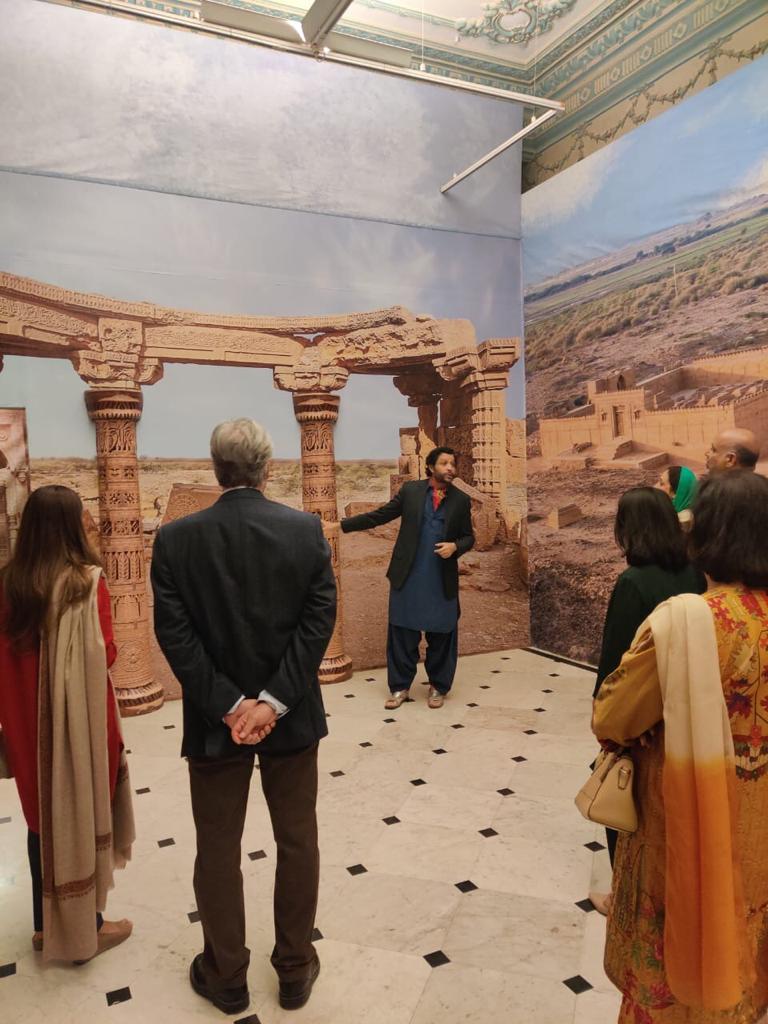
A place to keep the questions going
IRVI gives these activities somewhere to accumulate. Its publishing includes ICAHN, the Indus Culture & Architecture Heritage Newsletter, whose first edition appeared in autumn 2023 with Mustafa as managing editor. The publication draws architecture into conversation with music, textiles, film, literature, food, museums and education. Heritage acquires a broader reading list.
His institutional ambition is continuity. Mustafa has described wanting IRVI to become self-sustaining, carrying forward inquiry into cultural identity and bringing more people into it. An institute creates the possibility of work that can be shared, revisited and developed beyond one person’s tours or talks.
There is a quieter personal detail that belongs beside the projects. His companion dog, JJ, was named for the resemblance Mustafa saw to a Giacometti sculpture. The architect’s eye followed him home. A long-legged animal could bring art into daily life without any assistance from a gallery label.
His public responsibilities include the presidency of the Society for the Protection of Animal Rights, and his work has included the design concept for the Karachi Zoo revamp. Attention to animals runs alongside attention to places and the people living around them. His range of commitments makes a tidy professional description difficult.
“My real interest is inspiring dialogues.”
Zain Mustafa
In February 2026, IRVI announced his appointment as an adviser for heritage, design and educational leadership to the Eclectic Leadership Movement. Later that year, it announced Sambara: Crafting Conversations, imagined with Amneh Shaikh-Farooqui as a residential gathering at Diyaar near Islamabad. The proposed setting brought making and conversation together again.
Mustafa’s work keeps returning to the encounter: someone arrives, pays attention and leaves with a question they did not have before. In 2010, he was the visitor at Makli. He has since spent years arranging opportunities for other people to experience their own version of that disturbance. The classroom keeps finding another address.
Follow the conversation
- Zain Mustafa Design Studio
- Mustafa on LinkedIn
- Mustafa on Instagram
- Indus River Valley Institute
- Cube Edutours
- Watch: Cube Edutours video
- Cube Edutours on YouTube
- The 2017 Makli and Edutours interview
- The Manchar Lake workshops
- Taxila project brief
- The 2026 personal interview
- IRVI updates and reflections