A deck of playing cards is an unlikely introduction to the wine business. Zac Brandenberg’s route took a few turns in between, but the connection becomes clearer when you stop looking at the merchandise. Across his companies, he has returned to the work surrounding a purchase: attracting attention, understanding a customer and building the machinery that makes an order possible. The bottle is the charming part. Somebody must still persuade the checkout to cooperate.
Today, Brandenberg is the Austin-based co-founder and CEO of DRINKS. Founded in 2013, the company has moved from operating wine retail businesses toward supplying technology for other businesses to sell alcohol online. His career offers an unusually literal account of that transition. He has sold the product, built the advertising network and eventually sold a storefront while continuing to supply its engine.
A deck of cards, then the machinery
In 2003, while running a boutique media agency, Brandenberg entered the trade in Americana. His ecommerce business secured rights to reprint the US military’s “Iraqi Most Wanted” playing cards. The product belonged to a particular news moment; the operational demands were rather less temporary. A sudden rush of orders required software, processing capacity and relationships with online publishers.
He later recalled GreatUSAFlags.com grossing about $10 million in six weeks. He described it as his first full-fledged ecommerce project, one that helped form the group that would join him at Hydra. The useful inheritance was a team and experience working under pressure. A novelty could exhaust its moment. The ability to acquire customers had other places to go.
Hydra, founded that same year, charged advertisers for results such as sales or leads. Brandenberg emphasized proprietary conversion tracking and distribution through multiple digital channels. This was advertising with an impatient accountant standing nearby: an attractive campaign still had to produce something measurable. His advice to other entrepreneurs was correspondingly direct.
“The market will tell you what works and what doesn’t very quickly.”
Zac Brandenberg, on testing online marketing
He also credited colleagues with complementary skills, including people who had worked with him across ventures. That makes a useful corrective to the solitary-founder portrait. The recurring unit in his account is a group of people adapting a business model together. An idea may arrive wearing one person’s name; running it tends to require considerably more chairs.
Growth had an awkward second act
Hydra reached $108 million in revenue in 2008. The later chapters complicate the tidy version of an entrepreneur building a company and selling it. The business went into receivership in 2009. Adknowledge acquired its assets in June 2010. A large revenue number belonged to the story, alongside financial difficulty and an eventual change of ownership.
Brandenberg then became CEO of Meteor Games in July 2010. He had been an investor since 2008. Its founders, Adam and Donna Powell, had previously created Neopets; Meteor’s Island Paradise attracted millions of users. Bringing in an advertising entrepreneur to help scale a social gaming developer had a certain commercial logic. Games needed audiences too.
The hoped-for run of hits did not materialize. Meteor shut down in January 2012, and investors pursued an involuntary bankruptcy filing. Contemporary reporting described Brandenberg as its former CEO. The record supplies no reason to turn that episode into a fable about resilience, complete with a conveniently transformative moment. It supplies a business that closed. That is sufficient, and worth keeping in view.
Martha, a flamingo and the digital shelf
DRINKS brought him into a category where the physical product had centuries of history and the purchase experience still presented practical difficulties online. Wine carries geography, taste, packaging and occasion in a single bottle. A screen can show several of those things very nicely. It remains an indifferent substitute for a sip.
Brandenberg’s answer included curation. DRINKS worked with Martha Stewart Wine Co., and Stewart’s involvement extended to tasting wines and collaborating on the offering. A rosé developed with French producer Yvon Mau became one example. It combined a recognizable guide with a product intended to feel approachable. The consumer could borrow someone else’s confidence while choosing.
The packaging received its own attention. The Vol du Flamant label used a watercolor flamingo, contrast and typography designed to appeal online. Brandenberg publicly celebrated the collaboration. In this setting, a bird had to do more than look decorative; it had a thumbnail to survive. Attractive packaging has always courted the eye. Ecommerce simply makes the window smaller.

His interest also extended to matching products with shoppers. DRINKS developed PAIR, short for Predictive AI Retailing, using product and customer information to inform recommendations. In an earlier explanation of digital merchandising, he described connecting attributes such as packaging and label style with customer characteristics. Selection became a problem that could be studied, tested and adjusted.
He has been specific about the distinction between a recommendation and an education in wine. PAIR, he explained, was not designed primarily to broaden someone’s palate. It could suggest less familiar products when the data indicated that a customer would welcome them. The intended result remained a relevant shopping experience. The software was allowed to spare the customer a lecture.
Selling the shop, keeping the engine
The company’s technology ambitions acquired a concrete shape in 2022. DRINKS bought Electriq Marketing, bringing in Shopify experience and marketing services. It also partnered with Shopify to integrate wine tax and compliance into checkout. These are less photogenic achievements than a new rosé, though anyone operating the business would have reasons to admire them.
For wineries and retailers, the offering included configurable rules, tax calculations and reporting. Instead of treating every online store as a fresh exercise in assembling the same operational parts, DRINKS could make those capabilities available through a platform merchants already used. The work placed Brandenberg closer to the infrastructure of the industry.
In 2023, DRINKS sold Wine Insiders, which it had acquired in 2014, to Full Glass Wine Co. The buyer was co-founded by Louis Amoroso, formerly DRINKS’ president of direct-to-consumer operations, and entrepreneur Neha Kumar. The transaction concentrated DRINKS on its technology business. Financial terms were not disclosed.
The relationship continued after the sale. Full Glass used DRINKS’ compliance technology, wine-as-a-service platform and recommendation tools. Years of operating a retail business had helped produce capabilities another operator could use. The storefront and its supporting systems could now have different owners. Brandenberg’s business retained a role in the purchase without needing to own every customer-facing brand.
A bottle beside the cashmere
The next proposition widened the circle of potential merchants. Brandenberg argued that alcohol could become a category for businesses whose customers already trusted them for something else. He discussed work with businesses including Thrive Market, Imperfect Foods and Macy’s. His term “4th Tier” described an additional digital route into the established alcohol ecosystem.
Quince made the idea tangible in December 2025. The retailer introduced wine through DRINKS, beginning with a 2015 Dom Pérignon Brut Champagne. Licensed producers and retailers handled fulfillment, with compliance addressed at checkout. A customer browsing a familiar retailer could encounter a bottle there too. Cashmere had acquired an interesting neighbor.
There is a human version of the same argument in Brandenberg’s account of meeting Geoffrey Zakarian at a City Harvest event in New York in 2023. DRINKS was powering the chef’s alcohol business across QVC. Their conversation turned toward extending that business through Shopify and connecting it more directly with customers.
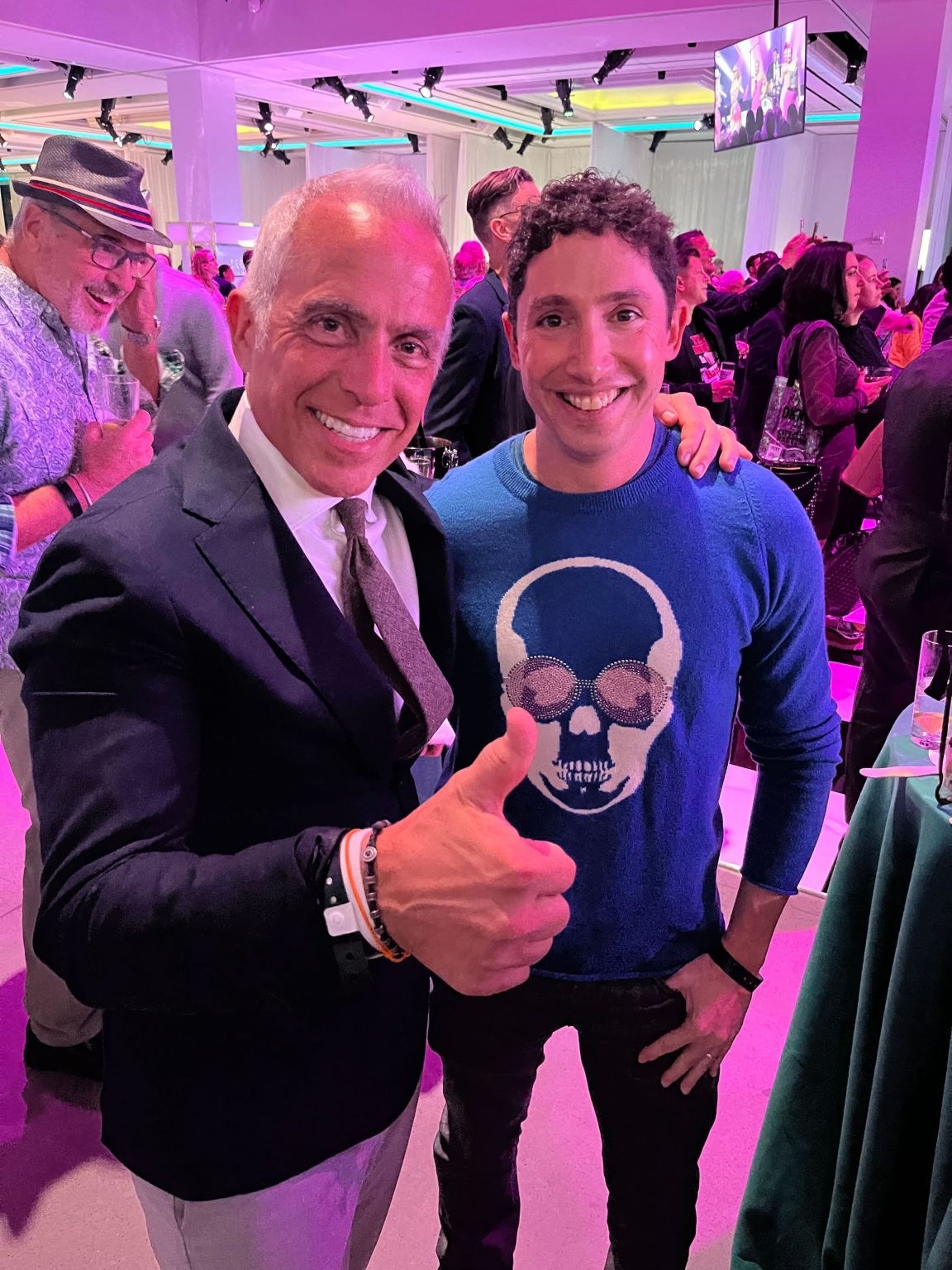
In his account, Brandenberg’s refusal to accept an obstacle arrived as a short declaration: “No” is never an answer. The photograph supplies a less corporate detail: Zakarian in a suit, Brandenberg in a blue sweater bearing a skull. Even an infrastructure discussion may occasionally dress for dinner.
The next customer may arrive with an agent
In January 2026, DRINKS announced a partnership with Commerce7 intended to open its supplier network to hundreds of winery brands. The announcement described an upcoming integration, with availability planned to begin in the first half of the year. Wineries would retain control over pricing, availability and fulfillment while reaching participating digital merchants.
DRINKS also commissioned consumer research to test that commercial premise. Its January 2026 national survey of 550 respondents found that 65 percent would buy alcohol from their favorite online retailers. It is a measure of stated willingness, rather than completed purchases, and comes from a company with a stake in the answer. Even with those qualifications, the question captures the business Brandenberg wants to build around an existing shopping habit.
The proposition continues the pattern visible in his earlier work: connect businesses with customers through shared infrastructure. His more recent writing asks how that connection might change again. In a May 2026 opinion article, he considered shopping agents that evaluate product information and purchasing conditions on a consumer’s behalf.
His argument gave accurate product data, fulfillment reliability and the experience after purchase greater importance. These were predictions about an emerging shopping environment, rather than a declaration that consumers had already surrendered their choices. Still, the question suited his professional history. An advertising founder who studied how to attract a person’s attention was now considering how a machine might select the product.
Brandenberg’s career has moved through changing merchandise, channels and company structures. The durable interest is practical: how a customer reaches something worth buying, and what has to work for the transaction to follow. The playing cards belonged to their moment. The bottle has its own romance. He keeps returning to the less romantic business of getting an order through.