Dispatch
HAIFA → NEW JERSEY → CHICAGO → WASHINGTON Founded National Affairs in 2009 and still edits every issue Author of seven books on political theory $250,000 Bradley Prize winner Reads the news through Edmund Burke "The Constitution is more like the solution than the problem" HAIFA → NEW JERSEY → CHICAGO → WASHINGTON Founded National Affairs in 2009 and still edits every issue Author of seven books on political theory $250,000 Bradley Prize winner Reads the news through Edmund Burke "The Constitution is more like the solution than the problem"
Person / Theory & Letters

Yuval Levin

He keeps an 18th-century pamphleteer on speed dial and runs a journal called National Affairs without a trace of irony.

Born Haifa, 1977 AEI, Washington DC Editor, National Affairs
Yuval Levin
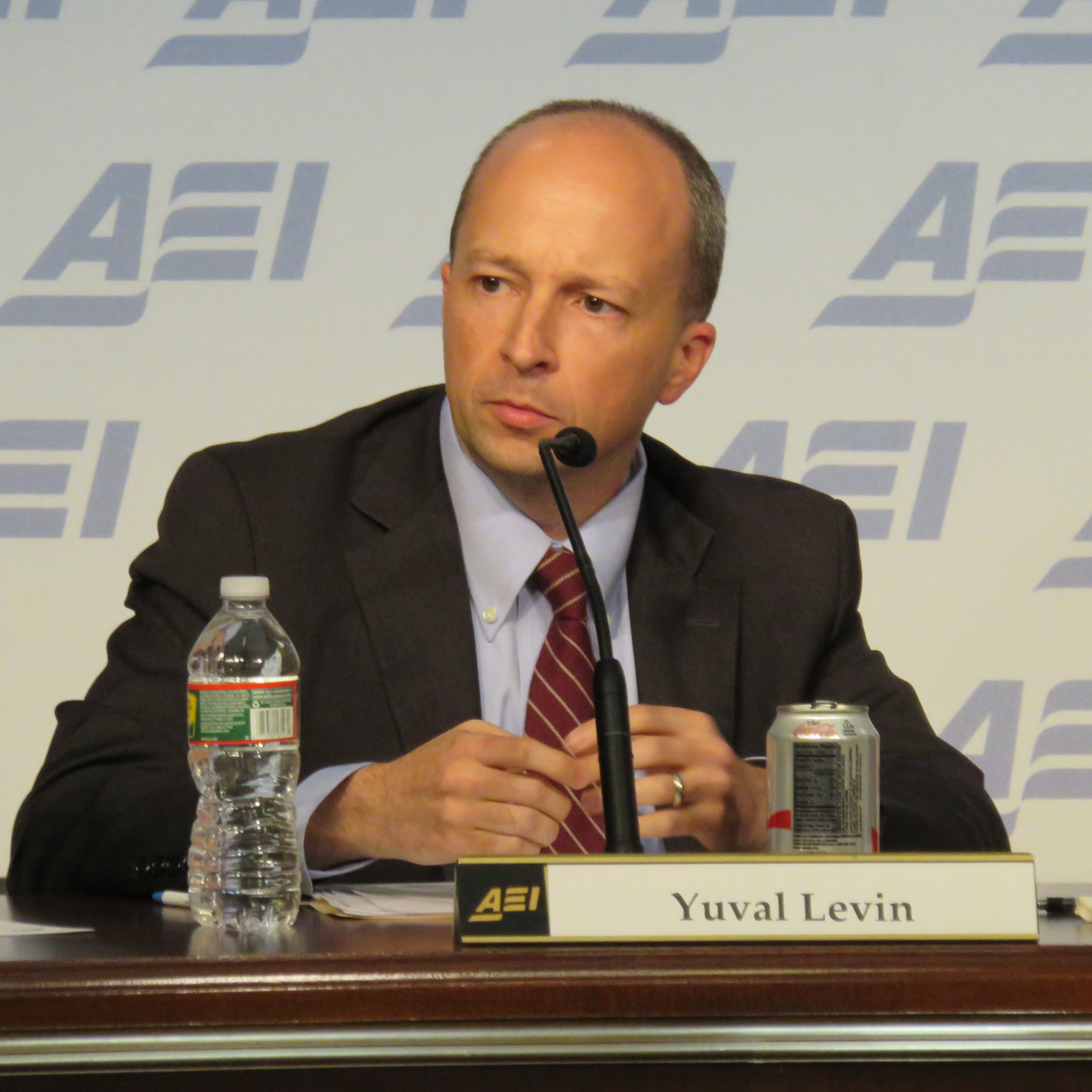
Levin, mid-argument and faintly amused. He spends his days insisting that the people who can't stand each other were the whole point of the design.
The File

The Burkean in the Beltway

On any given week Yuval Levin is doing three jobs that most people would consider a full career on their own. He runs Social, Cultural, and Constitutional Studies at the American Enterprise Institute. He edits National Affairs, the quarterly that Washington policy people actually read cover to cover. And he files columns for The New York Times, the same op-ed page he shares with the writers he most enjoys disagreeing with.

"The American Constitution is much more like the solution than the problem."
- Yuval Levin, on a document most people blame
By the Numbers
1977
Born in Haifa
7
Books written
2009
Founded National Affairs
$250K
Bradley Prize
The Long Story

Eight years old, off the plane, and into the founding

He arrived from Haifa at age eight, an Israeli kid dropped into the United States with a family and not much else. He ended up at Hillsborough High School in central New Jersey, where he became a founding member of the debate club. It is a tidy little detail that explains a great deal. A boy who builds the argument club from scratch tends to grow into an adult who builds journals, institutes, and book-length disputes between dead philosophers.

The intellectual turn came at the University of Chicago, in the Committee on Social Thought, the famously demanding interdisciplinary program that has a habit of producing public intellectuals rather than narrow specialists. He took a master's and a PhD there after an undergraduate degree in political science at American University. The Committee's house style runs all the way through his work: start with the big books, the Aristotle and the Burke, and only then turn to the budget footnotes.

Before he was known mainly as a constitutional thinker, Levin spent the 2000s inside the machinery of government. He worked as a congressional staffer at the member, committee, and leadership levels. He ran the President's Council on Bioethics as executive director, a job that put him at the table for the stem-cell and cloning fights of the era. Then he served as a special assistant to President George W. Bush on the domestic policy staff. He has seen how the sausage is made, which is partly why he writes about institutions with the patience of someone who knows they are slow on purpose.

In 2009 he did the thing that made his name. He founded National Affairs, a quarterly journal of essays on domestic policy, political economy, and the deeper questions underneath them. The bet was unfashionable: that serious people still wanted long, careful arguments, and that a magazine could be both rigorous and readable. It worked. Jonathan Chait, no ally, called Levin "probably the most influential conservative intellectual of the Obama era." Ross Douthat tagged him as the leader of the "reform conservative" movement, the loose group of writers trying to aim conservative policy at the actual worries of middle-class families rather than at slogans.

His books trace a single, stubborn preoccupation: the institutions and ideas that hold a free society together. The Great Debate (2014) stages an extended argument between Edmund Burke and Thomas Paine and shows how those two 18th-century pamphleteers quietly drew the map of the modern left and right. The Fractured Republic (2016) diagnoses an America stuck in nostalgia, fighting over a 1960s that is not coming back. A Time to Build (2020) makes the case that the country's crisis is really a crisis of institutions, and that the fix is to treat them as formative places rather than stages for personal branding.

Then came American Covenant in 2024, his most ambitious argument yet. The thesis cuts hard against the mood of the moment. Where most people look at a polarized country and blame the Constitution, Levin says the Constitution was built for exactly this. It was designed, he argues, to let a divided society disagree out loud and still govern itself, to "compel disparate factions to work together." A contract, he says, is transactional; a covenant describes a relationship. He would rather Americans negotiate than win, and he thinks the founders felt the same way.

That is the through-line from the bioethics council to the op-ed page. Levin believes politics is downstream of political philosophy, "much better understood when it's understood in light of political philosophy." He is temperamentally a Burkean, suspicious of the clean sweep, partial to reform over revolution, convinced that the spaces between the individual and the state are where a society actually lives. He is also, against the odds and against the headlines, hopeful, which in current Washington counts as the most contrarian position of all.
The Paper Trail

A career in arguments

1995
Graduates Hillsborough High School, NJ - founding member of the debate club.
1999
BA in political science, American University.
1995-2001
Congressional staffer at member, committee, and leadership levels.
2001-04
Executive Director, President's Council on Bioethics.
2003
Co-founds The New Atlantis; remains a senior editor.
2004-07
Special Assistant to the President for Domestic Policy, Bush White House.
2007-19
Vice President and Hertog Fellow, Ethics and Public Policy Center.
2009
Founds National Affairs and begins editing it.
2019
Joins AEI to direct Social, Cultural, and Constitutional Studies; Beth and Ravenel Curry Chair.
2022
Becomes a contributing opinion writer at The New York Times.
2024
Publishes American Covenant (Basic Books).
The Shelf

Three books, one obsession

2014

The Great Debate

Burke versus Paine, replayed in full. Levin lets two pamphleteers argue out the French Revolution and accidentally draws the modern left and right.

2016 / 2020

The Fractured Republic & A Time to Build

A diagnosis of a nation stuck in nostalgia, then a prescription: stop performing on our institutions and let them form us instead.

2024

American Covenant

The Constitution as a covenant, not a contract - a machine built to make people who can't stand each other govern together anyway.

2001 Tyranny of Reason
2008 Imagining the Future
2012 A Time for Governing
2014 The Great Debate
2016 The Fractured Republic
2020 A Time to Build
2024 American Covenant
"The Constitution is more than a contract. It is a covenant."
- American Covenant, 2024
In His Own Words

Quotable

"I think politics really is rooted in political philosophy, and is much better understood when it's understood in light of political philosophy."
"Conservatism understands society not as just individuals and government, but thinks of it in terms of everything that happens in between."
"The American Constitution is much more like the solution than the problem, because it was intended to help a divided society hold together."
On Camera

American Covenant, in conversation

Levin lays out his five propositions for reading the Constitution, in conversation with Ramesh Ponnuru at AEI.

Margins & Marginalia

Things you wouldn't guess

Origin story

He was born in Haifa and came to America at eight. The kid who arrived not speaking the language grew up to be a leading interpreter of the American founding.

First, he debated

He didn't join the debate club at his New Jersey high school. He helped start it. The career in argument was, in a sense, self-assembled.

Plot twist

Before the constitutional theory, he ran the President's Council on Bioethics - cloning, stem cells, the hard cases. Range is the point.

The training ground

His doctorate is from Chicago's Committee on Social Thought, the program built to manufacture public intellectuals rather than narrow specialists.