The Argument Is the Point
In November 2024, Jonathan Chait closed thirteen years at New York magazine's Intelligencer and walked into The Atlantic as a staff writer. The byline did not change. Neither did the method: take a position, defend it past the point most people would quietly let it drop, and treat the comment section as a sparring partner rather than a hazard.
What separates Chait from the rest of the opinion column trade is the direction he aims. Plenty of liberal writers spend their days swinging at the right. Chait does that too, with the practiced ease of someone who literally wrote a book about conservative economics. But he saves a special energy for his own side. When he decides that an argument coming from the left is sloppy, illiberal, or simply wrong, he says so, at length, knowing exactly who he is going to annoy.
Political correctness is a system of left-wing ideological repression.
- Jonathan Chait, New York Magazine, 2015
That 2015 essay landed like a thrown drink. He spent the better part of a long piece arguing that a certain strain of campus and online progressivism had stopped debating ideas and started policing them. The left told him he was punching down. The right gleefully shared it as proof. Chait, characteristically, kept writing about it.
From Ann Arbor to the masthead
The instinct showed up early. At the University of Michigan, where he graduated in 1994, he wrote a column for The Michigan Daily and learned the basic physics of the form: a deadline, an opinion, and the people who will be irritated by it. He carried all three to Washington.
He started at The American Prospect as an assistant editor, then joined The New Republic in 1995, the magazine that would shape his voice for the next decade and a half. In 2007 he inherited TRB from Peter Beinart, one of the oldest and most prestigious bylines in American magazine journalism. Writing TRB is not a job you get; it is a job you are handed, like a relay baton, with the expectation that you do not drop it.
The liberal hawk and the bad takes
Chait calls himself a liberal hawk, and he came by the label honestly. He supported the 2003 invasion of Iraq, a position he later revisited as the war curdled. He is unusual among pundits in that he keeps a running, public account of his own worst predictions. The most famous: his 2016 suggestion that a Trump presidency might look something like Arnold Schwarzenegger's turn as governor of California. He has since described it as one of the worst takes of the 2010s, and he is the one who described it that way.
Marxist governments trample on individual rights because Marxist theory does not care about individual rights. Marxism is a theory of class justice.
- Jonathan Chait
That willingness to grade his own homework in public is rare in a business built on never admitting you were wrong. It is also, in its way, the most consistent thing about him. The Iraq reconsideration, the Schwarzenegger mea culpa, the endless tussles over identity politics - they all run on the same engine: an argument is something you test in the open, not something you protect.
The book that named the con
Before the identity-politics wars, there was the economics fight. The Big Con, published in 2007, was Chait's attempt to explain how supply-side theory - the idea that tax cuts pay for themselves - went from a fringe notion to Republican gospel despite decades of evidence pushing the other way. The book's argument was less about left versus right than about how a bad idea survives contact with reality when enough powerful people need it to be true. It is the same suspicion that animates his columns: orthodoxies, he keeps suggesting, are usually load-bearing for someone.
A decade later he flipped the lens with Audacity. Where The Big Con was a prosecution, Audacity was a defense - of Barack Obama, against both the conservatives who called his presidency a failure and the progressives who called it a disappointment. Chait's wager was that the achievements would compound over time and the critics would look small. Whether that bet pays off is still being settled, which is exactly the kind of unresolved argument he likes.
The disclosure question
His independence has its complications. Chait's wife, Robin, has worked as a charter school advocate and analyst, and when he wrote critically about figures like Elizabeth Warren on education policy, critics noted that the connection was not always disclosed up front. It is the kind of entanglement that comes with covering politics for thirty years from inside Washington's professional class, and it is the sort of thing his sharper readers do not let him forget.
What he is doing now
At The Atlantic, Chait covers domestic politics and policy, the beat he has worked his whole career. He writes about the second Trump era as, in his framing, a threat to democratic norms, while still finding room to needle the left over tactics he thinks backfire. He has also written periodically for the Los Angeles Times. Online, he has migrated much of his audience to Bluesky, where he sits in the top sliver of users by following - the same role he has always played, now on a different platform.
If there is a through-line across thirty years, it is that Chait treats liberalism as something worth defending on the merits rather than the vibes. He would rather win the argument than win the room. Often he does neither, and writes about it the next day anyway.
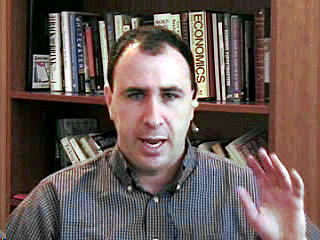 The face of a man drafting a rebuttal in his head.