BREAKING: National Review's editor still files columns for the Washington Post Finished high school at 16 Princeton, summa cum laude, 1995 The only husband-wife pair on the 2015 Politico 50 Reform conservatism's house intellectual BREAKING: National Review's editor still files columns for the Washington Post Finished high school at 16 Princeton, summa cum laude, 1995 The only husband-wife pair on the 2015 Politico 50 Reform conservatism's house intellectual
Ramesh Ponnuru
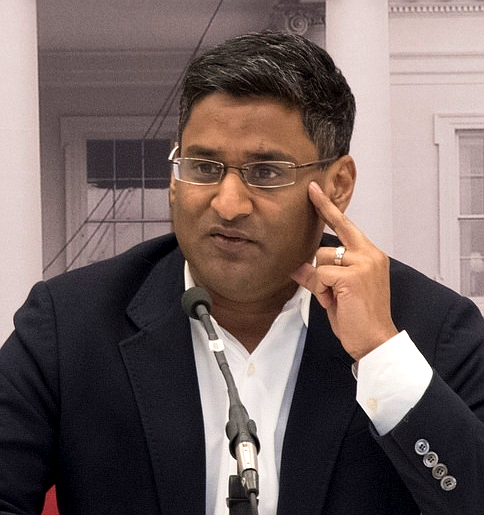
Ponnuru at the U.S. embassy in Vienna, 2016 - mid-argument, as usual.
The YesPress Profile

Ramesh
Ponnuru

He walked into National Review as an intern. Now he runs the magazine - and still finds time to argue about the child tax credit before lunch.

Editor, National Review Columnist, Washington Post Senior Fellow, AEI

The editor with two newsrooms and a standing invitation to disagree.

Ramesh Ponnuru runs National Review, the magazine William F. Buckley Jr. built. That is the job that fits on a business card. The fuller truth is stranger: the same week he closes an issue of the flagship conservative magazine, he files a column for the Washington Post, drafts a paper at the American Enterprise Institute, and very possibly co-writes something about monetary policy with an economist for the fun of it.

Most pundits pick a lane. Ponnuru collects them. He has spent more than two decades on a single beat - American politics and public policy - and somehow keeps finding new fights inside it. He is the editor who took the helm of National Review in 2022 after a quarter-century covering national politics there, having joined as an intern who simply never left.

What he argues for has a name: reform conservatism. The shorthand is a conservatism that takes policy seriously - expanding the child tax credit, rethinking how the Federal Reserve sets monetary policy, building an agenda for middle-class families rather than just cutting ribbons. When Sam Tanenhaus put the movement on the cover of the New York Times Magazine in 2014, Ponnuru was one of the faces of it.

He turned an internship into an institution - and then turned that institution into an argument worth having.

He is, by reputation, the rare commentator other commentators read closely before they pick a side. David Brooks called the policy book Ponnuru co-edited "the most coherent and compelling policy agenda the American right has produced this century." That is high praise for a writer whose first published book was about Japanese industrial policy.

The throughline across all of it is a refusal to coast on applause lines. Where a lot of opinion writing reaches for the loudest available verdict, Ponnuru reaches for the next question. He has covered national politics and public policy at National Review for the better part of three decades, and the body of work reads less like a career of takes than a single, long-running argument with itself - revised, footnoted, and never quite finished.
16Age finishing high school
25+Years on the politics beat
3Books authored or edited
2015Year he and April made Politico 50
The Strange Specific

A 107-page thesis on 19th-century abortion law, and a kid in a hurry.

He grew up in Prairie Village, Kansas, a suburb on the Missouri line, the son of a Hindu father of Telugu descent and a Lutheran mother. He moved fast: Shawnee Mission East High School done by 16, Princeton next, a history degree finished summa cum laude by 21.

The senior thesis tells you where his mind already lived. Titled "Abortion in Nineteenth-Century America, in Brief," it ran 107 pages and was supervised by the legal philosopher Robert P. George. The undergraduate who wrote it would later turn that interest into a full book.

Raised between two faiths, he arrived at a third on his own terms - converting to Catholicism after a stretch of agnosticism. It is the kind of detail that explains the seriousness he brings to the questions other columnists treat as talking points.

'95Graduates Princeton summa cum laude; joins National Review.
'99Named a senior editor at National Review.
'06Publishes "The Party of Death."
'12Becomes a senior fellow at the American Enterprise Institute.
'14Co-edits "Room to Grow"; reform conservatism hits the NYT Magazine cover.
'15He and April Ponnuru land on the Politico 50 together.
'22Becomes editor of National Review magazine.
The Idea He's Known For

Reform conservatism, explained in one editor.

For a stretch in the 2010s, a small group of writers tried to drag the American right toward concrete domestic policy - tax credits for families, healthcare ideas, an agenda aimed squarely at the middle class rather than at donors. Journalists called them "reform conservatives." Ponnuru was among the names always mentioned.

In 2014 the New York Times Magazine put the movement on its cover, and Sam Tanenhaus singled Ponnuru out as one of its intellectual leads. The same year, the manifesto landed: "Room to Grow," which he co-edited with Yuval Levin, gathering policy proposals into a single agenda. It is the book David Brooks would not stop praising.

The specific causes have stayed remarkably stable. Expanding the child tax credit. Pushing the Federal Reserve toward what economists call market monetarism. These are not the issues that trend on cable - which may be exactly why he keeps returning to them.

The Reform Agenda, In Brief

Three recurring fights

Family policy. A bigger child tax credit, aimed at parents and the middle class.

Monetary policy. Rethinking how the Fed sets policy, co-argued with economist David Beckworth.

Constitutional conservatism. Taking the founding documents - and the right-to-life debate - seriously rather than rhetorically.

On The Shelf

Three books, one through-line: ideas treated as if they mattered.

2006

The Party of Death

His most provocative book, arguing that the Democratic Party shifted over time from skepticism toward abortion to a firm pro-abortion-rights stance. Full title: "The Democrats, the Media, the Courts, and the Disregard for Human Life."

2014

Room to Grow

Co-edited with Yuval Levin, this was the reform conservative movement's manifesto - a policy agenda for a limited government and a thriving middle class. The book David Brooks couldn't stop praising.

1995

The Mystery of Japanese Growth

An early study of Japanese industrial policy, co-published by AEI and the Center for Policy Studies - proof he was writing serious economics before most people his age had a byline.

The Quirks & The Range

A man hard to put in a single box.

The Day Job, Plural

Two mastheads at once

Editing a conservative magazine while writing a column for the Washington Post is the kind of double life most journalists would find contradictory. He treats it as ordinary.

The Side Project

Monetary policy, for fun

He co-writes about the Federal Reserve and market monetarism with economist David Beckworth - a beat most pundits run screaming from.

The Range

Newsroom to seminar room

Meet the Press, PBS NewsHour, The Daily Show, The Colbert Report - and a fellowship at the University of Chicago's Institute of Politics in 2013.

The Power Couple

Two on the list

In 2015 he and his wife April became the first - and only - married couple to appear on the Politico 50 at the same time.

The Press He Keeps

A byline that travels.

Plenty of writers settle into one publication and stay there. Ponnuru's name has run almost everywhere serious political writing appears - the New York Times, the Wall Street Journal, the Financial Times, First Things, and beyond, alongside his home bases at National Review and the Washington Post. He is also a contributing editor to National Affairs, the quarterly that has become a kind of clubhouse for policy-minded conservatives.

Then there is the screen. He has turned up on Meet the Press, Face the Nation, and PBS NewsHour - and, in a twist that says something about his sense of humor, on The Daily Show and The Colbert Report. A conservative intellectual willing to sit across from a comedian is a particular kind of confident.

He also takes the argument on the road, speaking at colleges and law schools about politics, policy, and the Constitution. The classroom suits him. He was, after all, the teenager who finished a 107-page thesis before he could legally drink.

Seen & Read In

A partial roll call

Print: National Review, Washington Post, New York Times, Wall Street Journal, Financial Times, First Things, National Affairs.

Screen: Meet the Press, Face the Nation, PBS NewsHour, The Daily Show, The Colbert Report.

What he's after

The aim has been consistent for years: a conservatism built on serious policy rather than slogans. Expand the child tax credit. Reform how the Fed thinks. Keep National Review intellectually honest in a turbulent era. Ponnuru is playing a long game measured in arguments, not news cycles.

The Bylines & Feeds

Where to read and follow him.

X / Twitter National Review Washington Post AEI Profile Wikipedia

Spread the word

in  LinkedIn X  Post f  Facebook Instagram