The conservative columnist liberals keep reading anyway. A Catholic convert who told a comfortable civilization it had quietly stopped trying, then sat down to interview everyone who disagreed.
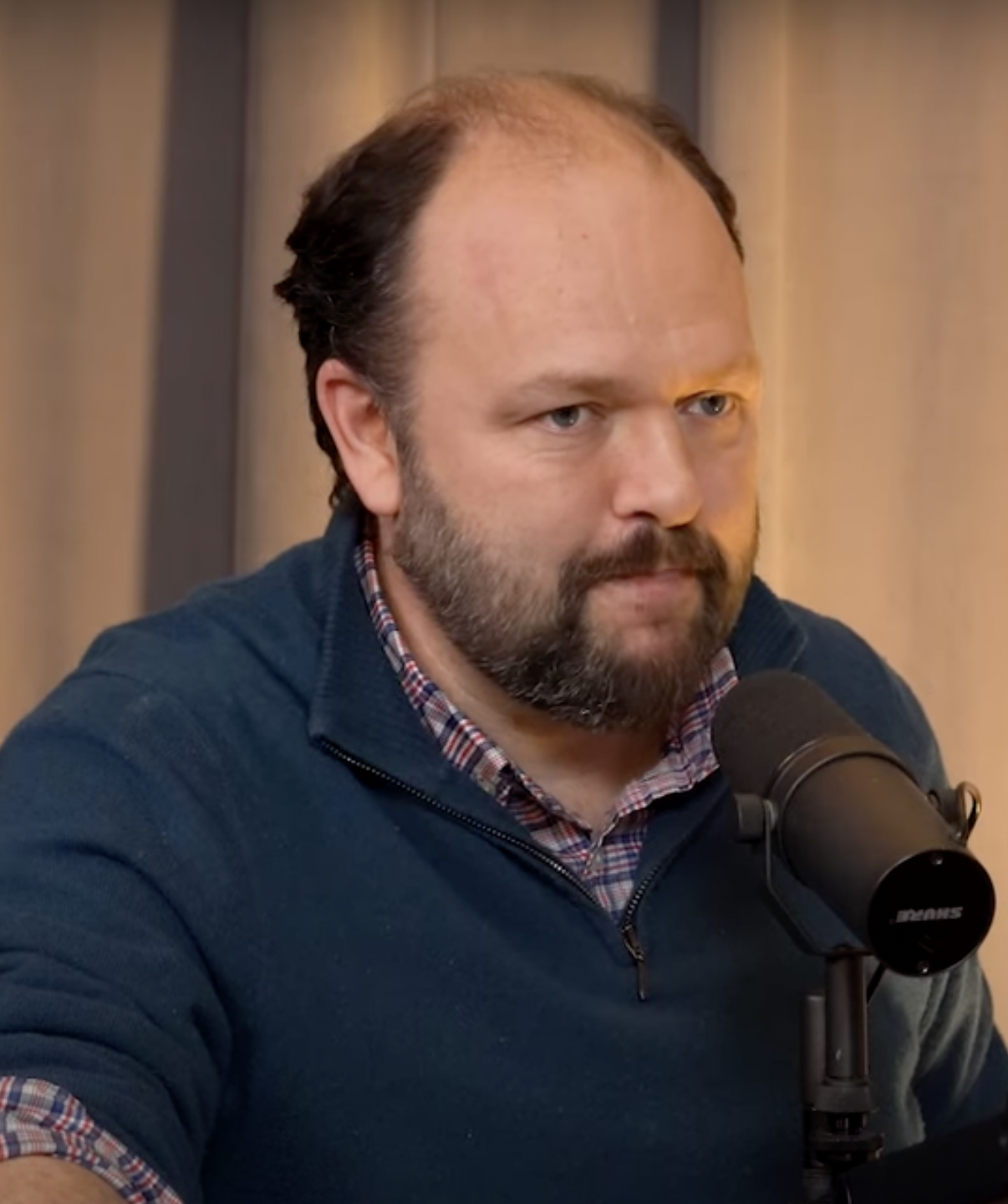
In April 2025, the New York Times handed Ross Douthat a microphone and a mandate: map the New Right and the new world order, week by week, on a podcast called Interesting Times. The guest list reads like a seating chart designed to start fights. Steve Bannon. Hasan Piker. Firebrands from corners of the internet that do not usually share an oxygen supply. Douthat treats each of them as worth a real, unhurried argument, which is precisely why the show became one of the rare places where embattled liberals go to hear what the other side actually thinks.
That is the trick he has been refining for two decades. He is a conservative on the op-ed page of the most liberal-coded newspaper in America, and rather than play the role of token provocateur, he writes like someone genuinely trying to figure things out in public. Readers who agree with almost nothing he believes still clear their Thursday mornings for him.
His current preoccupation is belief itself. In early 2025 he published Believe: Why Everyone Should Be Religious, a brisk argument that the secular consensus has gotten the cost-benefit math wrong. It is a provocation aimed squarely at the intelligentsia that signs his paychecks, delivered with the calm of a man who has been losing this argument politely for years and intends to keep at it.
To understand why he is so hard to file away, you have to go back to a teenager in New Haven who joined a Pentecostal church on his own, then brought his whole family with him into Catholicism. Conversion, for Douthat, was never a fashion statement. It was a habit of mind, the willingness to be persuaded all the way and then act on it.
In February 2020 he published The Decadent Society, arguing that the rich world had grown repetitive, sterile, and stuck - all the frontiers closed, all the paths leading only to more of the same. Weeks later, the planet locked its doors. The timing was accidental. The diagnosis was not.
Douthat's decadence is not the cliche of champagne and excess. It is stagnation dressed as stability: institutions that no longer build, a culture endlessly remixing its own back catalog, a politics that performs intensity while changing nothing. He borrowed the frame from the critic Jacques Barzun and aimed it at Silicon Valley, Hollywood, Washington, and the Vatican alike.
What saves the book from despair is its last move. Decadence, he suggests, tends not to last forever. Something eventually cracks the comfortable surface. And in his telling that something might be a renewed reach for the transcendent. As he put it, it shouldn't surprise anyone if decadence ends with people looking heavenward, toward God, toward the stars, or both.
Graduates magna cum laude and Phi Beta Kappa, then lands at The Atlantic, where he rises to senior editor and writes his first book before turning 26.
Starts reviewing movies for National Review, a side gig he has kept ever since. The political brain takes regular trips to the multiplex.
At 29 he replaces Bill Kristol on the New York Times op-ed page, becoming the paper's youngest regular columnist and one of its most-read conservatives.
Delivers the 28th Erasmus Lecture, "A Crisis of Conservative Catholicism," cementing his role as a leading voice in the church's internal debates.
Publishes his sweeping diagnosis of cultural stagnation just before the pandemic rewrites everyone's expectations.
Releases Believe: Why Everyone Should Be Religious and launches the Times Opinion podcast Interesting Times, with new episodes every Thursday.
A direct argument that faith makes more sense of the world than the secular default - aimed at the very intelligentsia that surrounds him.
A memoir of discovery written with the same probing honesty he brings to his columns.
His signature thesis: prosperity without progress, motion without movement. The book that gave the 2020s a vocabulary.
A sharp account of Pope Francis and the fault lines running through modern Catholicism.
How America traded traditional Christianity for a buffet of self-flattering pseudo-faiths.
Co-written with Reihan Salam, a roadmap for a working-class conservatism that David Brooks called the best single one going.
The Harvard salutatorian turns on his own alma mater, dissecting how elite schools manufacture the people who run the country.
He writes like a man who might lose, which is rarer than it sounds on an opinion page. The uncertainty is the point.
On Interesting Times he hosts the New Right and the populist left without flinching, treating opponents as people with reasons.
He can move from original sin to a summer blockbuster in one column. The film critic and the apologist are the same person.
He thinks the modern world is stuck, then keeps looking for the crack that lets the light in. Gloom with an exit.
Faith is not a brand for him but a conclusion he reached and refuses to soften for the audience.
Politics, religion, demographics, movies, the future of the species - he refuses to stay in one lane.
"The result is a society where pride becomes 'healthy self-esteem,' vanity becomes 'self-improvement,' adultery becomes 'following your heart.'"
Bad Religion"What I'm looking for when I gamble on a world-picture is something that makes sense of the four major features of existence that give rise to religious questions."
On belief, 2017His great-grandfather was the poet Charles Wilbert Snow, who also happened to be a Governor of Connecticut.
Mother a writer, father a lawyer who writes poetry. The sentences started early.
He has reviewed films for National Review since 2007, a quiet rebellion against being only a political pundit.
Graduated second in his high school class, then collected Phi Beta Kappa at Harvard. The credentials he later critiqued.
Replacing Bill Kristol in 2009 was not a comfortable inheritance. The conservative slot at the New York Times comes with a built-in audience that is ready to be annoyed, and a job description that asks you to be the loyal opposition inside a newsroom that mostly votes the other way. Douthat made the seat his own by refusing the easy version of the role. He did not become a troll, and he did not become a mascot. He became a writer worth reading on his own terms.
Over fifteen years he has used the column to think about the falling birth rate, the drift of the Republican Party, the future of the Catholic Church, the strange new religions of the internet, and whether the United States is sliding into a soft and managed decline. He returns again and again to the same underlying question: what happens to a society that has stopped believing in the future. It is a question that sounds abstract until you notice how much of contemporary politics is a fight over exactly that.
His critics on the right sometimes find him too willing to grant the other side a point. His critics on the left sometimes find him too willing to defend tradition. Both complaints describe the same quality. He is a writer who would rather be interesting and occasionally wrong than predictable and safely correct. That is the bargain he offers readers, and a remarkable number of them have taken it.
The launch of Interesting Times in 2025 extended the bargain into audio. Where the column is a finished thought, the podcast is the thinking out loud - long interviews that let a guest make the strongest version of their case before Douthat probes for the weak joint. In an information ecosystem built to confirm what you already believe, a show whose entire premise is sustained contact with disagreement is its own quiet argument.
Douthat does not write from Manhattan. He lives in New Haven, Connecticut, the city where he grew up, raising five children with his wife Abigail Tucker, herself a writer and former reporter for The Baltimore Sun. The household has a literary inheritance that runs back generations, from a poet great-grandfather who served as governor to parents who wrote for a living. The expectation in that kind of family is not that you will have opinions, but that you will be able to defend them in a sentence.
The contrarianism arrived early and sincerely. As a teenager he found his way into a Pentecostal church, an unusual move for a New England adolescent, before leading his family toward Catholicism. His intellectual companions became C.S. Lewis, G.K. Chesterton, and J.R.R. Tolkien, writers who treated faith as a serious account of how the world works rather than a private comfort. You can hear all three of them in the way he argues now: the logician, the wit, and the myth-maker, taking turns at the keyboard.
Douthat's project is unfashionable and he knows it: to argue, in the pages of secular institutions, that religious belief is not a relic but a better account of reality. Interesting Times is the laboratory, Believe is the manifesto, and the column is the running commentary.
If the decadent age really does end with people looking heavenward, he intends to have been one of the first to say so out loud - calmly, in print, every week, to a readership that mostly came to disagree.