The Story
Ask most brewers what is in the tank and you will hear about hops and malt. Ask Youngwon Lee and the answer might be kimchi, yuzu, bamboo tea, or Szechuan peppercorn. His brewery is called Dokkaebier, and the name is a pun you can drink: a dokkaebi is a mischievous, shape-shifting goblin from Korean folklore, and bier is how the Germans spell beer. Korean spirit, German craft, Oakland zip code. The whole company fits inside that one word.
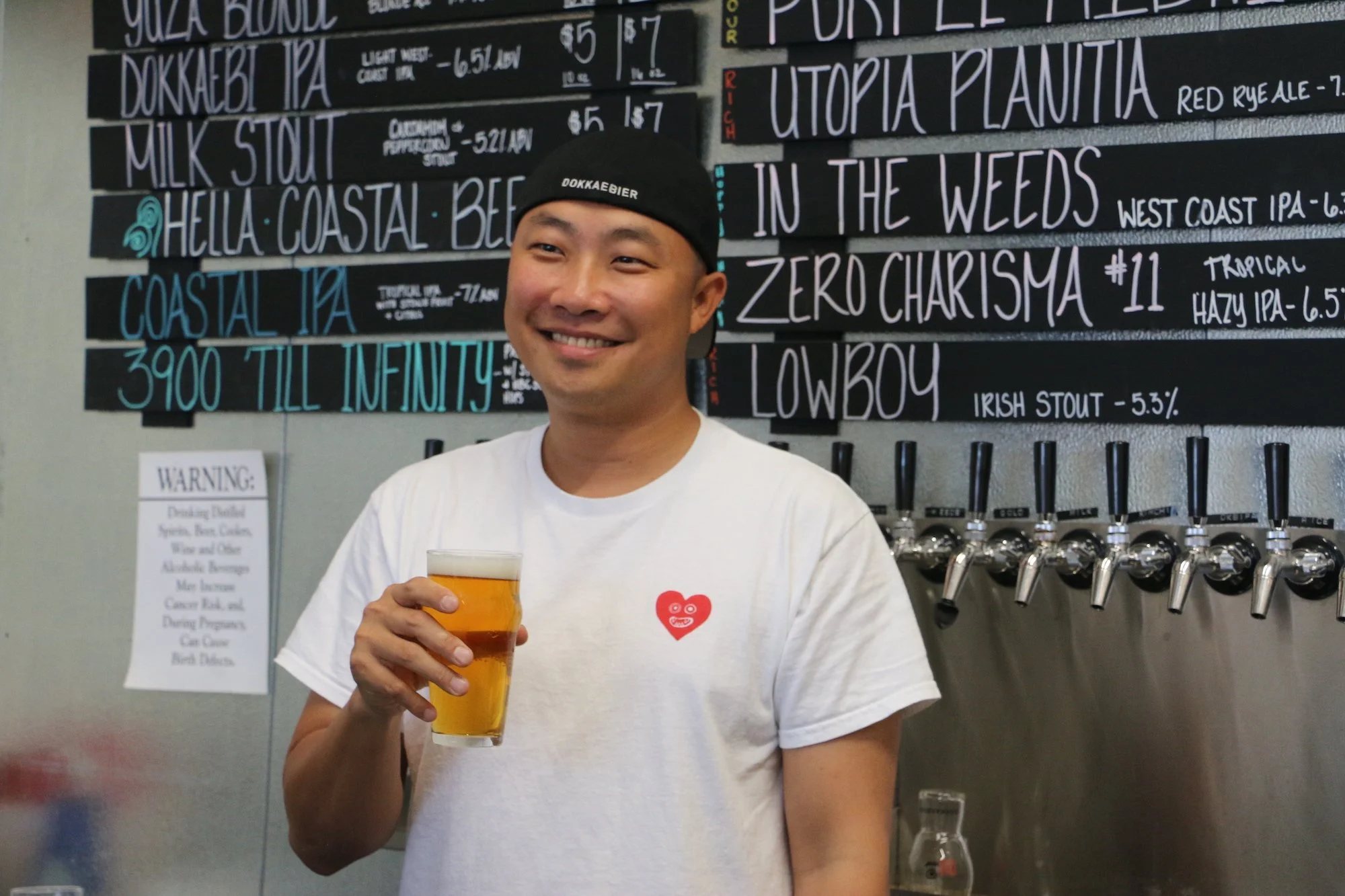
Lee runs Dokkaebier today out of a taproom at 420 3rd Street, a short walk from Jack London Square. The beers are unfiltered, unpasteurized, and unapologetically Asian in flavor. A kimchi sour. A yuzu blonde. A milk stout that, in 2022, was named Beer of the Year. The taproom is loud and warm, the kind of room where the founder might be filming a mukbang video with his staff one minute and pouring for a curious first-timer the next.
Start there, because that is where Lee is now: a working brewer-operator with 40-plus original recipes behind him, shelves in Whole Foods, H Mart, BevMo! and Total Wine, and a habit of putting Asian ingredients into a glass that, for a century, mostly avoided them.
"I saw the opportunity to be more Asian with my brand. And now we're living in a century where it's actually cool to be authentic to who we are."
The 2% problem
The origin of Dokkaebier is not a recipe. It is a statistic. Lee noticed that at beer festivals he was often one of only two Asian Americans in the room. He went looking and found that only about 2% of people working in craft beer identify as Asian American. For an industry that prides itself on creativity, that was a strange blind spot - a whole pantry of flavors, and almost nobody at the table reaching for them.
So he built a brand that was, in his words, distinctly Korean and proudly Asian. Not Asian as a garnish. Asian as the premise. The design, the packaging, the ingredients, the name - all of it pulled from the same well. The goblin, it turns out, was the perfect mascot: a creature that loves to eat, drink, and socialize, and that refuses to hold a single shape.
Guam, New Jersey, Berkeley, Seoul
Lee was born in Korea and grew up in motion - Guam, New Jersey, and California, with a stop at UC Berkeley. That restlessness shows up in the resume. In high school he tutored a US-based CEO in Korean, which led to his first restaurant job. In 2008 he founded a wine import and distribution business, building a portfolio that ran from wine to vodka to tequila to champagne. He helped launch and distribute names like Stolichnaya, Patron, Armand de Brignac, Agwa and Bernini, and opened Magnum the Tasting Room and a bottle shop in the Shinsa-dong and Cheongdam-dong neighborhoods of Seoul.
By 2014 he had built a brewery in Korea. There were financial setbacks - the kind that teach more than they cost - before he came back to California and went to work for a Korean-owned brewery startup, learning the trade from the production floor up. The wine importer had become a beer person. The next move was his own label.
Once you find an opportunity, look for ways to bring your unique perspective.
- Youngwon Lee, advice to aspiring founders
Launched into a lockdown
Lee conceptualized Dokkaebier in 2019 and officially launched it in February 2020. The plan was a pop-up taproom in San Francisco with pairings from a Michelin-starred chef. Then the world closed. Weeks after launch, the festivals, the tastings, and the dinners all vanished.
He shape-shifted, which is the only thing a dokkaebi knows how to do. He poured at the few local festivals that survived, stood up online sales, and turned to YouTube - documenting the daily grind of a tiny beer startup when no one could visit in person. The connection that a taproom usually builds in person, he built through a screen. It worked well enough that within roughly three years Dokkaebier crossed $1 million in sales and landed in more than 400 retail locations.
The awards followed the flavors. World Beer Championships medals. Ten Brewski Awards across 2021 and 2022. In one banner stretch, every beer the company entered won something, and the milk stout took Beer of the Year.
Buying the brewery that made his beer
In April 2023 came the move that turned a brand into an institution: Dokkaebier acquired Oakland's Federation Brewing, taking over its taproom and production facility on 3rd Street. For a company that had spent its early life brewing through partners and contract arrangements, owning the bricks and the tanks was a different kind of milestone. The taproom near Jack London Square became home base, pouring Dokkaebier alongside legacy Federation and Hella Coastal beers.
It is a tidy bit of symbolism. The immigrant kid who kept moving finally has an address - and it is the one where the beer gets made.
"Have a clear mission. Be passionate but realistic. Embrace challenges."
What is next
The ambitions are not small. Lee has talked about pushing Dokkaebier into new states and thousands more retail locations, brewing dozens of new recipes, and one day extending the Asian-influenced idea into spirits. The north star is simple to say and hard to do: make Dokkaebier a household name, and keep the door open for the underrepresented people he once counted on one hand at a festival.
He has described the early building of the company as feeling like a role-playing game - leveling up, taking on quests - before it tipped into something he actually loved: making a product that brings people together. The goblin, after all, is a party creature. So is the founder.
Flavor as an argument
It would be easy to file Dokkaebier under novelty. Kimchi in beer reads like a dare before you taste it. But Lee treats the pantry seriously. The ingredients he reaches for - lemongrass, galangal, Szechuan peppercorn, yuzu, bamboo - are not gimmicks borrowed for shock value. They are the flavors he grew up around, deployed for complexity rather than spectacle. The kimchi sour is the one people remember, the gateway drug that turns a skeptic into a regular. The yuzu blonde is the one that proves the first wasn't a fluke.
There is a thesis buried in the lineup. For decades, craft beer chased intensity through hops and barrels. Lee chases it through a different cabinet entirely, the one most American breweries never opened. The argument is not that Asian ingredients are exotic. It is that they were always good enough to belong in a pint, and somebody simply had to put them there.
"Now we're living in a century where it's actually cool to be authentic to who we are."
More than a label
Lee has not kept the mission abstract. He joined the Council of Korean Americans in 2021 and has served as an associate board member of the Korean American Community Foundation of San Francisco, working with Bay Area nonprofits on donation drives and volunteer efforts. The diversity gap that started Dokkaebier is not a marketing line he retired once the beer sold - it is a standing item. He talks openly about creating openings for underrepresented people in brewing, the kind of opportunities that were thin on the ground when he started counting Asian faces at festivals.
That instinct - build the thing, then hold the door - is the throughline. A high schooler tutoring a CEO in Korean. A wine importer learning beer from the floor of someone else's startup. A founder who launched into a pandemic and filmed his way out of it. Each step looks like a detour until you notice they all point the same direction: toward a room where the goblin is welcome, the kimchi sour is on tap, and the people pouring it look a little more like the people drinking it.