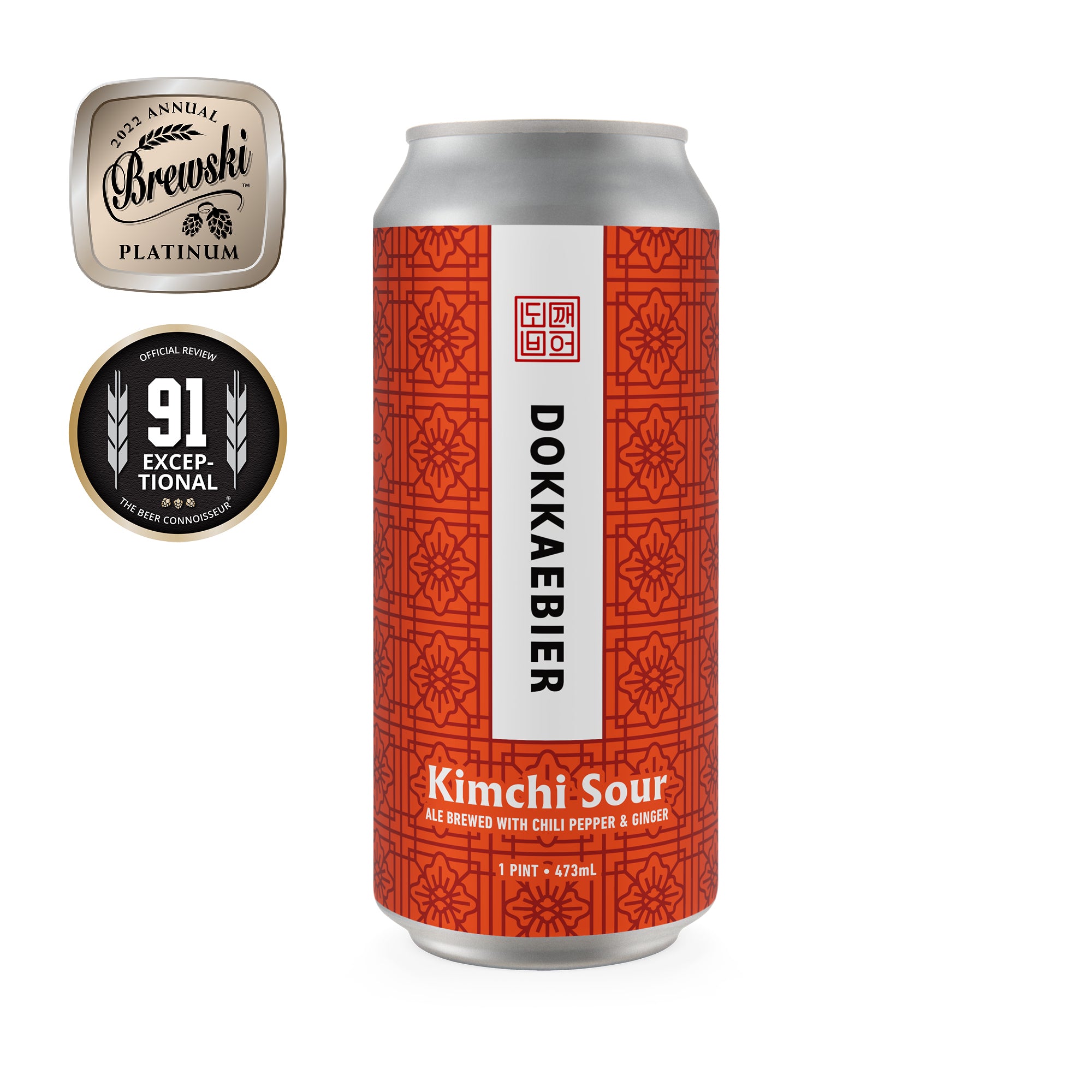
Here is a fact about the craft beer business that took a wine importer named Youngwon Lee about fifteen years and four alcohol startups to fully appreciate: nearly everyone pouring the beer looks the same, and it is usually not him. Lee kept noticing this at festivals - he would be the only Asian person behind a table in a sea of taps - and the observation eventually stopped being an annoyance and became a business plan. That plan is Dokkaebier, an Oakland brewery that brews beer with kimchi.
I want to be careful here, because "brewery that brews with kimchi" is the kind of sentence that gets a company written up once and then filed under novelty. Dokkaebier is more interesting than that, and the reason is that the kimchi is not a gimmick bolted onto an otherwise ordinary beer. It is the entire thesis. Lee's argument, roughly, is that craft beer spent two decades telling everyone to be bold and adventurous, and then defined "bold" almost entirely as "more hops." Dokkaebier reads the instruction literally. Its Kimchi Sour is built on ginger, gochugaru - Korean sun-dried chilies - and live kimchi culture. Its blonde ale is brightened with yuzu. There is a Rice Kolsch, a Bamboo Pilsner, a Lemongrass Wit, a Milk Stout. The lineup reads less like a taproom menu and more like a Korean dinner table, which is exactly the intended effect.
The name is doing work
A dokkaebi is a creature from Korean folklore - mischievous, shape-shifting, fond of eating, drinking, and hanging around people who are doing the same. As mascots for a brewery go, this is close to perfect, and it tells you how Lee wants the whole thing to feel: playful, a little chaotic, culturally specific rather than culturally generic. The company's tagline, "Playful Brews, Unforgettable Taste," is the polite marketing version. The dokkaebi is the honest version.
Lee's own path is its own kind of shape-shifting. Born in Korea, he grew up across Guam, New Jersey, and California, landed at UC Berkeley, and by 2008 was running a wine import and distribution company with a portfolio that ran through wine, vodka, tequila, and champagne. Dokkaebier, by his own count, is his fifth alcohol startup. The previous four taught him the deeply unglamorous mechanics of the business - distribution, margins, how a case actually gets from a warehouse to a bar. The fifth is the one where he decided to stop selling other people's culture and start brewing his own.
There is a second Lee quote that gets closer to the actual motive, and it is less about marketing than about accounting for one's own time. "I could make more of a contribution to the industry," he has said, "than just bringing a product to market." That is a peculiar thing for a serial alcohol entrepreneur to say, and it is worth taking at face value. Lee has framed diversity, equity, and inclusion in craft brewing not as a values page on the website but as the reason the company exists at all. The beer is the vehicle. The point is who gets to make it, sell it, and be seen doing so. He now sits as a member of the Council of Korean Americans, which is the sort of affiliation that signals he means the civic part.
Batch 33, and the case for experimenting in public
One of the quietly smart things about how Dokkaebier operates is its experimental batch program, which by 2023 had run past its thirty-third iteration. New flavors get brewed in small quantities and poured in the taproom before anything is committed to a wider release. This is, in effect, product development done in front of the customer rather than in a lab. A Szechuan-peppercorn something-or-other either lands with the room or it does not, and Lee finds out immediately, at the cost of a single small batch rather than a full production run. For a brand whose entire premise is unusual flavor combinations, this is the difference between "bold" and "reckless." You want the kimchi. You do not necessarily want every idea about the kimchi.
Two hundred miles a day
There is a version of the founding story that skips straight from "idea" to "brand," and it leaves out the part that actually matters. When Dokkaebier launched in February 2020 - a San Francisco pop-up, timing that anyone who lived through that particular spring will wince at - Lee did the distribution himself. He hand-delivered beer around the Bay Area, driving what he describes as two to three hundred miles a day, door to door. This is not a growth hack. It is the opposite of a growth hack. But it is how he learned who his first customers actually were, and it is why the brand had a following before it had a taproom.
The taproom came in April 2023, when Dokkaebier acquired Federation Brewing and took over its space at 420 3rd Street, near Jack London Square. The detail worth pausing on is what Lee did with the room. Rather than treating the space as his alone, he shared it - the taproom poured beer from Dokkaebier, from Federation, and from Hella Coastal, Oakland's first Black-owned brewery. Lee liked to point out that you could stand in one room and drink from the first Korean-owned brewery in Oakland and the first Black-owned brewery in Oakland at the same time. For a business built on the premise that the industry has a representation problem, sharing the taps was not charity. It was the mission, running at retail.
The money
Dokkaebier funded itself the way a culturally specific consumer brand with a devoted-but-small following tends to have to: partly through equity crowdfunding, which is a nice way of saying "the customers became the investors." The 2021 raise on Wefunder carried a $5 million valuation cap, targeted somewhere between $75,000 and $300,000, and reportedly closed north of $700,000 in total seed capital, including a chunk from Glasser Holdings and roughly 148 other backers. A 2023 round lifted the valuation cap to $8 million. Reported total funding sits around $1.59 million, with institutional names like ICA Fund and Sazze Partners appearing alongside the crowd.
Crowdfunding a brewery is a reasonable move when your product's whole appeal is belonging - people who put $200 into Dokkaebier are people who will bring friends to the taproom, which is a customer-acquisition strategy disguised as a cap table. It is also a reminder of the constraint. Craft brewing is capital-hungry and margin-thin, and a brand this distinctive is, almost by definition, not aiming at the mass market. The bet is depth, not breadth.
When the storefront closes
In December 2023, Dokkaebier closed the Oakland taproom - the last day at 420 3rd Street was December 29 - and shifted toward distribution and e-commerce, selling beer online and pushing into new markets. It would be easy to read a shuttered taproom as an ending, and the local coverage understandably framed it that way. But the taproom was never the business. The beer was. A brand that started with one man driving cases around in his car, and that built its earliest audience before it ever had a physical door, is unusually well suited to not needing one. The plan Lee has talked about runs toward more states, wider distribution, and - in the ambitions of strategy director Avery Glasser - eventually Munich, which is a very funny place to try to sell a rice Kolsch and exactly the sort of place a dokkaebi would go.
What you can actually do with it
For a drinker, the practical answer is simple: Dokkaebier is where you go when the fortieth hazy IPA has stopped registering and you want a beer that tastes like a decision. The Yuza Blonde is the gateway - light, citrus-forward, approachable. The Kimchi Sour is the one you order to find out something about yourself. For anyone building a consumer brand, Dokkaebier is a small, clean case study in a single idea: your differentiation can come from the pantry you already grew up with, and authenticity, done without apology, is a more durable moat than another variation on the same recipe. Whether that scales to Munich is an open question. That it is worth drinking is not.
You can find the beer, and the story, at the links below.