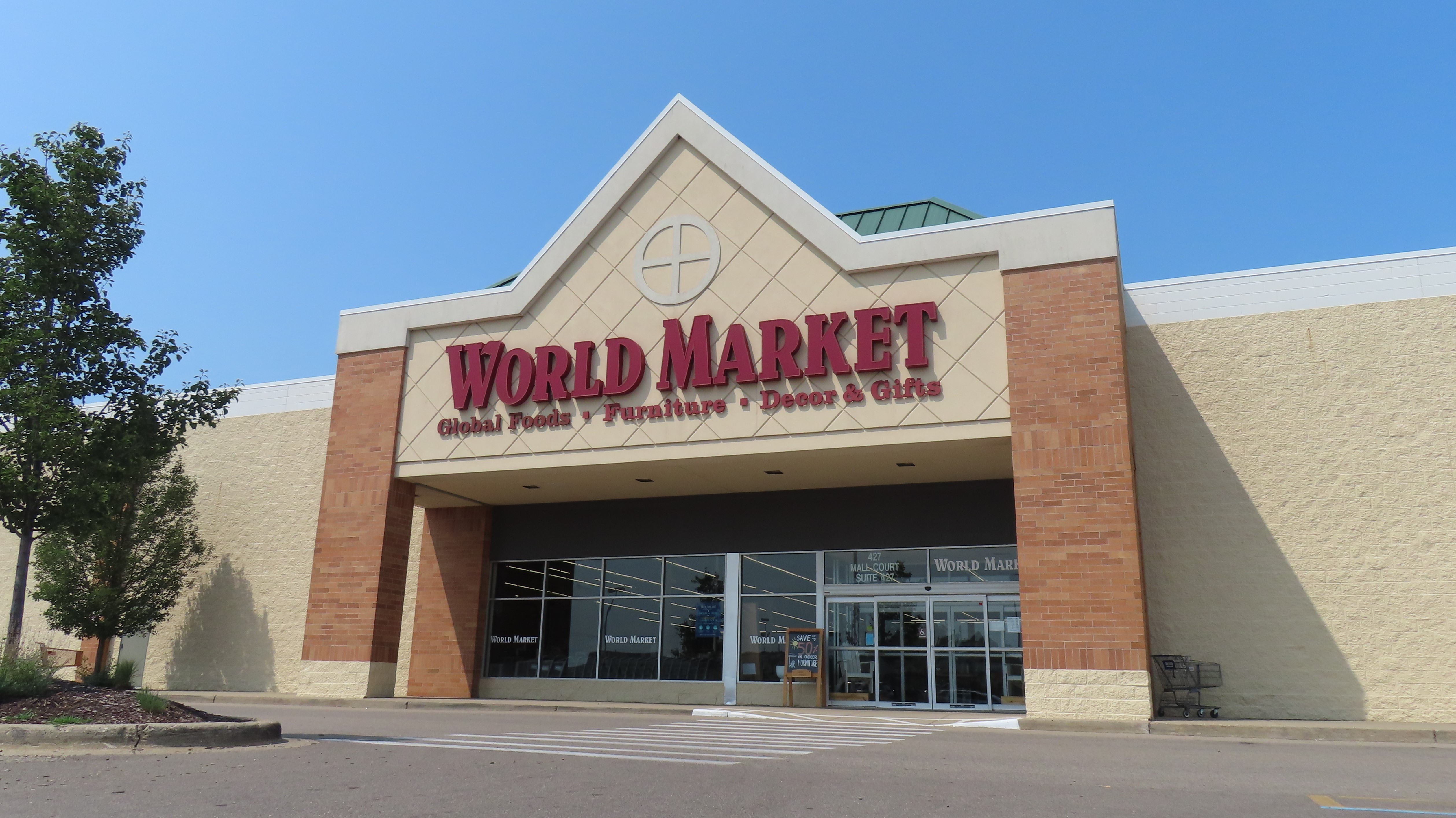
Walk into a World Market on a Saturday and the geography gets confusing in the best way. The front table is stacked with Moroccan-style poufs. Twelve feet later, a wall of imported pasta, German cookies and hot sauce from places you've only seen on maps. Turn the corner and there's a wine aisle, a coffee bar's worth of beans, a rug that looks hand-knotted, and a papasan chair that has been quietly outliving trends since the Eisenhower administration. It is a department store organized not by department, but by wanderlust.
This is World Market in 2026: roughly 240 stores across 39 states, a busy e-commerce operation at worldmarket.com, somewhere north of $800 million in annual sales, and a renewed appetite for opening doors after a long stretch of staying still. The legal name is still Cost Plus, Inc. The shorthand is just "World Market." The promise has not moved an inch since 1958 - bring the world to a shopper who is not going to fly to get it.
A country hungry for the world, with no easy way to taste it
In the late 1950s, importing was a luxury sport. If you wanted a Danish chair, Mexican glassware or Italian olive oil, you either traveled, knew a specialty importer, or paid a markup that made the whole exercise feel like showing off. The world's goods existed. Access did not. For most American households, "international" was a section of the encyclopedia, not a shopping option.
William Amthor noticed the gap the way most good retailers do - by accident. He had surplus imported rattan furniture and discovered San Franciscans would happily buy it. The lesson was not "people like rattan." The lesson was that ordinary shoppers were starving for the exotic, as long as the price tag did not require an apology.
Cost, plus ten percent, plus a passport
On October 23, 1958, Amthor and Lincoln Bartlett opened Cost Plus Imports at 2552 Taylor Street on Fisherman's Wharf. The name was the entire strategy spelled out on the sign: sell imported goods at cost plus roughly ten percent. It was radical transparency before that became a marketing phrase - a pricing model so plain it doubled as the brand.
The bet had two halves. First, that a retailer could go straight to the source - the markets, the makers, the docks - and skip the layers of middlemen that made imports expensive. Second, that the act of browsing could feel like travel. Amthor's frequent sourcing trips turned him into a sort of merchant-explorer, and the store inherited that personality: an ever-changing, slightly unpredictable inventory that rewarded the curious. You did not shop World Market for a specific thing. You shopped it to find out what was there.
It worked, then it nearly didn't. The first franchise opened in San Mateo in 1962. The chain expanded, stumbled badly after a 1980s leveraged buyout, and had to reinvent itself - trading some of the warehouse-bazaar chaos for a cleaner, more reliable store. The concept survived because the underlying tension never went away. Americans still wanted the world. Someone still had to make it affordable.
Six decades, three owners, one idea
One roof, many borders
What World Market actually sells is range. The catalog spans furniture and home decor, rugs, lighting and textiles; international foods and gourmet snacks; wine, craft beer and spirits where licensing allows; imported coffee and tea; plus a deep bench of gifts and seasonal goods. The unifying logic is not a category - it's a feeling. Each item is meant to look like it traveled to get to you.
Furniture & Decor
Globally inspired furniture, rugs, lighting and textiles - the papasan chair lives here.
International Foods
Gourmet snacks and pantry staples that turn a grocery run into a world tour.
Wine, Beer & Spirits
Curated imported and domestic bottles, available in many store locations.
Coffee & Tea
Imported blends and accessories for people who take their mornings seriously.
Gifts & Seasonal
Candles, gifts and holiday decor for the shopper who hates a boring present.
worldmarket.com
The full assortment online, with delivery and store pickup - the treasure hunt, digitized.
The numbers behind the bazaar
The chain is not a startup story; it's an endurance one. At its peak it ran 258 stores across 39 states and Washington, D.C. As a public company in 2011 it posted close to $964 million in revenue. Today it employs in the thousands and operates a coast-to-coast footprint that most direct-to-consumer brands can only model in a spreadsheet.
Store count: the survivor's curve
Approximate U.S. store counts. Sources: company filings, Wikipedia, ScrapeHero location reports.
The dip is modest, the trajectory turned upward in 2024 - a retailer that shrank carefully instead of collapsing.
Ownership has changed hands three times, and each transition tested the concept. Independent for its first half-century, then a $495 million Bed Bath & Beyond acquisition in 2012, then a 2021 sale to Los Angeles private-equity firm Kingswood Capital Management. The Bed Bath & Beyond years were lean on growth. Under Kingswood, the chain did something quietly notable in a brutal retail decade: it started opening stores again in October 2024, including new locations in Texas and California, and added a fourth New Jersey store at Bergen Town Center.
There's a community ledger too. World Market has partnered with Rebuilding Together to help repair homes for people in need - an extension of a line former CEO Jack Schwefel liked to use about giving everyone the chance to build happy memories where they live. It's a tidy summary of the whole pitch: the goods are global, but the point is the room you put them in.
Discovery you can touch
Strip away six decades of inventory and the mission is stubbornly simple: make the world's goods accessible to people who aren't going to chase them down. That sounds quaint until you remember what it's competing against. The modern alternative to a World Market is an infinite search bar - everything available, nothing discovered. You can buy the same Moroccan pouf online in eight seconds and feel absolutely nothing.
World Market's answer is the part the algorithm can't ship: the wander. The surprise endcap. The bottle of wine you weren't looking for next to the snack you've never heard of. In an era that optimized shopping into a transaction, World Market keeps betting on shopping as an experience - a low-grade adventure with a parking lot.
The case for the treasure hunt
The competitors are formidable and obvious - HomeGoods, Pier 1's ghost, Crate & Barrel, IKEA, Williams-Sonoma, Trader Joe's for the food side, and Amazon for the version of all of it that arrives in a brown box. Most of them are bigger or faster or both. What none of them quite replicate is the specific promise of one roof holding furniture, a meal and a gift, all sourced from somewhere far away, all priced for a normal weekend.
Whether that's enough is the open question. Physical retail keeps getting eulogized, and World Market keeps not dying. The 2024 return to growth suggests its owners believe the treasure hunt still has a market - that discovery is a feature people will drive to, not just scroll past. The skeptic's case is real. So is a 60-year track record of being underestimated.
So go back to that Saturday aisle. The Moroccan poufs, the imported pasta, the rug, the papasan chair that refuses to go out of style. For 60-plus years the layout has confused shoppers in exactly the same delightful way, because the confusion is the product. World Market did not invent the world's goods. It just decided, on a wharf in 1958, that you shouldn't need a plane ticket to bring them home - and it has been keeping that one promise ever since.