The troublesome thing about a tiny car part is that its price can be tinier still. In a 2017 account of XAPT’s early years, founder Zoltán Schvarcz remembered a Japanese customer whose accounting needed seven decimal places. The established software stopped short. His programmers, he recalled, made the necessary change in fifteen minutes. A small adjustment, with a rather large implication: the business should not have to round itself down to fit the software.
- XAPT builds NAXT365: dealer ERP and CRM on Microsoft Dynamics 365.
- The specialty is the machine’s whole working life: sales, rental, parts, repairs, warranty and finance.
- The head start: more than 700 preconfigured dealer processes.
- The catch: the dealership still has to learn how to work together.
Seven decimal places
Schvarcz reviewed nearly 70 systems after founding XAPT in 2000. Axapta won; it also supplied the company’s name. The business began with four people. A successful implementation at Huntraco, the Hungarian Caterpillar dealer, attracted attention from other dealers and helped open an international market. The origin is pleasantly unglamorous. Nobody needed another grand theory of commerce. They needed the numbers to work.
That history helps explain XAPT’s present identity. It is a software developer and implementation business whose flagship, NAXT365, brings an equipment dealership’s operations onto Microsoft’s business applications. Its niche is demanding enough to reward specialization: expensive machines, long relationships, multiple branches, and several ways of making money from the same asset.
One machine, several businesses
Consider a machine moving through a dealership. It might be purchased for inventory, rented out, inspected on return, repaired, and eventually sold. Each step changes what different people need to know. A rental manager wants availability. A technician wants the service history. The parts desk wants stock. Finance wants the costs and revenue to match. A perfectly respectable department can still produce a perfectly confusing company.
NAXT365 covers those overlapping needs through equipment management, rental, service and warranty, parts and supply chain, sales and finance. XAPT also serves agricultural equipment and material handling dealers, fleet operators and businesses managing complex equipment. The common denominator is an asset whose commercial life extends well beyond the original transaction.
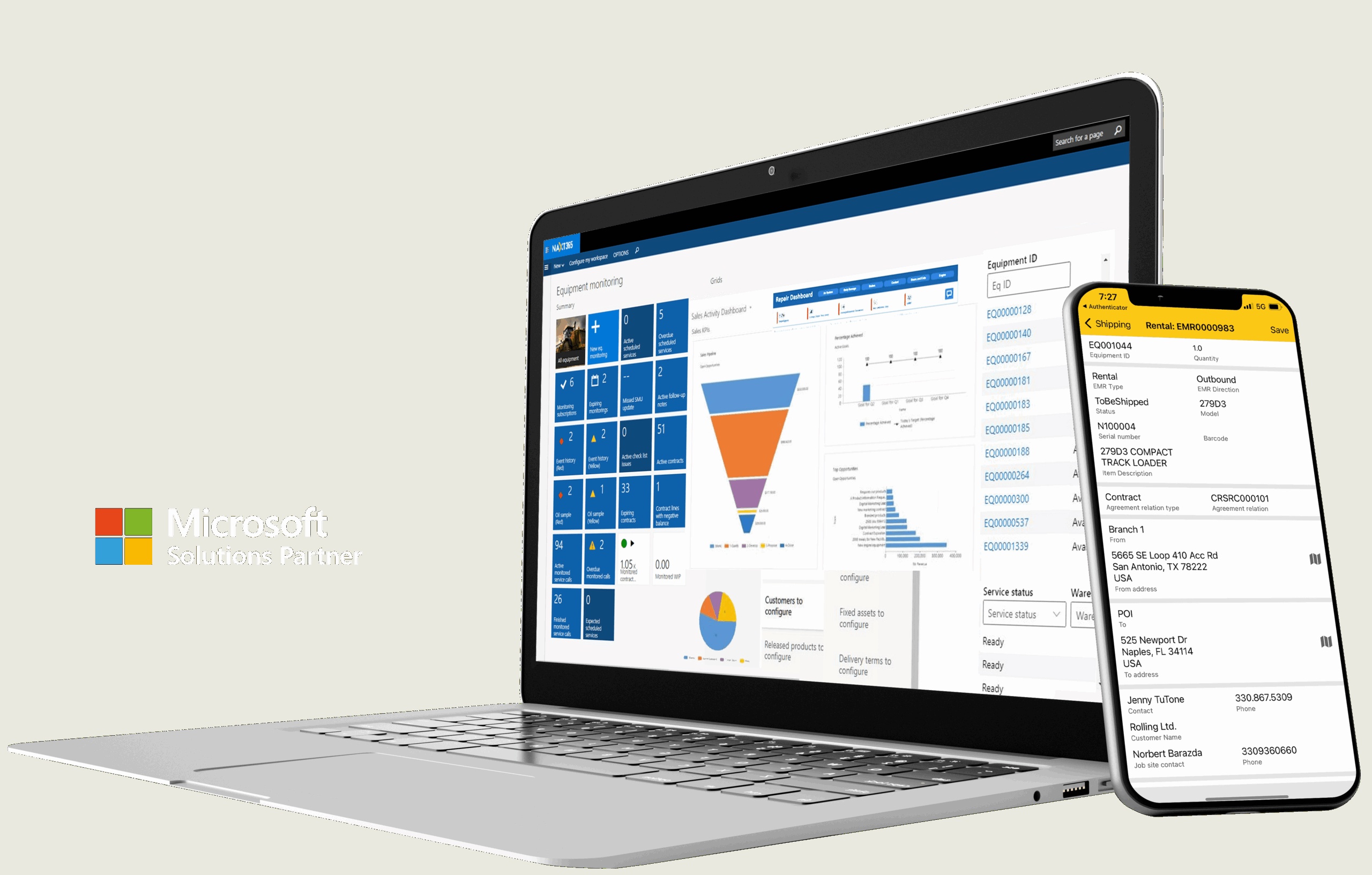
The front office matters too. NAXT Customer Engagement gives sales staff access to availability and equipment history, with templates for quotations. Freight, warranty, trade-ins, service jobs and discounts can enter the quote. Its appeal is practical: a salesperson should be able to describe the deal the dealership can actually deliver, without assembling it from a small committee of disconnected records.
The advantage of arriving second
XAPT’s distinctive number is more than 700. That is the company’s count of preconfigured equipment-dealer processes. Think of them as accumulated answers to recurring operational questions. A dealer buying NAXT is buying software, certainly, but also a starting point shaped by other dealers’ experience.
Thompson Tractor’s 2017 deployment makes the argument concrete. The system connected four divisions and 27 locations. Its ERP project manager, Matt Serotsky, credited earlier dealers’ work on the platform with helping the project finish within its agreed budget and timetable. The advantage was inheritance: Thompson could begin with processes others had already helped develop.
“NAXT kind of acts as this connective tissue between these dealers.”
Isaac Berling, Ziegler
Quoted in XAPT’s customer testimonials
XAPT formalizes that approach in SEAL, its implementation methodology. Teams start with a preconfigured environment, defined security roles, training manuals, feature test scripts and more than 21 migration templates. The company favors adapting an established industry process before commissioning a bespoke one. That is a useful discipline. Every exception should earn its keep.
It also demands judgment. A standard process may be a good starting point and a poor answer to a particular requirement. XAPT supports customization and localization; its partner program includes regional regulatory expertise. The buyer’s task is to distinguish a necessary difference from an old habit wearing a ceremonial hat.
The bill extends beyond the subscription
XAPT describes NAXT licensing as a user subscription model. Around that recurring software relationship sits implementation work: migration, configuration, integrations, training and support. This is enterprise purchasing, with a project wrapped around the product. A useful budget must account for the dealership’s own time as well as the vendor’s proposal.
The work is visible in the customer accounts. Migration partner DDPTech describes Gregory Poole’s upgrade as a 15-month project, with careful selection of essential configuration, master data and live transactions. Obsolete history was deliberately excluded. That is a decision a buyer can copy: decide what deserves to travel before packing the database.
XAPT’s SEAL page gives an implementation range of six to eighteen months. That is a planning range, not a promise. Scope, manufacturer interfaces, country requirements and staff availability change the work. A subscription can be counted by users. Readiness is harder to put on an invoice, which is precisely why it deserves a line in the plan.
The morning after go-live
Ziegler went live in February 2021. Its subsequent case study describes a three-year sequence: first stabilize, then improve, then innovate and optimize. The first year was about restoring dependable operation after the transition. Later stages moved beyond previous capabilities and reconsidered how people and processes should be organized.
- 01StabilizeMake daily work dependable.
- 02ImproveBuild beyond the previous system.
- 03OptimizeRethink processes and responsibilities.
That timetable is more instructive than a launch announcement. The case study recommends tracking downtime, help-desk tickets and resolution times, with named accountability. The software may be live while the organization is still learning. Go-live moves the problem into ordinary working hours.
Other accounts resist the fairy tale too. In its retrospective of six 2025 launches, XAPT describes Cleveland Brothers’ initial customer-engagement synchronization challenges and limited customer resources. Gregory Poole changed implementation methodology during its project. MADISA finished on budget but two months later than originally estimated. These are vendor-published accounts, yet their details are useful: data, dependencies and people put pressure on the schedule.

XAPT’s July 2026 employee feature supplies an example of that last mile. Juarbe’s MADISA work included unfamiliar tax documentation and manufacturer interfaces. International ERP cannot be made local by changing a language setting alone. Someone has to understand what a valid transaction looks like in the place where it happens.
A niche with room for rivals
XAPT competes in dealer management software, where VitalEdge’s e-Emphasys ERP and IntelliDealer are direct alternatives. Those products also connect dealer operations. A buyer therefore needs a more demanding comparison than a checklist marked “integrated.” The choice turns on workflow fit, manufacturer interfaces, migration effort, implementation support and the underlying platform.
XAPT’s platform choice is explicit. An August 2026 explanation names Dynamics 365 Finance, Supply Chain Management, Project Operations, Human Resources, Sales and Field Service as its foundation. Power BI adds analytics; the broader Microsoft ecosystem supplies tools dealers may already use. XAPT contributes the equipment-industry layer and delivery expertise.
Partners fill out the offering. Formpipe Lasernet handles business documents; CenPOS provides payment integration; DDPTech contributes migration expertise. In April 2026, XAPT described a Mavim partnership for process modeling and governance. The practical direction is clear: make the future workflow visible before building it, then monitor how people adopt it.
The relationships can last through multiple platform generations. NMC’s July 2026 announcement described a planned move to NAXT365 after twelve years with XAPT. That makes the purchase decision partly a choice of who will help with the next change, not merely who can complete this one.
Copy the sequence, not the brochure
There is a useful lesson here even for readers who will never sell a loader. Start an evaluation with one asset or transaction and follow it across departments. Ask each person what they need to see, what they enter twice, and where they wait for someone else. Then make the demonstration follow that route.
Compare the standard workflow with the existing one. Keep exceptions that serve a real requirement. Give data preparation an owner. Reserve staff time for training and stabilization after launch. For a dealership unwilling to change established processes, or unable to free people for that work, a broad ERP replacement is a difficult proposition. More features will not settle a disagreement about responsibility.
XAPT’s claim to attention is its knowledge of this peculiar business, collected and turned into repeatable software. The test is wonderfully concrete: when a machine returns, can the people who rent it, repair it and account for it agree about what happened? An enterprise system earns its place in that answer.