Before there was Mathematica, there was a documentation problem. Stephen Wolfram was designing a computing system and writing down how it should work. If an idea resisted a clear explanation, he treated that as a warning about the design. The manual became a test bench. It is an unexpectedly literary origin for a company whose products can solve differential equations.
- One computational foundation. Mathematica, Wolfram|Alpha and cloud tools offer different ways into related technology.
- Work you can inspect. Notebooks keep explanations, executable code and results together.
- A new customer. AI systems can call Wolfram tools when a question needs computation.
01 / The manual came first
Wolfram founded Wolfram Research in 1987. Mathematica arrived on June 23, 1988. Its proposition joined symbolic mathematics, numerical calculation, graphics and a notebook interface. You could manipulate an equation and present the result within the same working document. For someone moving between mathematical reasoning and computer output, that combination reduced the distance between thinking and showing.
There had been a rehearsal. Wolfram’s earlier Symbolic Manipulation Program, SMP, became a commercial product through another company. In his account, management disagreements included a proposal to build workstation hardware, which he opposed. He found the experience frustrating. When he started the next company, he made himself CEO. The organizational lesson arrived before the famous software.
“If I couldn’t explain something clearly in documentation, nobody was ever going to understand it”
Stephen Wolfram, recalling Mathematica’s design
02 / The notebook is the product idea
Open Mathematica and the central object is a notebook. Text sits beside runnable expressions, diagrams and interactive controls. Wolfram Language supplies symbolic rules, numerical methods, image processing, statistics and access to curated knowledge. A physicist can work with equations; an analyst can explore a dataset; a teacher can let students move a parameter and watch a curve change.
This is where Wolfram sits in the market. MATLAB is an alternative for numerical engineering; Maple for symbolic mathematics; Python libraries with Jupyter for teams assembling their own environment. Wolfram asks buyers to value integration. The trade-off is concrete: a proprietary language and licensing relationship in exchange for many capabilities designed to work together.
The customer list is wider than a mathematics classroom. Wolfram publishes stories from finance, medicine, engineering and education. One describes JPL using System Modeler during the Europa Clipper pre-project. That is a specific engineering application, rather than a claim that Wolfram built the spacecraft. System Modeler lets users connect physical components and simulate their behavior across several domains.
Consider a classroom exercise: explore how a projectile travels as its launch angle changes, under an explicitly simplified model with no air resistance. Put the equation, initial conditions and plot in one notebook. Add a slider for the angle. Students can compare predictions without rebuilding the calculation each time. The important part is the visible assumption about air resistance: the graphic becomes something they can question, rather than merely admire.
03 / An engine gets another front door
In 2009, Wolfram|Alpha opened another entrance. Users could type ordinary-language questions and receive computed results from algorithms and curated data. Mathematica gave people a place to build a calculation; Alpha helped people ask for one. The distinction matters when choosing a product. Checking an integral and building a reusable research workflow are different jobs.
The cloud extended the idea again. Wolfram Programming Cloud launched in June 2014, bringing computation and deployment into a browser-accessible setting. Consulting adds people to the offering: specialists can help develop algorithms, analyze data, model systems or build an application. Wolfram sells both the instrument and assistance learning how to play it.
Then the audience changed. Wolfram’s account of the late-2022 chatbot breakthrough describes a realization that AI systems also needed its tools. By March 2023, the company had worked with OpenAI on a ChatGPT plugin. A language model could translate a request into a computational task and use the returned result. Decades of engineering had found another route to the user.
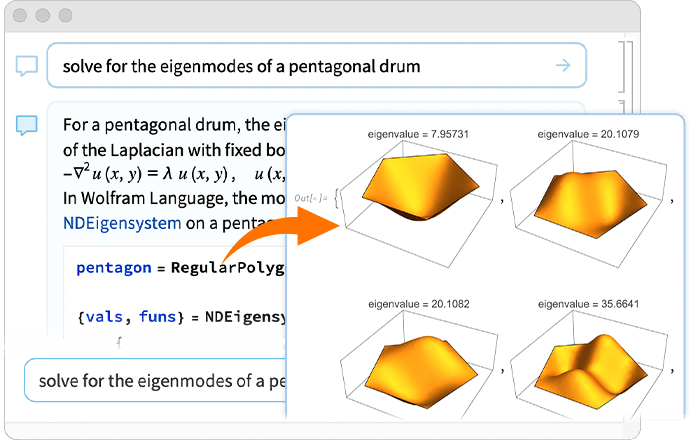
The June 2026 release of Mathematica 15 made AI Assistant part of every notebook and added MCP capabilities for external AI clients. July’s 15.0.1 followed with fixes and security updates. The interesting continuity is the inspectable working document. A conversation becomes more useful when its calculation can be examined, altered and run again.
04 / Who pays for the long view?
Wolfram earns money through licenses, subscriptions, organizational access, deployment offerings and professional services. Alpha has free access and paid Pro features. Its public US pricing lists Pro at $9.99 monthly or $60 billed annually. Those prices buy Alpha features, including step-by-step solutions and more computation time; they do not buy a Mathematica license.
Equivalent to $5 a month.
US public web pricing, checked October 2026.
Free access also has boundaries. The developer engine is available for pre-production development; production use has separate licensing. Raspberry Pi users have a free noncommercial route. Inside the company, Wolfram describes geographically distributed teams. The founder has described commercial product revenue supporting research without outside investment. That ownership choice helps explain the willingness to pursue projects on a long timetable.
For a buyer, the total cost also includes learning the language, maintaining notebooks and fitting the tool into existing work. An institution’s license may already cover a student or researcher; a commercial team needs to check its own terms. The right comparison includes those human hours alongside the invoice. Integration has value only when it removes work that someone actually needs to do.
05 / Borrow the habit
A reader can copy the documentation test immediately: explain the intended result before building the feature. Then borrow the notebook habit. Keep assumptions, data, code and charts together. Start with a modest question, change one input, and ask a colleague to reproduce the result. The point is to leave enough working detail for disagreement to become useful.
There are limits. An open-source requirement can rule out Wolfram’s proprietary core. A settled Python workflow may make retraining expensive. And a computational engine can correctly solve the wrong problem. Wolfram himself advises checking what an AI sent to the tool and what came back. The question still needs an owner, even when the machine does the arithmetic.
Keep a notebook open
Try / read / watch