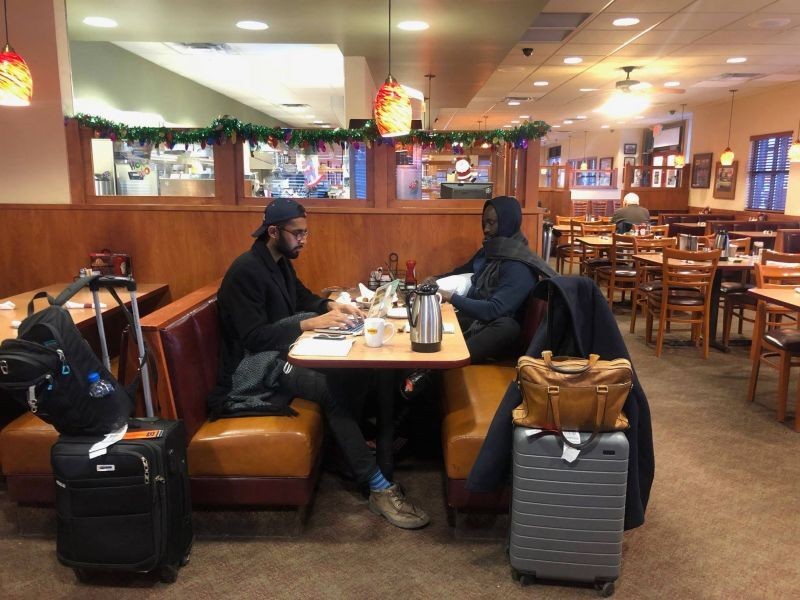
The photograph has everything a startup presentation tends to leave out: luggage, a diner booth, and two people trying to get some work done. Samir Goel sits on one side of the table. Wemimo Abbey sits opposite. There are laptops and coffee cups. The suitcases suggest a business trip; the booth supplies the office. The accommodation was proving harder to arrange.
They had landed an early $20,000 contract for Esusu, the company they were building together. They could not afford a hotel. A contract promises money; it does not necessarily put money in your pocket that evening. Their plan involved a Grand Slam, working through the night, and a flight to San Francisco to raise capital. They dozed off. The manager asked them to leave.
In the longer account of Abbey’s career, the scene sits somewhere between the bank that rejected his family and the investors who eventually funded his company. Each episode turns on the same awkward distinction: having something valuable and persuading an institution to recognize it.
The ring that paid for a beginning
Abbey grew up in Lagos, Nigeria, raised by his mother and two sisters. His mother treated education as an investment worth making even when money was scarce. She worked at the post office and paid for his schooling. Her son eventually secured a place at the University of Minnesota Crookston.
In 2009, he came to Minnesota. The weather alone demanded an adjustment: his recollection moves from 80 degrees in Lagos to minus 22. A student can prepare for a new curriculum more easily than for air that appears to bear a grudge.
The financial adjustment was less amusing. Abbey and his mother needed money for college. Without an American credit score, they could not obtain a loan from a major bank. His mother pawned his father’s wedding ring. The family borrowed from church members and turned to a payday lender charging roughly 400 percent interest.
Years later, Abbey would recount those details before Congress. The ring gives the story its emotional weight. The credit score supplies its mechanism. A family had crossed an ocean, reached a university, and found that the next decision depended on a record they had never had an opportunity to create.
“Relationships matter. Invest in them.”
Wemimo Abbey
Before rent, there was water
At Crookston, Abbey studied business management and took part in research. A university account from 2012 describes an internship involving community data, food availability, and energy consumption. It also recalls his early experience selling candy bars for fundraising in Nigeria. The future founder was already interested in how an organization could gather information and turn it into something useful.
His undergraduate research had brought opportunities beyond the campus. He received grants and traveled to Edmonton to present a project. In describing his work as a student, he emphasized service and the responsibility to give something back. Those concerns were already present while he was learning to compare data sets and conduct research. The attention to people and the interest in measurement developed alongside each other.
He graduated in 2013. That year, he founded Clean Water for Everyone, a social venture focused on affordable access to water. He also founded Open Aid Initiative, a data company concerned with organizations and development activity in Africa; it was acquired in 2014.
These ventures put practical questions ahead of a tidy professional category. Water access required one approach. Making organizational data usable required another. The recurring interest was in access, and in the machinery that could make access possible.
He earned an MPA at NYU’s Wagner school in 2015. His career also took him through corporate finance: at PwC, he worked as a mergers and acquisitions consultant on more than 20 deals. There were earlier experiences at Accenture, Goldman Sachs, and the European Commission.
In October 2015, Crookston made him the first recipient of its young alumni award, then named the award after him. The Abbey [Promise] Award still recognizes graduates beginning to make a public contribution. It is an unusual souvenir of college: most people leave with a degree and perhaps an unpaid library fine.
Two names on the door
Abbey met Samir Goel through the Clinton Global Initiative. Goel had been working on food access; Abbey had been working on water. Friendship preceded the company. They shared rooms at conferences to save money and made introductions for each other.
Goel’s family history gave him his own reasons to care about financial exclusion. His father had been robbed after arriving in the United States, and the family lacked an established financial identity. The two founders could recognize the problem without commissioning a consumer survey.
Recognition did not make the decision to start a company easy. Both had family responsibilities and student debt. They developed Esusu while holding corporate jobs, working through the practical question of when they could afford to leave. The company launched in 2018.
They chose to become co-CEOs. That arrangement drew objections from prospective investors who wanted a single person in charge. The founders saw value in sharing the burden, including the frustrating days. Their early fundraising involved hundreds of refusals; Abbey has put the total at 326.
The Denny’s photograph belongs to this period of strained personal finances. It also captures something about the partnership: two people at work across a table, each carrying luggage. Their first institutional financing brought relief after months of bootstrapping. By January 2022, Esusu had raised a $130 million Series B at a $1 billion valuation.

The payment hiding in plain sight
Esusu’s central proposition is easy to understand if you have ever paid rent. A household can make that substantial payment every month without the history becoming part of the credit record a lender examines. Abbey’s company works with property owners and managers to report rental payments to credit bureaus.
Its name reaches back to West African communal savings traditions. The company’s early product included a digital version of rotational saving, in which people contribute to a shared pool. Rent reporting gave the founders another way to turn existing financial behavior into a recognized record.
A conceptual view of rent reporting. Credit outcomes depend on the individual record and the scoring model.
The business also needs to work for the people who own the buildings. Property managers get a service they can offer residents, along with data and tools for managing their portfolios. For Abbey, designing around several participants is part of making the idea last. Renters, landlords, and the institutions receiving the data all have a place in the arrangement.
The approach has expanded through partnerships. Esusu and Zillow announced CreditClimb in November 2025. The following month, Esusu announced a $50 million Series C led by Westbound Equity Partners, at a $1.2 billion valuation.
Company-reported financing and availability at the announcement date. Unit coverage is different from active renter enrollment.
At that announcement, the company described availability in more than five million rental units. It laid out plans for embedded rent reporting, flexible rent payments, and rental data for underwriting. The growing product list takes Abbey further into the operating details of a financial system he first encountered as a student seeking a loan.
The attention brought recognition as well as financing. Abbey and Goel were named NYU Alumni Changemakers of the Year in 2022 and appeared together on the 2023 TIME100 Next list. For two founders who had insisted on sharing the chief executive role, the joint recognition seems fitting. Their account of the business keeps returning to the partnership, including the years when sharing a room was a way to save money.
A different seat at the table
On June 30, 2022, Abbey appeared before the House Financial Services Committee’s fintech task force. The hearing concerned obstacles to investment in fintech companies with diverse ownership. He introduced himself as the co-founder of a Harlem-based company, then returned to his family’s experience in Minnesota.
The setting gave that history a different audience. Bank rejection, expensive borrowing, and the difficulty of raising startup capital were matters for lawmakers to examine. Abbey had become someone who could bring personal experience and operating experience into the same room.
In May 2023, the SEC appointed him to its Small Business Capital Formation Advisory Committee for a four-year term. The appointment listed Los Angeles as his location. His public work now included advising on the conditions under which other businesses could find capital.
At an April 2026 committee meeting, he discussed the cost and time involved in going public. He described Esusu’s progression from its earliest financing to Series C and the demands that public-market reporting could place on founders. The institutional details had changed since his family’s first bank visit. His attention to the terms of admission remained.
Call him Wemimo
For years, many interviews introduced him as Abbey Wemimo. In 2022, he explained the choice: he had used Abbey to honor his father and the family name. After marrying Taylor Goodridge Abbey, he decided to go by Wemimo. He supplied a pronunciation, too: Weh-mee-more.
He connected that decision to the way people introduce themselves at work. Esusu began adding name pronunciations to email signatures and business cards. A name can be a small administrative detail until it is yours.
There are quieter details in his public accounts as well. In 2020, he described gospel music in the morning and said his best ideas often came on planes. Travel, family, friendship, and work appear together in his telling, with his mother’s choices still close to the center.
His advice to aspiring entrepreneurs is compact: “Be caught trying.” He has had occasion to practice it. The diner photograph preserves one attempt, complete with coffee and suitcases. The company that followed asks institutions to keep a fuller record of other people’s attempts, beginning with the payment they make to stay at home.