The advice was not glamorous. It had no talk of destiny, leadership or global brands. Nelson Herndon, who had left school after eighth grade and ridden north from Georgia to work at General Motors, kept telling his daughter Wanda: “You should get an office job.” He knew the assembly line. He knew what it could provide, and what it took. His ambition for her was a chair, a desk and the economic freedom of work that did not punish the body.
Wanda Jean Herndon took the suggestion rather further than anyone could reasonably have ordered. She moved from a working-class childhood in Flint to Michigan State University, from the Michigan legislature to Dow and DuPont, and then to the executive team at Starbucks. There she built a global communications function while a young coffee company became an international habit. Later came her own consultancy, a return engagement during a corporate crisis, basketball ownership, Broadway investments, civic boards and, in 2026, a memoir.
It is tempting to tell this as a glass-ceiling story because Herndon herself has supplied the excellent title: Working Class to Breaking Glass. But the more revealing image may be a door. Her career has been about entering rooms that were not designed with her in mind, learning how decisions moved through them, and making the entrance less mysterious for the people behind her.
Flint, Michigan
Twelve cents and a paved road
Herndon was born in LaGrange, Georgia, in 1952. The following year her family joined the Great Migration north. Her father found work in the Buick division at GM; her mother worked at Hurley Hospital. Their new home sat on Maybury Avenue, then a dirt road in an all-Black, blue-collar neighborhood. Her mother went door to door with a petition until the city paved it. This was an early master class in communications: identify an audience, assemble a coalition, ask until concrete arrives.
Money was tighter than young Wanda understood. At about nine, she asked her parents for twelve cents to join the weekly milk program at school. Their silence delivered the answer. She sat among classmates with their cartons and made herself a private promise: adulthood would include enough money for milk. The amount was tiny. The lesson was not. Security meant having choices, and choices depended on more than luck.
Words offered a route. She liked English, news and poetry; mathematics and science were less cordial acquaintances. When Herndon was sixteen, her eleventh-grade journalism teacher, Mrs. Strong, took her to Michigan State to meet the dean of journalism. A good teacher had spotted ability and turned encouragement into an appointment. Herndon earned a bachelor's degree in journalism in 1974, worked as a legislative assistant in the Michigan House of Representatives, and returned for a master's degree, completed in 1979.
Firsts without fanfare
Learning the business behind the message
In 1978, Herndon entered Dow's communications development program as its first African American and its first external hire. Firsts sound polished when compressed into biographies. Living one is mostly the daily business of being watched, learning quickly and discovering which errors other people are allowed to make casually. Over twelve years she led communications and marketing work for Lorsban insecticides, Specialty Plastics and DowBrands. The assignments taught her to master a business before trying to explain it.
At DuPont from 1990 to 1995, the work moved closer to the nerve center. She supported the company's $6 billion Polymers and Automotive business and led employee communications, advising senior management on change. This was communications without confetti. Employees notice when official language has been scrubbed clean of reality. Herndon's task was to make strategy legible enough that people could act on it.
That combination - curiosity, fluency in a complicated business and steadiness around powerful people - prepared her for Seattle. Starbucks hired her in 1995. She became an officer and senior vice president, creating and leading global communications as the company sprinted into new cities and countries.
A company grows faster than its vocabulary
Between 1995 and 2006, Starbucks grew from roughly 550 North American stores to more than 11,000 stores in 37 countries. Revenue rose from $465 million to more than $6.3 billion. Herndon did not cause those numbers, and serious communicators do not confuse the story with the business. She built the system that let the business explain itself while its size, scrutiny and responsibilities changed.
A brand expanding at that speed can outrun its own meaning. The customer sees a cup and a room. Employees see schedules, standards and decisions. Investors see growth. Communities see a new corporate neighbor. The communications leader must keep those audiences in the same story without pretending they want the same thing. Herndon's remit crossed media relations, employee communications, executive counsel, reputation and the inevitable emergencies. She gave an increasingly global company a voice capable of traveling.
She retired from Starbucks in 2006 and founded W Communications that year. Then, in January 2008, Howard Schultz returned as chief executive during a painful transformation and asked her back. An internal Starbucks memo said she had “interrupted her retirement” for the assignment. It is a dry corporate phrase containing a warm truth: when the institution wobbled, it remembered her judgment.
W Communications became the vehicle for that return and for later counsel to organizations including the Schultz Family Foundation, lululemon and Otsuka America Pharmaceutical. Herndon had moved from occupying a senior chair to putting her own name on the invoice. The office job had become the office.
Beyond the corporate script
Basketball, Broadway and the useful surprise
Herndon's résumé refuses to stay in one genre. From 2001 to 2006, she held a minority stake in the NBA's Seattle SuperSonics and the WNBA's Seattle Storm and served on the Basketball Club of Seattle's executive board. She also invested in three Broadway musicals: Memphis, First Date and Come From Away. Two of those productions collected major Tony Awards. For someone who spent decades shaping corporate narratives, theater is not such a detour. A stage makes the mechanics of attention visible.
The civic work is less showy and more continuous. She was an original member of the Starbucks Foundation and founded the Wanda J. Herndon Foundation. Her board service has included the 5th Avenue Theatre, where she served as chair and is now board emeritus; the Lacewing Foundation; Cancer Lifeline; YWCA Seattle | King | Snohomish; and International Women's Forum. She established an endowed journalism scholarship at Michigan State in 2004. She has more than fifty years of service in Alpha Kappa Alpha Sorority and is an alumna member of the Greater Seattle Chapter of The Links.
These are not decorative affiliations. They form a second communications network, one based on who is invited, funded, mentored and heard. Herndon describes learning as a social obligation. Acquire knowledge, share it, and help somebody else move. She credits her own progress to ancestors, parents, teachers and colleagues rather than the lonely genius beloved by business folklore.
The memoir is a handrail
In June 2026, at 73, Herndon published Working Class to Breaking Glass: One Woman's Fight to Belong and to Lead. The book returns to the bus ride that brought her father north, the twelve-cent milk carton, the teachers who noticed her and the workplaces where race, gender and class shaped what belonging could cost. Its arrival turned a private archive into a public instrument.
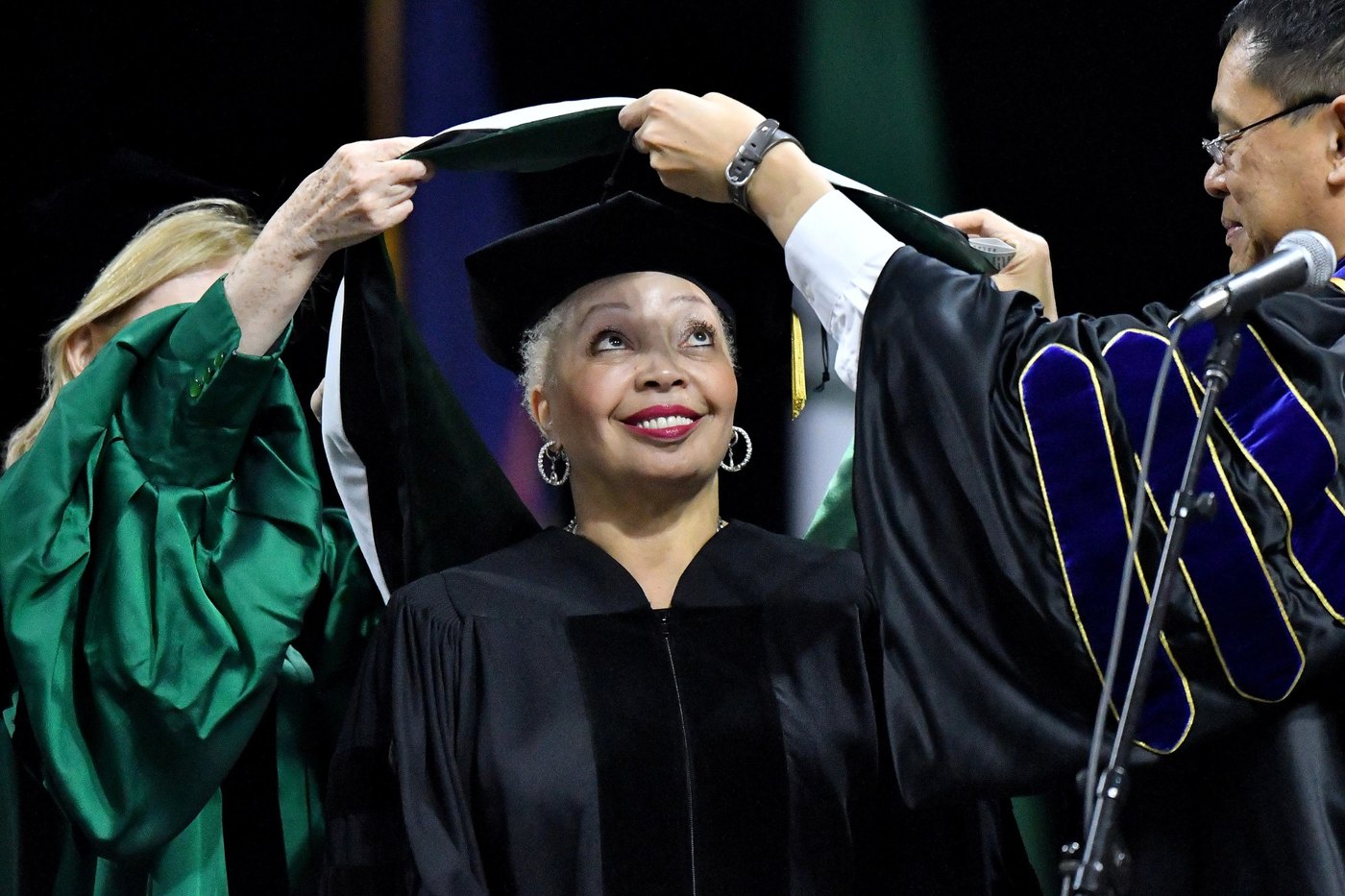
There is a sharp intelligence in telling the story now. Herndon has already accumulated the honors: Michigan State distinguished alumni awards, recognition among leading Black professionals in public relations, a Puget Sound Business Journal Woman of Influence honor and an honorary doctorate from her alma mater. A memoir adds something awards cannot. It preserves the awkward parts between the plaques.
Her recent conversations dwell on curiosity and the question underneath the question. This is natural territory for a person whose profession depends on hearing what a nervous executive, skeptical reporter or uncertain employee is really asking. But it also describes her life. “Get an office job” sounded like employment advice. Underneath it was a father's larger question: can my daughter inherit more freedom than I had?
Herndon answered with a career, then revised the answer into an obligation. The office was never merely a room with cleaner floors than the factory. It was access to decisions. It was a place from which language could influence capital, culture and opportunity. She entered it, learned its grammar and kept a hand on the door.
That is the difference between arriving and leading. Arrival makes a fine photograph. Leadership notices who is still outside the frame.