The flowers were doing rather more work than flowers usually do in an office. They lined the reception desk, hung across the inauguration arrangements and framed a welcome sign at Space Inventive’s new capability center. For Vivekananda Reddy Chintakuntla, the occasion came with a comparison that no architectural photograph could quite convey: in 2007, the business had occupied a small leased cubicle. Now it owned its space in Hyderabad’s Financial District.
Reddy began his announcement with a single word in capitals: gratitude. Mentors, investors, clients, employees and extended family all appeared in his thanks. The founder and CEO was celebrating property, certainly, but also the people who had helped the company reach the point where it could buy some. An office opening can produce a heroic quantity of ribbon. His account gave the occasion a more practical purpose.
The center would incubate new products alongside an existing services business. The destination mattered because of what he wanted to build there. After years of doing technology work for clients, Reddy was giving Space Inventive another assignment: develop software of its own and get it into the market.
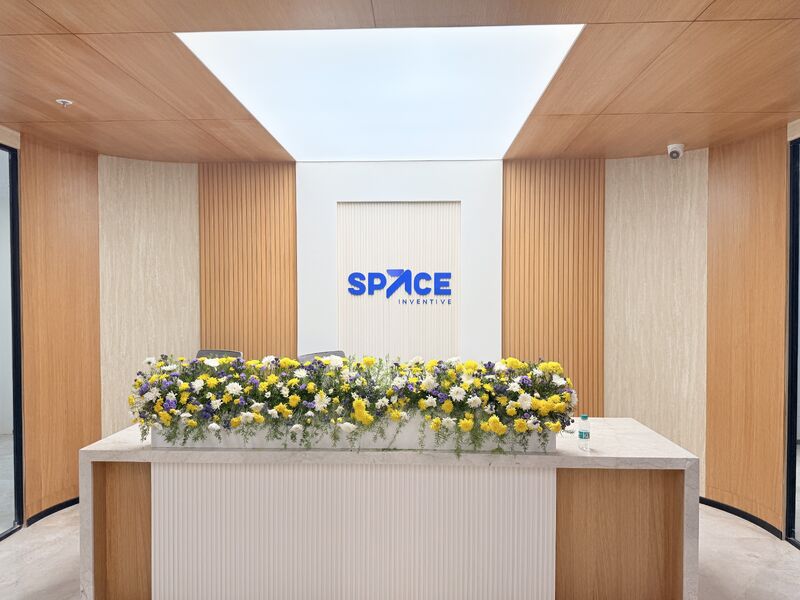
The opening photographs offer a tour in miniature: a wood-lined reception area, glass partitions, white chairs and a meeting table arranged around an open center. The flowers temporarily soften the office geometry. It is a setting prepared for people to arrive, sit down and work together. Reddy’s comparison with the leased cubicle gives those ordinary details their significance. More room means more places for a conversation, a demonstration or a team meeting. His announcement gave the rooms a purpose beyond their appearance, connecting the space to the products he wanted the company to develop.
The cubicle gets a second act
That small cubicle provides the opening scene in Reddy’s account of the business. It is a useful detail because it is specific. A company can describe its beginnings in any number of flattering ways; a leased cubicle supplies a physical boundary. Whatever the initial ambitions, the working space was modest.
There are two dates in this history worth keeping separate. Space Inventive traces its beginnings to 2007. The Indian private limited company’s incorporation came on September 4, 2015, when Reddy became a director alongside Chintakuntla Sudha Bindhu. The earlier date describes the business’s origin; the later one belongs to its corporate registration.
His education entry lists Bangalore University from 1997 to 2001. Today, his professional profile places him in Hyderabad. Between the university dates and the current role sits a career in technical consulting, the work he uses to describe his experience. His company’s earlier name, Space Multimedia, also survives in business listings and in its own recollections of the journey.
Names can be surprisingly durable office furniture. They linger after the signs have changed. In November 2024, Space Multimedia’s rebranding as Space Inventive was announced publicly. The new identity accompanied a description of work spanning data science, data engineering, design and product development. Reddy’s business had a broader brief than its original name suggested.
A services business makes room for products
The change Reddy described at the office opening was organizational as well as physical. He wanted the center to help products reach customers more quickly while the services and innovation teams continued their work. That parallel ambition is the hinge of this chapter: maintain the work already supporting the business, and create something that can have a life beyond an individual client assignment.
Space Inventive’s product names give that ambition some substance. SharkVision was presented as a data visualization tool. Talliant addressed recruitment. They occupy different corners of working life, but both deal with information that someone must sort, interpret or act upon. The attraction of such software is easily understood by anyone who has spent an afternoon negotiating with a spreadsheet.
Reddy’s stated goal in the rebranding announcement was to simplify complex business problems and create value for clients. That is a fairly restrained test once the promotional language is stripped away. A product has to earn its place in the working day. A pleasing demonstration is a beginning; helping someone complete the task is the continuing assignment.
For a founder, building products beside services also creates a story with two clocks. Client work has its own commitments. Product work has development, revision and release. Reddy’s public account explicitly makes room for both. The capability center was intended to help that combination work, rather than merely provide a more impressive address for the same activities.

The product someone hated to leave
One account of that product work comes from Gautham Anand, who described leaving Space Inventive after roughly 15 months. He had joined as a trainee data scientist and progressed to associate data scientist. In his farewell, Talliant received particular attention: he had worked on it from its inception and cared about its smallest details.
Anand said he would leave before the launch. That detail catches a familiar tension in building software: people’s careers and product schedules rarely proceed in tidy formation. He could take pride in what the team was making while moving on before the public moment. The attachment in his farewell gives the recruitment platform a human scale that a product description cannot supply.
He thanked Reddy and ChandraSekhar Karanam for the opportunity, Navin Gnaneshwar for noticing him, and Venkata Sai Santosh Gajjela for mentorship. It is a useful glimpse of the people around the founder. An organization becomes more legible when the names belong to people doing particular things, rather than appearing as a decorative list beneath a mission statement.
Reddy replied with encouragement: “Keep growing gautham,” and thanked him for his contributions. The exchange is small, public and specific. It shows a departing employee expressing affection for unfinished work, and the CEO wishing him well. Their exchange places the founder inside a particular working relationship, with a colleague whose next step would take him elsewhere.
“Keep growing gautham”
Reddy, replying to a departing data scientist
Miami puts a date on the ambition
By October 28, 2025, Reddy was inviting people to see Talliant at the GDS CHRO Summit in Miami. The event was scheduled for November 5 and 6 at Trump Doral. His post described an unveiling for US and global customers, with an audience of human resources leaders. The product plan announced around the capability-center opening now had a named platform and a place to demonstrate it.
His description lingered on the engineering: hours of revision, connected thinking and integration with existing human capital management systems. That last point deserves attention. Recruitment teams already have software, records and established routines. Reddy was presenting Talliant as a companion to that environment, able to connect with it while automating parts of the recruitment journey.
The company promoted the platform as covering tasks from resume screening to interviews. Those are product claims and ambitions, rather than a reason to assign every hiring outcome to automation. Reddy was moving toward showing a recruitment product to prospective customers, with integration central to his own explanation.
Shruti Bhardwaj subsequently described representing Space Inventive and Talliant at the Miami summit with Gajjela. She thanked Reddy for supporting the opportunity. Her account brings colleagues into the customer-facing chapter as well as the development chapter. The product was leaving the office through people who could explain it, demonstrate it and hear what hiring leaders wanted to ask.
There is a pleasingly ordinary difficulty here. A services engagement begins with a particular client and a defined requirement. A product has to make sense to customers who were never in that first conversation. It needs explanations, demonstrations and a way into their existing routines. The emphasis on integration in Reddy’s Miami invitation addresses that difficulty directly. The software must fit somewhere. His colleagues’ presence at the summit also puts human conversation beside the engineering effort. The person asking questions across a demonstration table may see a complication that a product announcement leaves out.
A problem worth the flight
The geography of Reddy’s work extends beyond Hyderabad. Space Inventive lists offices in India, the United States and Dubai, and describes supporting customers across several regions. His Miami invitation fits that wider reach. For a founder based in Hyderabad, the audience for the next product need not be confined to the city where it was built.
In October 2026, ahead of the Dubai AI Festival, he put the purpose of those conversations succinctly: “the most interesting AI conversations don’t start with technology. They start with a problem worth solving.” He was looking forward to discussing intelligent systems, cybersecurity and the region’s technology ecosystem. The emphasis was on work a system could improve.
That thought connects to the earlier product plan without requiring a grand prediction. Reddy has described an office intended to support new products, a recruitment platform built to connect with existing systems, and international events where the team can meet potential users. Each introduces a concrete next step. Together they show what he is trying to do with the business he began in a cubicle.
The opening flowers have their place in that story. So do the developer who left before launch, the colleagues who took the product to Miami and the clients Reddy thanked when the new center opened. His next chapter depends on making their work useful to someone beyond the photograph. Buying the office supplied a milestone. Giving people reasons to use what comes out of it supplies the ongoing plot.
Follow the next chapter
Space Inventive · Reddy on LinkedIn · Talliant
Inside the capability center · Reddy’s Miami product announcement · A developer’s farewell