A shopper can want a mattress, need a mattress, and still fail to qualify for the financing beside it. That gap was Vive Financial’s territory. The retailer had merchandise. The customer had future income. The first lender had said no. Vive offered another credit decision, with different economics attached.
- Vive financed retail and healthcare purchases for customers outside traditional prime lending offers.
- Its model combined merchant discounts, borrower interest and fees, and responsibility for credit losses.
- In October 2025, its parent sold the receivables portfolio and began winding down Vive.
The ending changes how the company should be understood. A description of Vive as an expanding checkout lender now misses the essential event. PROG Holdings sold substantially all its loan receivables to Fortiva Funding, an Atlanticus affiliate, on October 20, 2025. The useful story is how this second look worked, and why its owner chose to hand it over.
A dental bill before a checkout button
Vive’s roots go back to 1983 and Dent-A-Med, later known through the HELPcard name. Healthcare gave the business a practical starting point: a service could be needed immediately while the money to pay for it arrived gradually. By 2006, when Harbert and Cambridge Place affiliates acquired a majority interest, Dent-A-Med financed healthcare services and home healthcare products through a nationwide provider network.
Progressive, then an Aaron’s subsidiary, acquired Dent-A-Med in 2015. The annual report recorded a $54.9 million purchase price, including $4.2 million of acquired cash. The strategic fit was straightforward. Progressive had lease-to-own products; Dent-A-Med brought revolving credit. A merchant could reach shoppers whose circumstances required different payment arrangements.
The eventual Vive network included furniture, mattresses, fitness equipment, home improvement, and medical and dental providers. Those categories help explain its place in the market. These were purchases substantial enough to create a financing problem, often attached to a particular retailer or provider rather than a general shopping expedition.
The merchant was a customer, too
Calling Vive a lender leaves out half its proposition. It also sold merchants another chance to complete a transaction. Its private-label and Vive-branded credit programs linked retail distribution with bank-originated loans. The Bank of Missouri was identified as the account owner in the agreement governing the 2025 portfolio sale.
Historically, Vive bought receivables through bank partners at a discount. The 2019 filing disclosed negotiated merchant discounts generally ranging from 3% to 25%, plus promotional discounts generally of 1% to 8% where applicable. These were historical ranges, not a present-day price list. They reveal the mechanism: the merchant could surrender part of the sale proceeds to help fund the financing.
makes a sale
originates credit
the receivable
repays over time
The distinction from a short installment plan mattered. Vive offered revolving credit, while sister business Four offered four interest-free payments, generally over six weeks. Progressive’s lease-to-own arrangement was different again. These products occupied neighboring territory, but their ownership rules, repayment schedules and risks were different. A second-look offer was also subject to underwriting; it was never a promise that everyone qualified.
Its closest historical comparison was Fortiva Retail Credit, which also targets shoppers declined by prime lenders. In healthcare, CareCredit provided another financing route; broader retail card programs came from companies such as Synchrony and Bread Financial. Availability depended on the merchant, and eligibility and terms differed. Vive’s particular expertise was coordinating the retailer, the issuing bank and the borrower in a second-look program. For a shop choosing a financing partner, the meaningful comparison was the whole arrangement: approvals, merchant cost, customer terms and account servicing.
Two clocks on the same purchase
Vive advertised deferred-interest promotions and low monthly payments. The attraction was easy to see. A large bill became a series of smaller obligations. But a promotional account could carry two clocks: the monthly payment date and the date by which the promotional purchase had to be cleared.
One program disclosure dated December 2020 listed a 35.99% purchase APR and a $59 annual fee. Its deferred-interest plan required the purchase to be paid in full by the promotional deadline, with required monthly payments made on time. Otherwise, interest could be imposed from the purchase date. Those figures describe that historical program, not every Vive card or a current offer.
“Today’s announcement reflects our continuing commitment to optimize capital returns”Steve Michaels, PROG Holdings CEO, announcing the portfolio sale, October 2025
The difference was consequential. In a May 2025 BBB response, Vive said one customer’s authorized monthly withdrawals left a small balance when a 12-month promotion expired. Deferred interest followed. Vive agreed to waive it, along with related charges, and the customer accepted the resolution. That single case cannot establish how often this happened. It does show why automatic payments and a promotional payoff plan were different things.
The work after approval
Vive’s mobile app supplied the everyday machinery: balances, available credit, transaction history, eStatements, payments and AutoPay. Its Apple release history records a credit-score viewing feature added in December 2024. The product’s less glamorous job was making an obligation visible after the excitement of buying had passed.
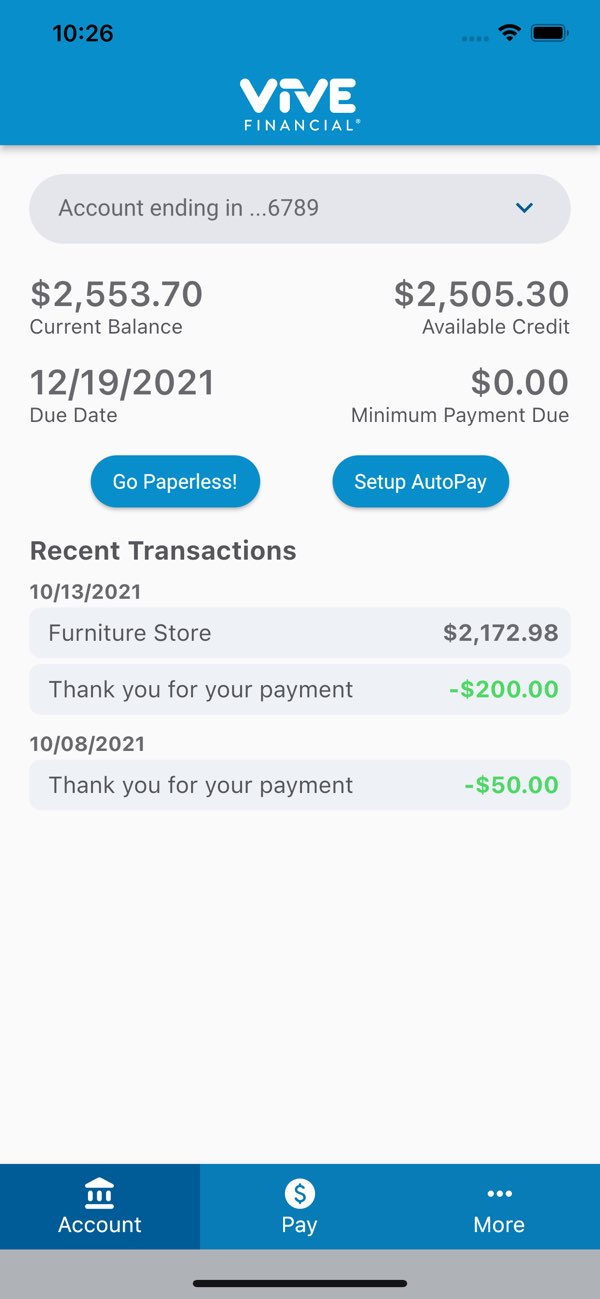
The financial results expose the pressure behind those screens. In 2024, Vive recorded $64.415 million of revenue, $37.311 million of credit-loss provisions and $26.932 million of operating expenses. Operating profit was $172,000. Revenue had to pay for customers who would not repay as expected and for the operation that kept the accounts running.
Operating profit: $0.172 million. Provisions are accounting estimates of credit losses, not the same as cash charge-offs.
A second look at the business itself
The October 2025 announcement framed the sale around capital efficiency and profitability. Atlanticus described the portfolio as a way to deepen retail relationships. Approximately $165 million of gross receivables transferred; PROG’s annual filing ultimately reported $143.9 million in net consideration. The assets could serve a different strategic purpose inside a buyer already operating in this credit market.
By July 2026, PROG continued to exclude Vive from continuing operations. For existing borrowers, the practical reference point is the latest account statement and transfer notice. For merchants and product builders, the copyable lesson is to design repayment as carefully as approval: show the promotional balance, the payoff deadline and the amount needed to reach it. A manageable monthly bill only solves the problem when the full repayment plan is manageable, too.