Founder · Engineer · AgZen
Vishnu Jayaprakash
He counts the droplets nobody else thought to count - 1.2 billion of them per acre.
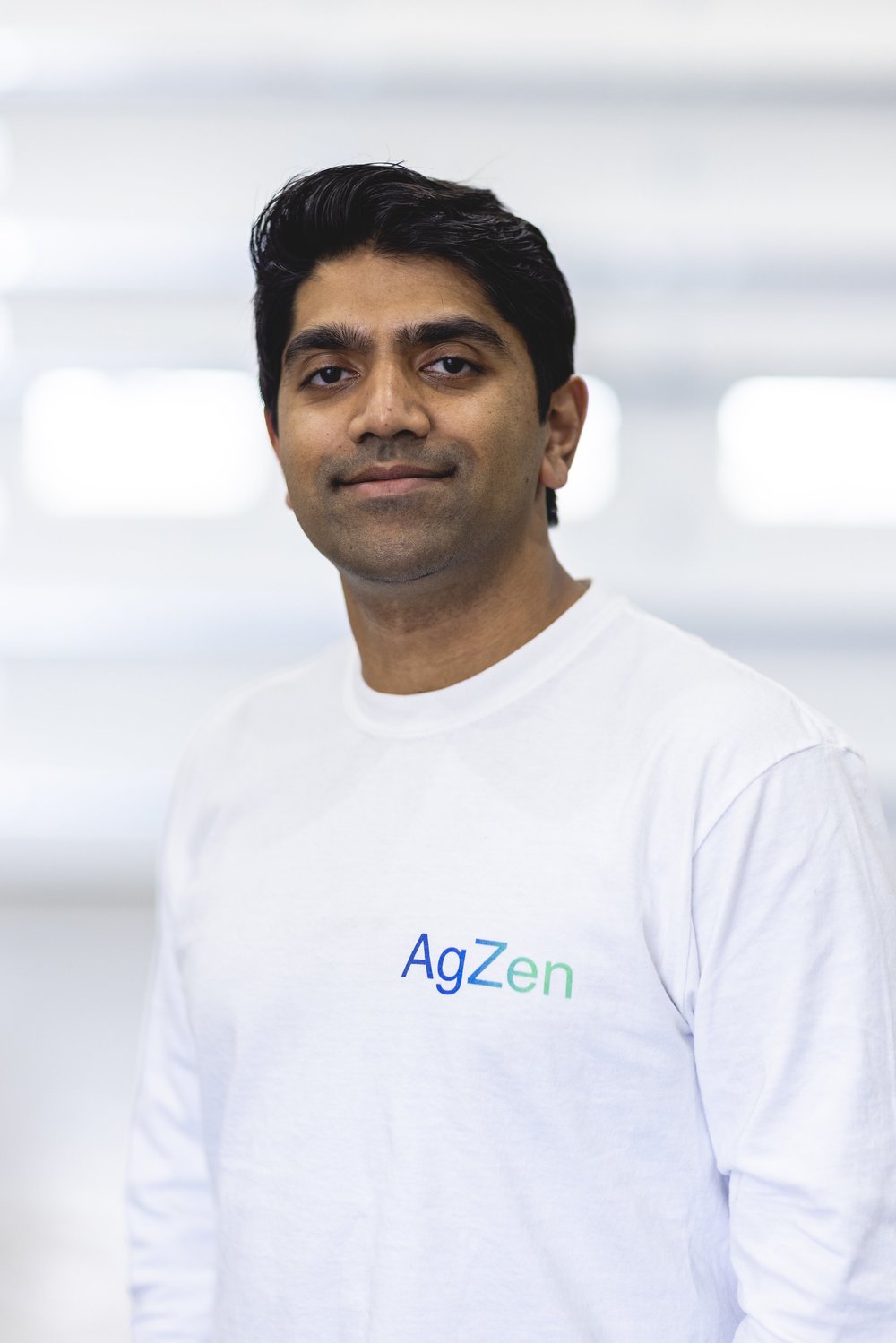
// The kid with the backpack sprayer grew up and built a feedback loop.
He counts the droplets nobody else thought to count - 1.2 billion of them per acre.
Spray one acre of soybeans and you launch roughly 1.2 billion droplets into the air. For eighty years, no one bothered to ask where they landed. Vishnu Jayaprakash asked.
Today he runs AgZen, an MIT spinout that bolts cameras and AI onto crop sprayers and, for the first time, tells a farmer mid-pass what percentage of their chemical is actually sticking to the leaf. The product is called RealCoverage. It watches droplets as small as 150 microns hit the plant, then tells the operator what to fix - the nozzle, the pressure, the boom height, the droplet size, how fast to drive, how many gallons per acre. A tablet in the cab shows it all happening in real time. Four hours to install. One soybean season to pay for itself.
The numbers moved fast. Zero paid acres in 2023. Then 65,000 in 2024, the first commercial year. Then close to 920,000 in 2025. That is not a typo and it is not a pilot. Growers leased or bought these systems, at around $97,500 a unit, and put them on nearly a million acres of working farmland. In October 2025, Corteva - one of the largest crop-protection companies on earth - signed on to test the technology across its portfolio. The kid with the backpack sprayer now sits across the table from big ag.
Rewind. The backpack sprayer is real, and it was, in his words, "pretty awful." Jayaprakash grew up near Chennai, India, where his family farms about ten acres of rice and mangoes. He strapped on the tank and walked the rows because that is what you did, even though he could feel how much of the chemical was missing the plant and drifting into the dirt and the air. He understood why farmers kept doing it. He also never forgot how wasteful it felt.
That memory followed him to MIT. He spent more than a decade in the orbit of Professor Kripa Varanasi's lab, studying a deceptively small question: why does water bounce off a leaf, and how do you make it stay? Leaves are often waxy and water-repellent, which means a huge share of every spray pass rolls off and falls to the ground. Jayaprakash earned a master's in 2019 and a PhD in 2022, both in mechanical engineering, picking apart the interfacial physics of a droplet meeting a surface. The work had a name and a trophy attached - his pesticide innovation, AgZen-Cloak, took first place in the graduate category at the Collegiate Inventors Competition, run by the National Inventors Hall of Fame.
The first product out of that research was a clever nozzle. It cloaked each droplet in a thin shell of plant-derived oil so the droplet would grip the leaf instead of ricocheting off - cutting bounce-off and, in the lab, slashing the chemical needed by as much as 80%. Jayaprakash and Varanasi founded AgZen in 2020 to sell it. They took it to farmers. And a farmer asked the question that quietly rebuilt the whole company.
Nobody could answer it. Not AgZen, not the chemical companies, not the equipment makers. The entire industry was flying blind, optimizing a spray nobody had ever measured. So AgZen stopped leading with the nozzle and started leading with the eyes. RealCoverage was the camera that finally checked. The nozzle - now sold as EnhanceCoverage - became the fix you reach for once you can see the problem. "We are taking the blindfold off," is how the technology gets described. The framing matters: AgZen pitches "better, not less." It does not walk into a grower's barn selling a budget cut. It sells coverage - the confidence that the chemical landed - and the 30-50% input reductions validated in university and field trials come along as the happy side effect.
It is a subtle, important reframe, and it is very Jayaprakash. He is a physics-first builder who learned to listen harder than he lectures. The pivot from "we have a better droplet" to "we have the only way to measure droplets" came from the field, not the lab. The technology has since been stress-tested in places that have almost nothing in common - Massachusetts berry farms, Italian vineyards, California ranches - because a droplet on a leaf is a droplet on a leaf, whatever is growing underneath it.
Look closely at what RealCoverage actually does and the audacity of it lands. A spray boom is a chaotic system: nozzle choice, line pressure, boom height, ground speed, droplet size, and gallons-per-acre all interact, and a change to any one of them ripples through the others. Traditionally an operator sets those dials once, at the edge of the field, on the basis of a label and a hunch, then drives. AgZen's cameras turn that one-time guess into a live conversation. They watch the droplets land - down to 150 microns, smaller than a grain of fine sand - and push corrections back to the cab while the sprayer is still moving. It is closed-loop control applied to something the industry had only ever run open-loop. The phrase the company keeps reaching for is "feedback-optimized agriculture," and the word that does the work is feedback.
What makes Jayaprakash interesting as a founder is that he did not stumble into agriculture as a market; he is from it. Plenty of agtech gets built by people who have never walked a row at dawn with a tank on their back. He has. That is why the "better, not less" framing is not a marketing trick to him - it is how a farmer actually thinks. Tell a grower to spray less and you are asking them to gamble their yield. Show them where the chemical is landing and let the savings fall out of the precision, and you are handing them confidence instead of a cut. The same instinct that made him notice the backpack sprayer was wasteful at sixteen made him notice, at the founder's table, that you cannot sell a farmer a discount on their own anxiety.
The mission underneath all of it is older than the company. Pesticide runoff is one of agriculture's quiet pollution problems: chemicals that miss the plant end up in soil and water. Jayaprakash's whole pitch is that you can cut that waste without asking farmers to spray less or grow less - you just have to let them see. "Growing up, I would spray crops on my family farm wearing a backpack sprayer," he says. "So, I've always wanted to work on research that made farmer's lives easier." The man building the feedback loop for a billion droplets is, at bottom, still trying to fix the thing that annoyed him as a teenager in the mango rows.
Where it goes next is a question of scale. AgZen has raised on the order of $23 million across rounds - a $3 million seed led by Material Impact, a $10 million growth round, and momentum that keeps the acreage curve nearly vertical. The Corteva deal hints at the real prize: not selling one camera at a time, but becoming the measurement layer underneath the entire crop-protection industry. If spraying has been a faith-based exercise for eight decades - spray and pray, as the founder interview put it - Jayaprakash's bet is that the next eighty years will be feedback-optimized. Every drop counted. Every drop made to count.
Paid acres running AgZen's feedback-optimized spraying. The curve is the pitch.
Growing up, I would spray crops on my family farm wearing a backpack sprayer. So, I've always wanted to work on research that made farmer's lives easier.
We've been spraying at scale for 80+ years, but no one has measured how many droplets actually reach weeds or crops.
We have gone from two years ago not having a single paid acre to doing 65,000 acres in 2024, and this year we're on 920,000 acres.
Corteva's strengths are in agronomy and formulation science - and we bring the expertise of droplet monitoring.
His family farms about 10 acres of rice and mangoes near Chennai, India - the original test plot.
One acre of soybeans can throw off roughly 1.2 billion droplets. AgZen exists because no one tracked them.
RealCoverage bolts onto sprayers a grower already owns and feeds a tablet in the cab.
The early product cut chemical use up to 80% in the lab by cloaking droplets in plant oil.
"Better, not less" - AgZen sells coverage, and the input savings come as the side effect.