The internet is very good at keeping receipts. Businesses are less consistent about reading them. For Vipul Mishra, that gap became the starting point for Neotas, the due diligence company he co-founded in 2017. Before the company, there were fraud investigations. He had been head of information security at an algorithmic hedge fund, dealing with cases that suggested a frustrating possibility: useful warnings could already exist beyond the boundaries of the organisation looking for them.
A finished investigation has the advantage of knowing what to look for. An investor considering a deal, or an employer considering a hire, has to ask useful questions earlier. Mishra's business grew around that difference in timing. Online material might help inform a decision before money, employment or a reputation was committed. Finding it, connecting it to the right person and understanding it were separate jobs.
In a conversation with Nina Carr of Symvan Capital, Mishra described risk indicators he had encountered across social media and other parts of the web. His shorthand was disarmingly plain: “It's very hard to hide from the internet nowadays.” The harder commercial question was whether a company could make that scattered evidence useful, repeatedly, for people whose working day did not allow for an endless succession of browser tabs.
Two founders, one awkward question
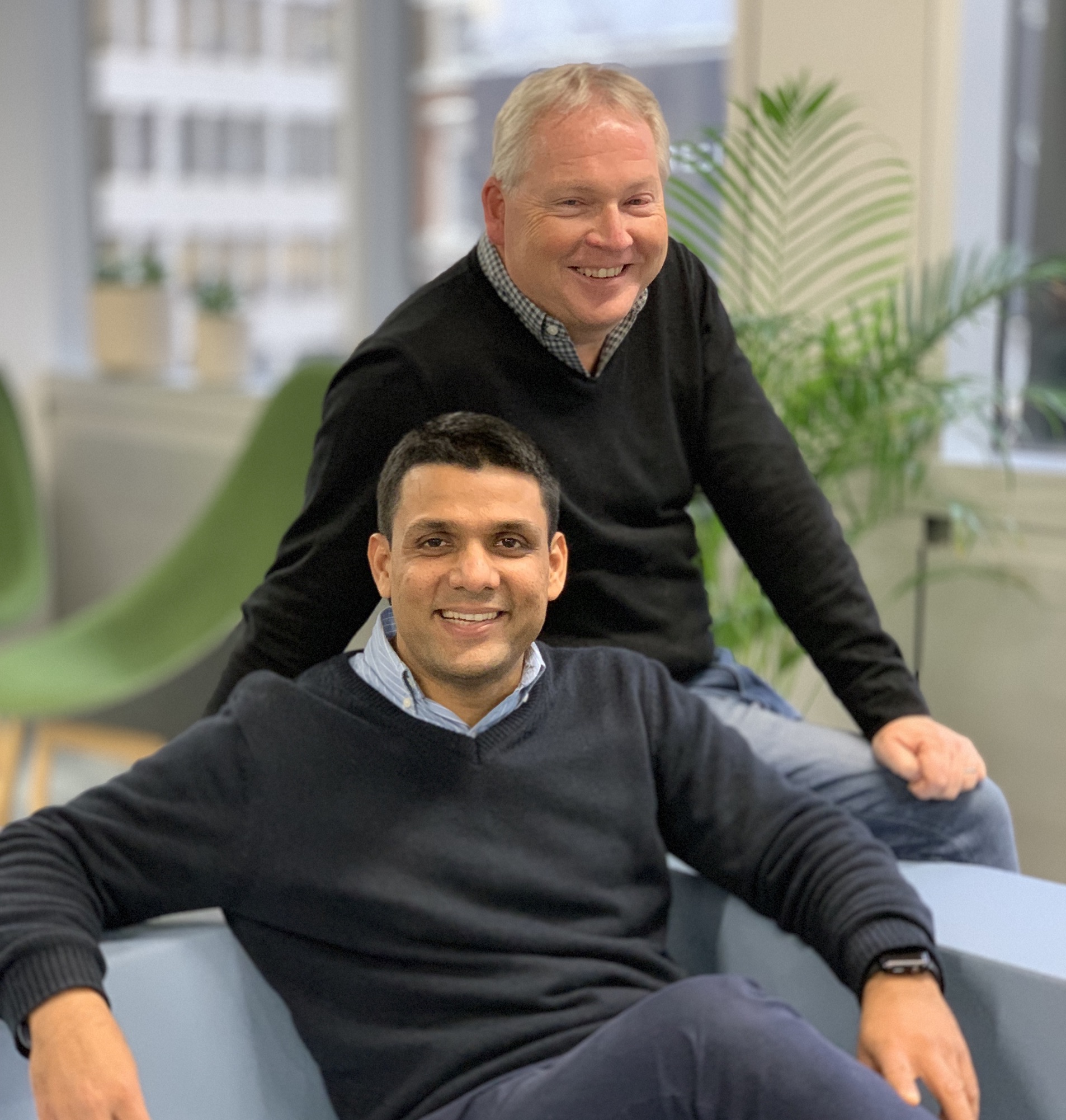
Neotas was incorporated on 6 February 2017. Mishra and Ian Howard were both appointed directors that day. Their backgrounds met at a useful junction: Mishra brought information security and investigations experience; Howard brought more than three decades in finance and investment. Together, they were addressing customers who needed to understand the people behind a transaction as well as its paperwork.
The pairing matters to Mishra's story because his technical experience alone does not explain the business that followed. A private equity firm, an insurer and a bank may all need due diligence, but each has its own procedures and reasons to hesitate. Howard's financial background sat alongside Mishra's experience of investigating what had already gone wrong. The product had to fit the circumstances in which a customer could actually use it.
In November 2018, Neotas announced more than £1 million in investment backed by Symvan Capital and Force Over Mass. The stated uses were practical: develop the technology, expand the analyst team, and strengthen sales and marketing. Software and investigators appeared together in that plan. Even at this early stage, the company was spending on both the machinery for finding information and the people responsible for making sense of it.
A photograph needs a little context
The next difficulty was less cinematic than uncovering a secret. An online search can return the wrong person. A phrase can be misunderstood. An image can look troubling until someone understands the activity it depicts. Collecting more material does little good if it gives a decision-maker more opportunities to be confidently mistaken.
In 2019, Neotas began a Knowledge Transfer Partnership with the University of Essex, supported by almost £200,000 from Innovate UK. Professor Ansgar Scherp led the academic work, with a natural language processing specialist recruited to work within the company. The project combined language processing and image analysis to improve the collection and interpretation of open-source intelligence. Privacy and the risk of misidentification were explicit concerns.
One example used to explain the research was the distinction between a photograph of someone clay pigeon shooting and one depicting an armed terrorist. The shared visual element is obvious; the meaning depends on everything around it. For Mishra, this was his company's first university collaboration. He described the partnership as a way to develop technology Neotas had already spent almost three years building. The research problem was wonderfully inconvenient: the computer had to pay attention.
The long route into a bank
A useful investigation tool still needs someone to buy it. Neotas joined the 2019 Accenture FinTech Innovation Lab, entering a cohort of 20 selected from almost 300 applicants. The programme connected participants with senior banking and insurance executives. For a founder selling into financial services, access to people who understand the buying process has a value that a product demonstration cannot supply on its own.
In March 2020, ING included Neotas in its Brussels accelerator programme. Mishra linked the opportunity to international expansion and access to the networks needed to grow. He also stated a broader ambition: “Our mission is to make online due diligence readily available to all”. That is a more demanding promise than completing an occasional investigation. Availability requires a process that other organisations can adopt.
By June 2020, when Neotas joined the EIT Digital Accelerator, the business had more than 80 financial-services customers. Mishra was looking to expand across Europe. Later that year, he credited the accelerator with opening doors to major enterprise accounts faster than the company would ordinarily have managed. These milestones describe a founder learning the commercial geography of his market. A bank has an address, of course, but finding the right door is a separate research assignment.
- 2017Neotas incorporated
Mishra + Howard - 2019Accenture lab + Essex research
Industry access meets contextual analysis - 2020ING Labs + EIT Digital
International expansion - 2022PwC partnership
Technology inside an established workflow
The work behind the impressive name
The PwC partnership announced in May 2022 made that adoption story more concrete. PwC's Intelligence business would use Neotas technology to identify and assess risks involving third parties. Its RADAR integrity due diligence service was part of the arrangement. For Mishra's company, the work was moving into an established professional-services operation, where evidence needed to be understandable to someone beyond the person who first found it.
The partnership announcement described a central platform bringing together corporate records and archived web material, with the aim of improving consistency and preserving an audit trail. That last detail is easy to lose among the large database figures. An analyst must be able to explain how a conclusion was reached. A client receiving the result needs more than the assurance that an algorithm took an interest.
Seen this way, Mishra's career connects two kinds of responsibility. In information security, he dealt with investigations inside a financial organisation. As a founder, he helped build technology that other investigators could use within theirs. The distance between those roles is measured partly in customers and partnerships, and partly in how much of the investigative process can be made repeatable without stripping away the reasoning.
When the claim itself becomes the clue
In September 2023, Neotas won The Fast Solution award for the second problem statement at the Global Financial Innovation Network's Greenwashing TechSprint. Its entry used open-source intelligence and natural language processing to identify potential greenwashing by public and private companies. Neotas worked with PwC UK's Forensic Services team on the project.
Greenwashing brought a different kind of question into the same investigative territory. A company can publish a polished account of its environmental commitments. Examining that account alongside other public information gives an investigator something to test. In this setting, the online statement being promoted becomes part of the material under examination. The brochure has, rather awkwardly, volunteered to be evidence.
The award recognised a practical solution that could be developed and implemented quickly. It was a company achievement, rather than a personal prize for Mishra. Within his career, however, it marks an extension of the original idea: the methods used to examine people and business relationships could also help scrutinise claims. The question had widened, while the need to connect words with supporting evidence remained.
More data, the same demand for judgement
The business now describes its platform in terms of third-party risk management, continuous monitoring and connections to customers' existing systems. Its MACH Alliance profile sets out an API-first approach, configurable workflows and newer agentic AI capabilities. The stated direction is to automate routine research and reserve investigators' attention for more complex cases. That ambition makes the division of labour between software and analysts more consequential.
In September 2026, Neotas announced its recognition as a RiskTech100 2027 Disruptor in Risk Intelligence and Data Management. Mishra's accompanying comment returned to the problem of interpretation: “Risk teams don't have a shortage of data.” His emphasis was on identifying what matters, understanding context and turning fragmented information into something people could use. Nearly a decade after incorporation, the vocabulary had expanded, but the practical difficulty was familiar.
There is a useful restraint in that observation. A larger collection of records does not tell a decision-maker which connection deserves attention. An automated workflow still needs a defensible basis for an alert. Mishra's public description of the task keeps returning to that middle stage between discovery and action, where information has to be checked, related and understood. It is the part a database total cannot describe.
“Risk teams don’t have a shortage of data.”
Vipul Mishra / September 2026
A receipt is only the beginning
Mishra's working world has widened from a hedge fund's information security function to research partnerships, enterprise customers and public discussions about screening. The June 2026 National Vetting Symposium agenda listed him alongside Howard and Neotas consultant David Lean for a session on modernising vetting through open-source intelligence and social media. The subject was another expression of the problem around which he had built the company.
His story is clearest when followed through those choices: an investigations business with a finance co-founder; investment in analysts alongside technology; academic help with context; partnerships that put the tools into other people's working routines. Each addresses a different obstacle between an online clue and a useful decision. None makes the next obstacle disappear.
The internet will continue to supply material. Mishra's declared ambition is to make due diligence more readily available, and Neotas is pursuing more automated ways to deliver it. The test remains a human one: whether the person receiving the result can understand why it matters. A receipt can tell you that something happened. Reading it properly is where the work begins.
Follow the trail
Conversations, research and the work itself.