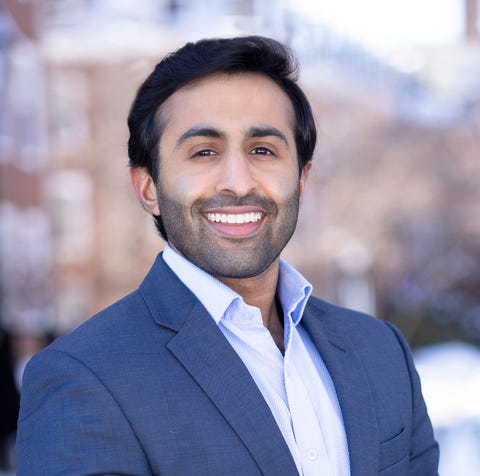
He bet a career on the unglamorous middle of medicine.
The flashiest corner of healthtech is the wearable, the AI scribe, the app that promises a doctor in your pocket. Vijay Kedar went the other direction. He went toward the oxygen concentrator that shows up three weeks late, the ostomy supplies that get faxed to the wrong vendor, the wound-care order that nobody can confirm. That is the terrain Tomorrow Health works in, and Kedar built the company because he once lived inside the chaos.
Today he is co-founder and CEO of Tomorrow Health, a New York company that sits between health plans, providers, and the suppliers who deliver durable medical equipment and home health services. The pitch is deceptively plain: make home-based care arrive on time, get paid for correctly, and feel less like a fax-machine relay race. The metrics suggest it is working. Tomorrow Health reports 97% on-time care starts against an industry that limps in around 50 to 60%, and patient Net Promoter Scores north of 95 in a sector where the average hovers near zero.
Investors noticed. The company has raised roughly $92.5 million across its life, with Andreessen Horowitz leading an early round and BOND leading a $60 million Series B in 2022. Obvious Ventures and Sound Ventures sit on the cap table too. In 2023, Home Health Care News named Kedar a Future Leader. None of that is the interesting part. The interesting part is why a Goldman Sachs private-equity analyst with a Harvard MBA decided the most important problem in the world was a delivery logistics gap in someone's living room.
Grit is constantly iterating your approach to overcome an obstacle - not just persisting against an immovable wall.
- Vijay Kedar
The six weeks that became a company
Shortly after Kedar joined Oscar Health, his mother was diagnosed with stage 3 rectal cancer. The treatment was hard. The logistics were almost worse. She needed oxygen support, ostomy care, wound management, and respiratory equipment, and the family spent six weeks trying to coordinate it all across a scatter of disconnected vendors. Kedar had spent his early career evaluating roughly a billion dollars of deals at one of the most sophisticated financial institutions on earth. He could not get his own mother a reliable supply chain.
That gap is the whole thesis. The home is where most people want to recover and age, and it is the setting that healthcare technology forgot. Hospitals got electronic records. Pharmacies got apps. Home medical equipment got the fax machine and a prayer. Kedar's wager is that the home should be a patient's primary place of care, and that it cannot be until the plumbing underneath it stops leaking.
From Goldman to Oscar to the living room
Kedar grew up in Pittsburgh, the son of a cardiologist father and a computer-engineer mother. Medicine and software were both spoken at the dinner table, which turns out to be a useful upbringing for someone who would later try to merge the two. He studied government and economics at Harvard College, spent a junior year abroad in Accra working with NGOs in the city's largest slum, and later returned to Harvard for an MBA.
His first act was finance. At Goldman Sachs's Private Equity Group, Kedar evaluated deals across healthcare, technology, and energy, landing there around the time the Affordable Care Act passed. He spent a lot of time reading the law and tracing how it would ripple through each subsector of medicine. That homework paid off when he left to join Oscar Health as an early employee, alongside Josh Kushner and Mario Schlosser, when the insurer was still a scrappy bet. He started in finance and strategy, then became a general manager and launched the company's Texas market. Building an insurance market from scratch is a useful education in exactly how health dollars move - and where they get stuck.
On-time, by the numbers
Tomorrow Health reported metrics vs. home-care industry norms
He interviewed thousands before he built anything
Most founders fall in love with their solution first. Kedar did the reverse. He left Oscar and spent months interviewing patients, hospital discharge managers, suppliers, and clinicians - thousands of conversations mapping the precise places home care breaks. Only then did Tomorrow Health, founded in 2017, start writing software. The product connects the ordering, delivery, and payment of home-based care into one coordinated flow, with the financial incentives finally pointed the same direction.
The model has not been static. In 2024, Kedar reworked it, winding down the company's own medical-supply distribution operation to concentrate on the technology and data platform that ties health plans, providers, and suppliers together. It was a sharp call - close the part that looked like a business to double down on the part that scales like one. That is the grit he talks about. Not pushing harder on an immovable wall, but changing the angle of attack.
Cardiologist dad, computer-engineer mom. Medicine and code were both native languages in the Kedar house.
Spent a junior year in Accra, Ghana, working with NGOs in the city's largest slum.
Was an early Oscar Health employee and launched its Texas insurance market from scratch.
Credits an "immigrant hustle" from his father, who came to America at 19.
The Uber-for-the-living-room ambition
Ask Kedar where this goes and the answer is consumer-grade. He wants a patient to access home healthcare as seamlessly as they hail an Uber or order from Amazon - the equipment, the supplies, the services, all coordinated through one platform and embedded inside their insurance benefits. It sounds simple. It is the opposite of simple. It means rewiring how a famously fragmented industry talks to itself.
He has been blunt in public about the gap that remains. In 2024 he argued that home-based care still runs on inefficient, manual processes, and that the cure is technology rather than another layer of middlemen. That is a pointed thing to say in an industry that has historically profited from the inefficiency. It also happens to be the kind of thing a founder says when his entire company is a bet that the inefficiency has an expiration date.
What makes Kedar worth watching is not the funding number, though it is real. It is the chosen difficulty. Home medical equipment is boring, regulated, low-margin, and emotionally heavy - the orders are placed by people in the hardest weeks of their lives. He could have built almost anything with that resume. He picked the wound-care order that never shows up. That is either stubbornness or conviction, and the on-time numbers suggest it is the second one.
The story is still being written. Tomorrow Health is in the long middle of a hard problem, the part with no confetti. But Kedar seems comfortable there. He grew up watching his father practice medicine and his mother write code, then spent six weeks failing to get his own mother an oxygen tank. The company is, in a real sense, an attempt to make sure the next family does not have to.
Why the home is the hardest room in healthcare
To understand the size of the bet, picture the journey of a single home medical equipment order. A patient is discharged from a hospital and needs, say, a hospital bed, oxygen, and wound supplies. A discharge planner faxes paperwork to a supplier. The supplier checks whether the patient's insurance will cover it, a process that can involve prior authorizations, documentation requirements, and a phone tree. The order might bounce between three or four parties before anything ships. Every handoff is a chance for delay, and every delay is a patient sitting at home without the equipment they were sent home to use.
That is the machine Kedar is trying to replace. Tomorrow Health's platform stitches the steps together so that eligibility, ordering, fulfillment, and payment talk to each other instead of relaying paper. The company partners with more than 100 health plans, which matters because the health plan is the one party that touches every order and pays the bill. Win the plan's trust and you can fix the whole chain at once instead of one supplier at a time. It is a wholesale strategy for a problem that usually gets attacked retail.
The financial logic is just as deliberate. Home-based care has historically rewarded volume and friction - more orders, more middlemen, more administrative drag. Kedar's argument is that aligning incentives toward outcomes, on-time delivery, and patient satisfaction is not charity, it is a better business. The 95-plus NPS is not a vanity metric to him; it is evidence that doing the unglamorous logistics correctly is itself a moat, because almost nobody else bothers.
An operator, not just a visionary
It would be easy to file Kedar as another mission-driven founder with a tidy origin story. The harder thing to notice is that he is, by training, an operator. He learned how capital moves at Goldman, how an insurance market gets stood up at Oscar, and how a benefit actually pays out by launching one in Texas. When he talks about home care, he talks in the language of process - care starts, authorizations, fulfillment rates - not slogans. The 2024 decision to shutter the supply business was an operator's decision: unsentimental, focused on where the leverage actually lived.
That blend of conviction and pragmatism is the throughline. The conviction came from a hospital waiting room. The pragmatism came from a decade of watching how healthcare money really behaves. Put them together and you get a founder willing to sit in the least glamorous part of medicine for years, because he has done the arithmetic and decided that is where the impact compounds.