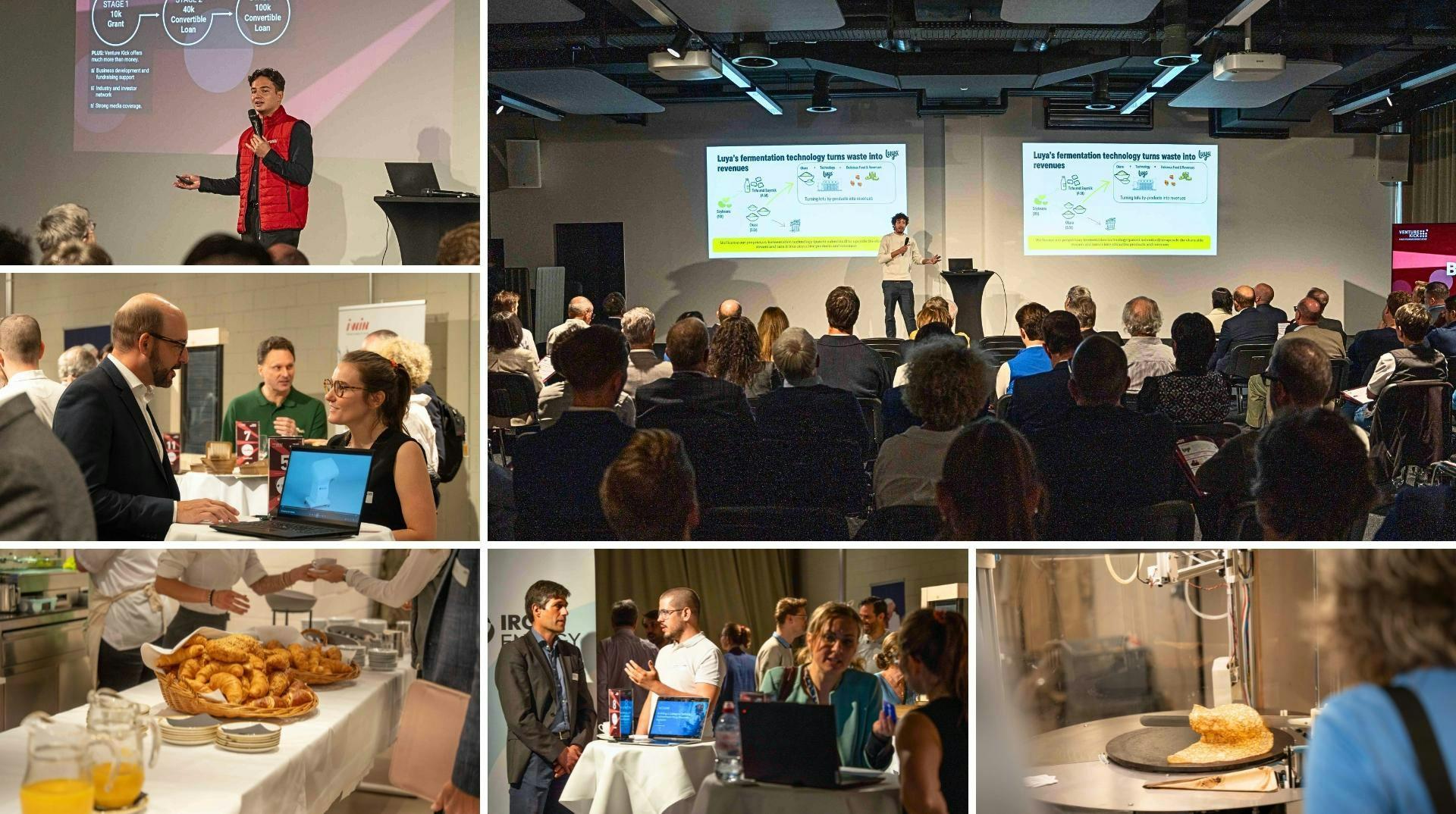
At a Venture Kick Demo Brunch in May 2026, the crêpes came from a robot. Maus Robotics, one of the program’s alumni, supplied the automated cooking; another alumnus, Luya Foods, contributed to the meal. Seventeen founders were there to meet investors. For once, the demonstration could be eaten.
- Swiss research teams get early cash and commercial coaching.
- Three stages offer up to CHF 150,000 over nine months.
- Later awards are convertible loans; extra funding is conditional.
The detail is charming, but it also explains the operation. Venture Kick wants research to leave the laboratory and encounter a customer. A working machine serving breakfast is a rather persuasive answer to the question that haunts university inventions: who will actually use this?
Based in Switzerland, Venture Kick provides early funding, business coaching and introductions for science-based startup teams. Its position is unusually early, often before incorporation and before professional investors arrive. The beneficiary is a researcher becoming an entrepreneur. The hoped-for return is a company, employment and useful technology.
A television show noticed the missing money
The initiative’s origin was more television than term sheet. During the Swiss television series “Start up,” discussions about growth financing repeatedly exposed a more immediate problem: getting enough capital to start. The launch announcement in June 2007 described research that never made the journey into commercial use.
Gebert Rüf Stiftung and Ernst Göhner Stiftung backed the launch, with CHF 1 million available for the pilot. Beat Schillig and Jordi Montserrat took operational responsibility. The original maximum award was CHF 130,000. Its founding ambition was to double the number of spin-offs emerging from Swiss universities.
Today, Venture Kick is an initiative of the charitable Kick Foundation, operated by Venturelab. Private foundations, individuals and companies finance it. This matters because its work begins where a scientific idea can be promising while a conventional investment case remains distinctly unconvincing. Someone must pay for that awkward interval.
Three payments, three different questions
The core process takes nine months. First comes a business idea and a CHF 10,000 grant. After three months, the team returns with a business case for the CHF 40,000 second stage. Another six months brings the final jury and a possible CHF 100,000. Each presentation asks for more evidence than the last.
The first money pays for business development. Under the published participation conditions, it cannot supply incorporation capital or salaries for founders and permanent employees. That restriction gives the small cheque a purpose: investigate the market instead of treating the award as comfortable laboratory funding.
The later CHF 140,000 is offered through convertible loans, rather than another gift. The published conditions specify 5% interest and conversion at the next investment round’s valuation, without a discount. A company must be incorporated to receive the final stage. Founders should therefore budget for future ownership consequences as well as present cash.
Two-day Kickers Camps accompany the stages, with execution support and feedback from experienced entrepreneurs. Business development, pitching and fundraising sit together. The curriculum has a deadline attached: a team must return to the jury with something that happened outside its slide deck.
The hypothesis goes out to meet strangers
Consider Swissloop Tunneling, a team developing a micro tunnel-boring robot. Its announced use of a CHF 10,000 Stage 1 award was targeted customer interviews and validation of market assumptions before a pilot. The invention is ambitious. The first funded task is admirably ordinary: ask the people who might buy it.
This is the part a reader can copy. Write down the assumption that makes the business work, spend a limited sum testing it, and arrange a date when an informed outsider will ask what you learned. Bigger spending follows stronger evidence. A calendar can be a surprisingly effective antidote to scientific procrastination.
For L.E.S.S., which develops lighting technology, co-founder Yann Tissot described the experience this way: “They continuously challenged our vision.” The useful pressure is commercial. An elegant device still needs a buyer, a route to market and a reason to survive procurement.
Applicants need a Swiss academic connection, an intention to establish the business and jobs in Switzerland, and no prior professional investor funding. Recently incorporated companies may be considered under restrictive conditions. For an established business already selling and employing people, this particular starting line will usually be behind it.
“They continuously challenged our vision.”Yann Tissot / L.E.S.S.
The million comes with separate doors
Venture Kick’s “1 Million Plus” message combines several instruments. Its own three stages total CHF 150,000. Qualifying teams can pursue up to CHF 150,000 from Gebert Rüf Stiftung’s InnoBooster and up to CHF 850,000 from Kickfund. Access is an opportunity, not an automatic cheque for every applicant.
InnoBooster illustrates the distinction. It supports research and development or design that can accelerate market entry; funding goes to the university, rather than directly to an incorporated startup. Its criteria require progress through Venture Kick and evidence including proof of concept, secured intellectual property and market interest.
The market position is a bridge between academic support and private investment. Founders receive money and commercial practice; investors meet teams that have already faced several rounds of scrutiny. At the May brunch, the presenting companies had about 44% of their fundraising rounds committed on average. The room was designed for conversations with a next step.
Count the companies, then read the fine print
In March 2026, Stellar Alpina, developing in-space transportation, became the program’s 1,000th incorporated startup. Venture Kick reported 1,286 funded projects at that point. The distinction matters: a funded project and a company are different milestones. Its alumni include carbon-removal company Climeworks, antibiotics developer BioVersys, chip company Kandou and alternative-protein maker Planted Foods.
The 2025 accounts put a price on the machinery: CHF 11.325 million excluding VAT. Of that, CHF 8.32 million was cash support, CHF 2.52 million business development support and CHF 485,000 administration. Coaching, introductions and project review cost real money. The grant is only the visible part of the intervention.
Venture Kick reports that alumni attracted CHF 1.25 billion in follow-on financing in 2025, and that 66 appeared in that year’s Top100 Swiss Startups. These are portfolio outcomes, not proof that every franc of subsequent investment was caused by the program. Strong selection and the surrounding Swiss research system belong in the explanation too.
The model depends on a supply of research talent, patient donors, credible jurors and teams willing to test their ideas commercially. It cannot promise that a market exists. What it can provide is an affordable first test and a reason to finish it. Even at a brunch, sooner or later somebody has to judge the crêpe.
CHF 8.32m cash · CHF 2.52m business support · CHF 485k administration. Excluding VAT; percentages rounded.
Step into the jury room
Explore the program ↗ · Apply ↗ · Startup news ↗
LinkedIn · X · Instagram · Facebook
Watch Venture Kick’s introduction ↗
Watch the founder video playlist ↗