The most revealing moment in enterprise software is rarely the demo. It is the meeting after two dashboards produce different answers. The room stops discussing strategy and starts interrogating the arithmetic. Which report is right? Who owns the definition? When did the number change? A company can possess oceans of data and, in that instant, discover it has very little confidence.
Vasu Sattenapalli has spent his career in the machinery beneath that awkward pause. Before co-founding RightData, he served as a senior vice president at Bank of America, responsible for data integrations, reporting, planning and forecasting functions. Those are not decorative systems. They are the connective tissue between what an institution did, what it thinks happened and what it plans to do next.
His public diagnosis is blunt: organizations confuse having data with trusting it. Availability feels reassuring. Reports arrive on schedule. Pipeline checks remain green. Then one number moves or two reports refuse to agree, and the reassurance proves fragile. For Sattenapalli, trust becomes practical when a user can answer three questions: What does this number mean? Does it make sense from a business point of view? Can I rely on it now?
“Just because data is available doesn't mean people believe it.”Vasu Sattenapalli on the gap between access and confidence
The education of a systems founder
Sattenapalli's path to the founder's chair ran through implementation rather than theater. His biography is filled with data management strategy, analytics, integration, modeling and application development. He worked across the kind of systems where a tidy diagram eventually meets an untidy institution. The work rewards people who can translate between technical possibility and operational consequence.
In 2012 and 2013, he studied management of technology at Georgia Tech's Scheller College of Business, earning an MBA on an entrepreneurial track. The combination fits his later role unusually well. RightData lists him not only as CEO and co-founder, but also as chief architect. One title points outward to strategy and markets. The other stays close to how the product fits together.
He co-founded RightData in 2016. The Atlanta company began in the world of data testing, validation and reconciliation, the necessary work of proving that information survives movement between systems. Over time, the frame widened. Testing a migration matters, but so does watching production data after the migration. Finding an asset matters, but so does knowing its lineage, quality and policy. Publishing a data product matters, but only if a consumer can securely receive and use it.
In 2022, RightData closed a $6 million Series A investment from Level Equity. The company used the moment to add leadership and expand sales, marketing, research and development. Sattenapalli's comments around new executives reveal an operator looking for complementary experience: deep development on one side, customer evangelism and strategy on the other. Enterprise software needs both. An elegant control nobody adopts is simply a well-engineered secret.
Making technical rules speak business
The most useful piece of Sattenapalli's thinking is linguistic. Data teams often validate columns, tables, formats and ranges. The business does not naturally think in any of those. It thinks in revenue, claims, orders, policies and customers. A technically precise failure can therefore arrive in language its intended audience cannot act upon.
His prescription is to tie validation to business meaning. When a rule fails, the alert should indicate more than a wounded column. It should reveal the business concept that needs attention. This sounds like a change in labeling, but it is really a change in accountability. The problem becomes legible to the people who feel its consequence.
“Trust in data doesn’t scale at the column level. It scales when validation aligns with business meaning.”A practical doctrine for enterprise data teams
RightData's current platform follows that reasoning across three products. DataTrust handles testing, validation, reconciliation and production controls. RightSight handles observability across quality, metadata, pipelines and usage. DataMarket handles governed discovery, certified products and consumption. The names are less important than the sequence. Trust cannot be awarded once and left on a shelf. It has to survive creation, movement, operation and use.
This lifecycle also explains why Sattenapalli favors no-code and low-code tools. His argument is not that technical specialists have become unnecessary. It is that they should not spend their days as human adapters between every business question and every data system. Widening access lets specialists concentrate on harder architecture while business users move closer to the information they need.
A product should finish the job
“Data product” is one of those phrases that acquires meanings faster than it acquires clarity. Sattenapalli has outlined several common definitions: metadata with an owner, a domain-owned asset with a contract, the output of a pipeline or a searchable marketplace listing. Each contributes something useful. He asks one more question: can the consumer actually get governed, usable data from it?
His answer sets a demanding final mile. A data product should join business context, quality, governance policy, discoverability, access and delivery, then enforce those controls when consumption happens. A catalog entry may describe the restaurant. Sattenapalli is concerned with whether dinner reaches the table, is what the menu promised and goes only to the person who ordered it.
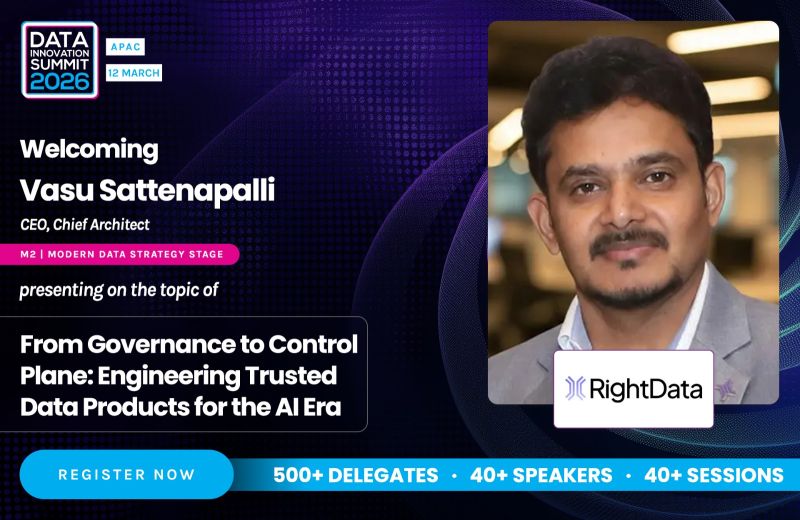
That idea traveled with him to Singapore in March 2026. At Data Innovation Summit APAC, his session was titled “From Governance to Control Plane: Engineering Trusted Data Products for the AI Era.” Earlier that month, he spoke to the DAMA-Georgia chapter about the shape of an AI-ready data foundation and the practical steps required to prepare an enterprise data ecosystem.
The AI connection is not a fashionable attachment to an old concern. Models and agents consume information at a pace that makes weak controls more consequential. A person may pause when a dashboard looks strange. An automated system may confidently pass the strange result onward. Sattenapalli's case is that modern platforms require an operating model for trust, not merely storage and compute.
The operator in public
Sattenapalli's public voice has the cadence of a practitioner teaching from a whiteboard. He returns to simple contrasts: data versus trusted data, technical checks versus business meaning, a cataloged asset versus a consumable product. His articles on data democratization emphasize accessible products, reliable information and interfaces that do not require every user to write code. His short videos often begin with the meeting-room consequence before descending into architecture.
There is a personality visible in that choice. He is direct without turning every problem into a slogan. He likes systems, but insists that systems answer to use. He frames data quality less as housekeeping than as the basis for a decision someone will have to defend.
His writing also reveals a preference for the last mile. In an essay on data democratization, he organized the task around accessible data products, trustworthy information and low-code or no-code options. The three parts reinforce one another. Access to unreliable information merely distributes doubt. Reliable information locked behind specialist queues preserves a bottleneck. A friendly interface without governance makes the wrong action easier. The useful product is the combination, designed around the moment someone has a question and needs to act. It is a founder's view shaped by enterprise patience: grand transformations eventually arrive as a person trying to finish ordinary work before the next meeting.
The career arc is coherent in retrospect: complex implementations, a bank leadership role, technology management study, then a company built around making hidden uncertainty visible. Yet coherence should not be mistaken for simplicity. RightData operates between Atlanta and Hyderabad, sells into enterprises with accumulated systems and asks teams to change not only tools but definitions, ownership and habits. Software can automate a rule. It cannot, by itself, persuade two departments that “customer” should mean the same thing.
That may be why Sattenapalli keeps returning to business language. Trust is partly architecture and partly agreement. It lives in lineage, controls and policy, but also in whether people recognize the meaning of the alert. The ambition behind RightData is to turn that agreement into an operating layer: measurable enough for engineers, intelligible enough for business users and enforceable enough for AI.
The dashboard meeting will never disappear. Numbers will still surprise people, definitions will still wander and healthy skepticism will remain useful. Sattenapalli's bet is narrower and more practical. When the room asks whether a number can be trusted, the answer should not depend on the confidence of the loudest person. The system should be able to show its work.