The most revealing thing about a communications tower is how little attention it attracts. It stands beside a highway, behind a rink or on a rocky island, quietly carrying the calls, broadcasts and emergency traffic that everyone notices only when they stop. Varcon Inc. makes its living in that gap between invisibility and failure. The Fredericton engineering firm designs towers, calculates what they can carry, sends people up them, diagnoses what time and weather have done, specifies the repair and stays around to make sure the repair is built correctly.
Founded by the Vardy family in 1987, Varcon grew with Canada's wireless networks. Today it has roughly 65 employees, offices in Fredericton, Dartmouth, Barrie and Calgary, and work across Canada and the United States. Its customers include carriers, tower owners, utilities and public agencies. Rogers and Bell Canada give public testimonials; the company also displays customer logos for CBC, Xplore, Eastlink and the City of Fredericton. The service menu reaches into aviation, coastal infrastructure, defense, mining and oil and gas, but the governing problem stays familiar: valuable equipment is being added to structures that are getting older.
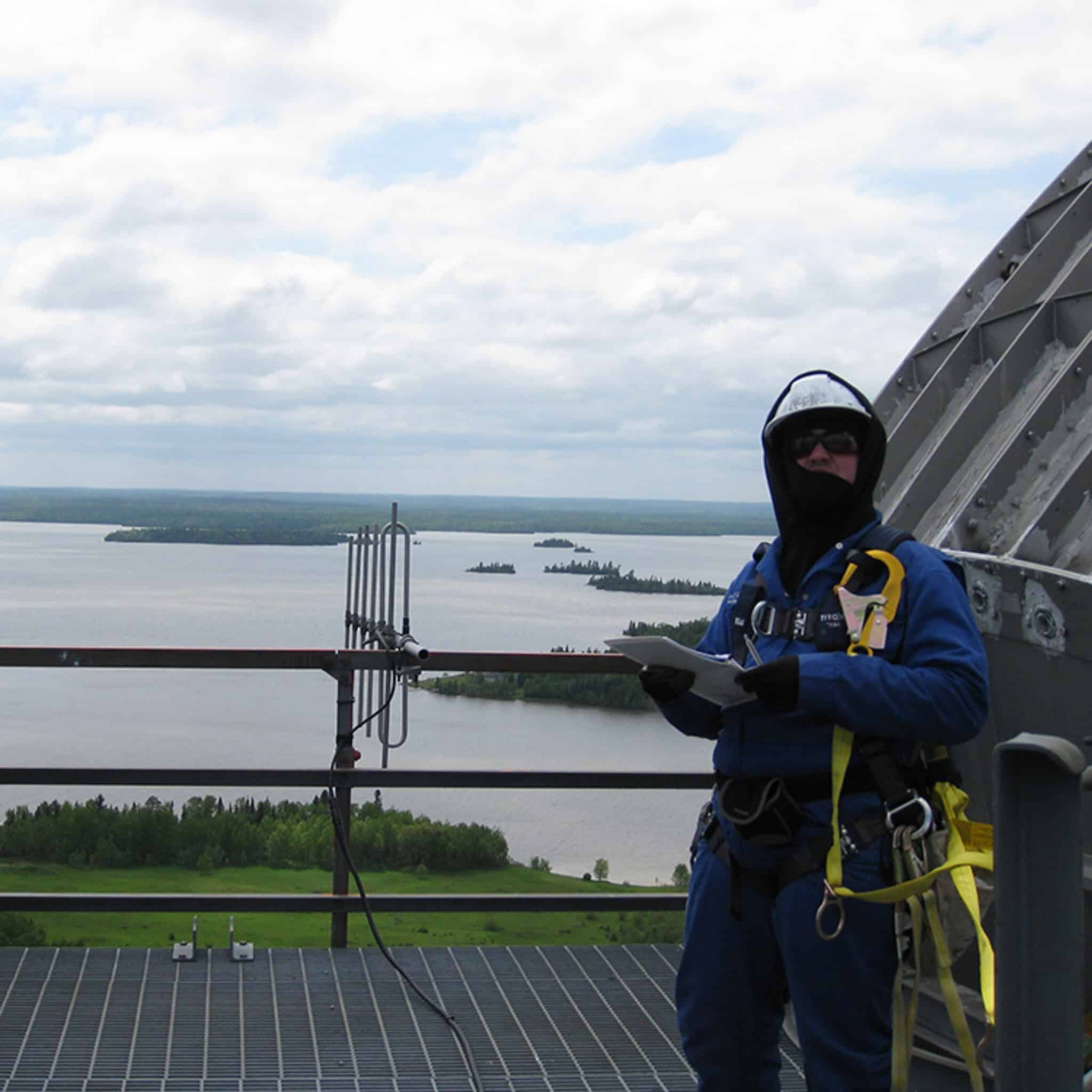
The product is fewer handoffs
Plenty of firms can produce a structural report. Plenty of contractors can replace steel. Varcon's more defensible proposition is that a client should not have to conduct an orchestra every time a crack appears. Inspection, engineering, fabrication coordination, construction management and final verification can move through one accountable workflow. That matters because the conventional sequence is full of waiting: hire an inspector, receive findings, tender engineering, approve a repair, find a crew, then discover that somebody interpreted the drawing differently.
Varcon turned that chain into a standing urgent-response program for a major Canadian telecom operator. The client sends roughly 30 priority issues a month; the company says it remediates more than 250 a year, often within 15 days. There is still a formal quote - speed is not permission to become vague - but the working relationship and combined disciplines remove much of the procurement drag. A repeat emergency becomes a managed queue. For the client, the payoff is not just a faster bolt replacement. Predictable response time makes maintenance budgets and upgrade plans less fictional.
What failed first
The sharpest proof arrived in February 2020. Two monopole towers belonging to a large carrier collapsed within three weeks, just as the pandemic began complicating travel. Investigators identified tower fatigue: bolts had rusted and developed cracks before a chain reaction brought the structures down. Up to 500 similar towers might have been exposed. Varcon, then a minor regional consultant to the carrier, organized a national response under shifting provincial restrictions.
The crisis did not begin with an exotic material. It began with a bolt nobody wanted to think about.YesPress analysis of Varcon's national mobilization
Teams triaged the portfolio, flagged 45 towers for immediate intervention, and inspected, repaired and documented more than 300 monopoles over the following months. The repair effort cost millions, according to Varcon, but no precise total is public. The company says the client has had zero tower failures since. Just as important, photo documentation of every bolt replacement became a new maintenance standard. Two collapses changed the carrier's mind about treating each site as a one-off job; evidence, triage and repeatable documentation became the system.
A pair of sloshing white cans
Varcon can also be pleasingly literal. A 30-metre monopole in Calgary was vibrating as wind curled around its cylindrical surface. The alternating vortices were close enough to the tower's natural frequency to create repeated motion, accelerating fatigue. The required damping improvement was 3.2 percent. Heavy reinforcement could address the risk, but the top of the tower had an access hatch occupying the obvious installation space.
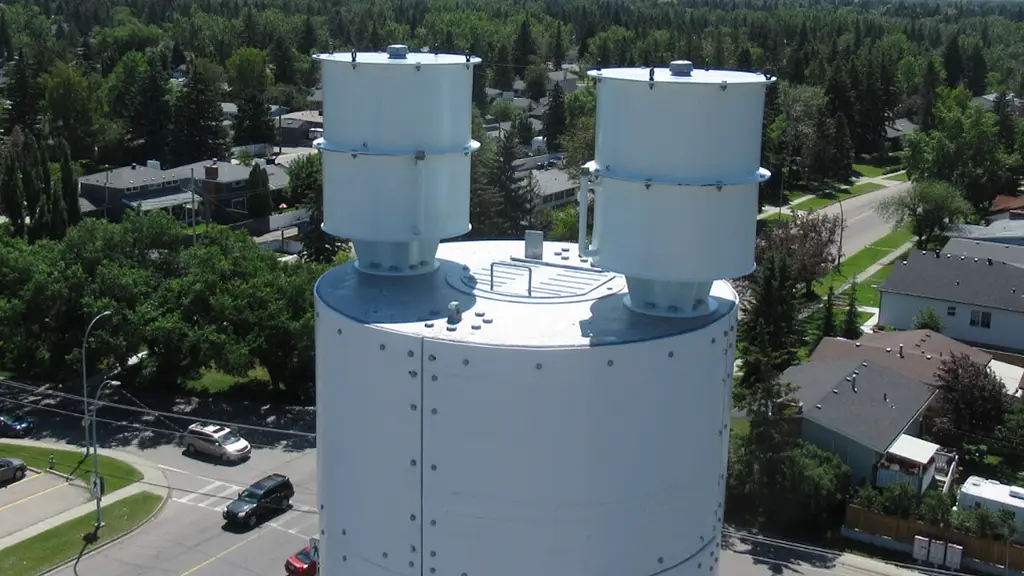
The Alberta team split a tuned liquid damper into two smaller units. Liquid moving inside sealed chambers countered the wind-driven oscillation; the pair fit around the hatch without changing the tower's basic design. Post-installation testing measured a 3.74 percent improvement, beating the target. It is a compact example of Varcon's niche: high-fidelity analysis ends in a physical intervention a crew can install. The elegant answer was not more tower. It was two containers of moving liquid placed in exactly the right spot.
The island that nearly disappears
Another project replaced wind with water. On a small, uninhabited island in the Bay of Fundy, salt exposure had eaten away more than half the cross-section of tower anchors. A grout pad washed out, one tower leg dropped, and bracing buckled on two faces. The island is routinely submerged around the base at high tide, leaving no stable work area. A collapse could have interrupted power to remote communities.
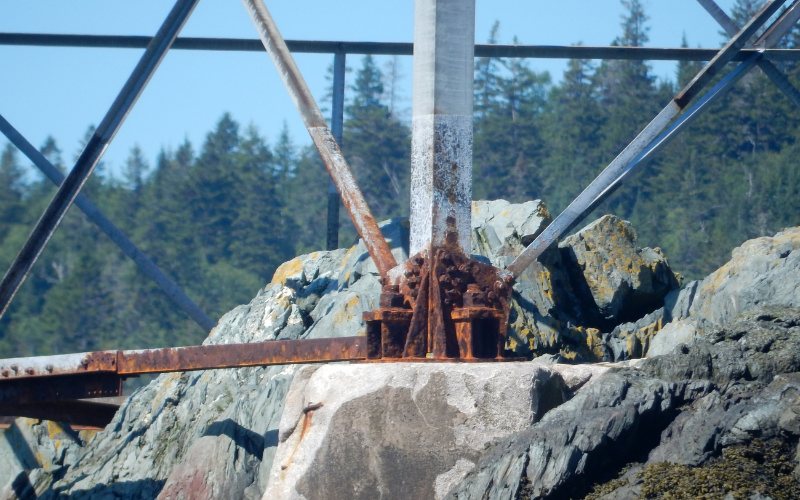
Varcon designed emergency stabilization, then a full refurbishment. Crews encased footings in concrete and modified the structure so primary components sat above the high-tide line. Concrete delivery had to be synchronized with access to the island. Follow-up inspections confirmed the repair, and Varcon estimates that the intervention added more than 25 years of service life. This is where its market extends beyond telecom: towers are also supports for power, radar, navigation and industrial communication, and each harsh site invents a different way to punish steel.
From snapshots to a pulse
Traditional tower maintenance is periodic. An inspection every three to five years offers a detailed snapshot, but a cracked weld does not consult the calendar. Through a partnership with Australian structural-monitoring company Viotel, Varcon now sells accelerometer-based monitoring of the tower itself. Sensors track natural frequency and vibration; meaningful changes can indicate loose bolts, cracked welds, missing members or impact damage. Most remote tower systems watch peripheral equipment such as doors, lights and power. This one listens to the structure.
Varcon says savings can exceed C$10,000 per tower over four years by reducing unnecessary climbs and directing crews toward assets whose data warrants attention. The larger prize is a longitudinal record: owners can compare towers across a portfolio, prioritize reinforcement and decide where another antenna can safely go. This nudges a project consultancy toward a recurring relationship, with monitoring generating the next inspection or engineering assignment.
How the business changed hands
The company itself needed a lifecycle plan. In 2019, Sean Hayman and Trevor Bolt - senior employees with six and 19 years at Varcon - joined marketer David Lewis to buy the business from the Vardy family. BDC Capital supplied C$2 million in mezzanine financing alongside a senior lender and investments from the buyers and sellers. The patient, non-dilutive structure was designed to protect operating cash while the new owners pursued growth. Lewis, initially brought in to lead marketing, is now chief executive; Hayman is chief operating officer and Bolt remains a co-owner and senior technical leader.
The management buyout explains some of Varcon's tone. It is an operator-owned consultancy, not a roll-up imposed from another city. Leadership biographies emphasize people who have analyzed thousands of towers, supervised field teams and contributed to standards. The careers page promises coaching and clear goals, but it also advertises the part a brochure cannot soften: some engineers wear harnesses and climb.
Turn the ugly exception into a designed service.
- Map the full delay between diagnosis and resolution, including procurement and documentation.
- Pre-build a triage rule so urgent cases do not depend on whoever shouts loudest.
- Keep a formal quote, but standardize everything around it: evidence, drawings, dispatch and closeout.
- Document the repair as carefully as the defect. Today's photo is tomorrow's maintenance record.
- Add monitoring only where an owner can act on the alert. Data without a response path is decoration.
Where the model bends
Vertical integration works when downtime is expensive, defects cross disciplines and the buyer values one accountable lead. It is less convincing for commodity drafting, a simple local build, or a client that requires strict separation between designer and independent reviewer. Continuous monitoring also needs enough asset value and failure risk to justify sensors, connectivity and analysis. A small, accessible tower with cheap routine inspection may never clear that bar. And no sensor replaces a crew when the question is corrosion hidden behind a connection.
The condition: Varcon's playbook is strongest for distributed, regulated assets where the cost of delay exceeds the premium for coordination. If the work is simple, local and low-risk, specialist vendors may be cheaper.
That restraint is part of the appeal. Varcon occupies a practical middle ground between a global engineering conglomerate and a local tower crew. Its approximately 65 people are large enough to mobilize nationally but specialized enough to know why a hatch at the top of one Calgary monopole changes the entire design. The company sells engineering hours, inspections, program management and monitoring, but the real product is closure: a questionable structure becomes a documented structure, then a safe one, without the customer losing the thread between the two.