Usman Iftikhar had done what the prospectus implied he should. He had moved from Pakistan to Australia, completed a master’s in engineering management at the University of Wollongong and graduated with distinction. His résumé carried volunteer work, student leadership, two Australian internships and references. There was, on paper, rather a lot to recommend him. The Australian job market remained unconvinced.
He began looking for the missing variable. Perhaps he needed more applications. Perhaps more networking. Perhaps his name was getting in the way. In his account of that period, he called the elusive requirement an “ingredient ‘X’”. That is an engineer’s way of describing a very human predicament: you have followed the instructions, assembled the parts and still cannot make the thing work.
He had arrived in 2013. By 2016, he and Jacob Muller had co-founded Catalysr, an organisation helping migrants and refugees start businesses in Australia. The route between those dates matters. A personal disappointment became a question about who gets to use their skills, and who gets left waiting for permission. Iftikhar decided there might be another way into working life.
The decision contains a pleasing complication. Finding it hard to secure meaningful employment, he helped establish an organisation that would teach other people how to create it. There are more conventional responses to an unsuccessful job application. Few involve becoming responsible for an entire room of aspiring founders.
Ten people, nine weeks, two businesses
Iftikhar grew up in Pakistan and trained as a mechanical engineer at the Ghulam Ishaq Khan Institute of Engineering Sciences and Technology. His early experience already stretched beyond one country. AIESEC took him into international volunteer and community work; a management traineeship brought him to Krasnoyarsk in Russia in 2011. Moving to Australia continued that habit of learning through unfamiliar surroundings.
The practical beginning of Catalysr was smaller than its later reputation might suggest. Iftikhar joined the School for Social Entrepreneurs in Australia, met Muller and started turning the idea into a program. A nine-week pilot ran at the Collaboratory coworking space in Parramatta, with the Community Migrant Resource Centre as a partner and funding from the NSW Office of the Small Business Commissioner.
Ten immigrants took part. Two had launched trading businesses by the time Iftikhar described the experiment in January 2017. One was Waleed Elsabbagh, a marine engineer from Egypt who also struggled to find work in Australia. His business, Koshari Korner, brought Egyptian street food to customers. Another was Long Phan, a former international student from Vietnam, whose migration and investment consultancy served Vietnamese entrepreneurs.
Those examples gave the idea some weight. A marine engineer could bring a different skill to market; a former international student could help others navigate a journey he understood. Neither needed to shed the experience accumulated before Australia. The question was how to put it to work, with enough local knowledge and enough people willing to help.
“Migrapreneurs” became Catalysr’s shorthand for migrant and refugee entrepreneurs. It is a slightly crowded word, doing the work of a small sentence. But it keeps the entrepreneur in view. The person entering the room has an idea, experience and ambitions, along with the practical task of learning how business works in a new country.
The quiet person taking notes
One revealing account of Iftikhar comes from startup mentor and Catalysr director Alan Jones. Iftikhar shadowed him at the Startmate accelerator, watching mentoring meetings, asking questions and taking notes. Jones remembered a quiet observer. A month or two later, Iftikhar returned with Muller and a plan for their own program, including ways to reduce friction he had noticed at Startmate.
The anecdote is more useful than a string of adjectives. It shows someone willing to learn the machinery before trying to improve it. A mentoring session contains information beyond the advice being offered: who speaks, where people get stuck, what gets repeated, what a newcomer has to know before the conversation can even begin. Iftikhar was paying attention to the arrangement of the room.
Catalysr’s work deals with those ordinary obstacles. Its early-stage programs help founders test whether customers need a proposed solution before spending time building it. Community sessions connect participants to one another. Later-stage support introduces businesses to investors and mentors. By 2021 the pre-accelerator had expanded across Australia, beyond its earlier concentration in Sydney and Melbourne.
The distinction between stages is practical. Someone with an idea needs space to question it. Someone with a product and customers may need a different conversation about funding or growth. Treating both as simply “entrepreneurs” is administratively convenient and not especially helpful. Iftikhar’s work has involved building the connections around each stage, rather than assuming a good idea will find its own way.
I am a mechanical engineer by training.”Usman Iftikhar · 2018
A royal handshake, then more homework
In April 2018, Iftikhar received the Commonwealth Young Person of the Year award from Prince Harry in London. He was also the Pacific regional winner. The award brought an unusually public moment to work that had begun in a Parramatta coworking space. At the time, Catalysr had worked with 66 migrapreneurs and helped launch 15 businesses.
Asked about the recognition, Iftikhar treated it as validation for the team and a chance to strengthen partnerships. His stated ambition was to help create 10,000 jobs in Australia. That figure was a mission, with all the uncertainty a mission contains. The useful question after the photograph was how to build an organisation capable of keeping going.
His 2019 Westpac Social Change Fellowship gave him room to study that problem. He travelled to meet people working on social enterprise and refugee entrepreneurship, attending the Social Enterprise World Forum in Ethiopia and a global refugee entrepreneurship summit in the United Kingdom. He completed Stanford’s Executive Program in Social Entrepreneurship in 2020. The chief executive continued making time to be a student.
The same period brought selection for the Obama Foundation’s inaugural Asia-Pacific leaders cohort in 2019. Those connections reached beyond personal recognition. He helped develop the Global Refugee Entrepreneurship Network and became the inaugural chair of its Design and Delivery Working Group. He also worked with a New Zealand collective to pilot Catalysr’s approach there. A local experiment was becoming something other places could adapt.
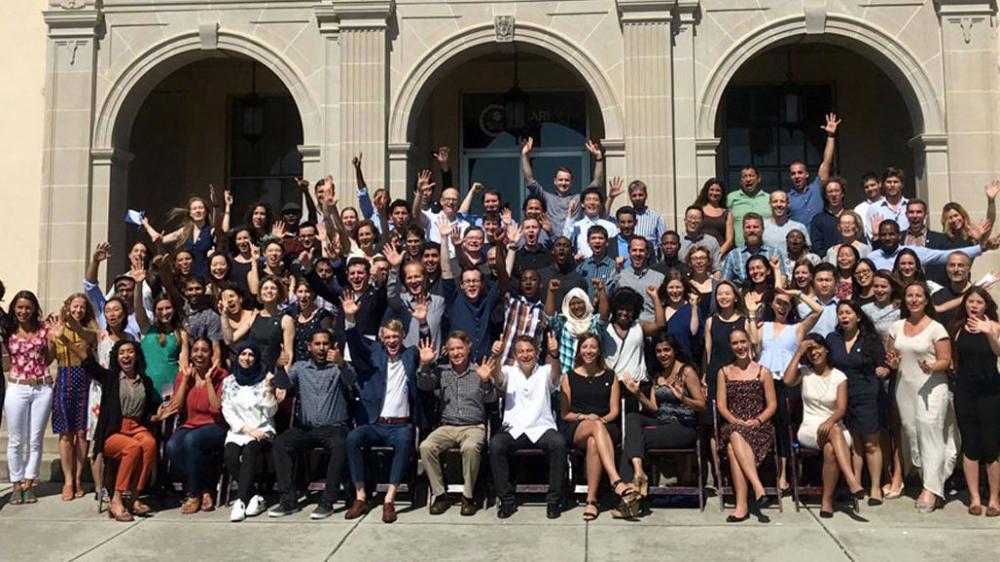
Photo: University of Wollongong feature archive.
There is also the small matter of space
An accelerator for migrant founders would occupy most people quite adequately. Iftikhar’s interests also extend beyond the atmosphere. In 2017, he joined Singularity University’s Global Solutions Program, spending nine weeks at NASA’s Ames Research Center in California. The program brought together participants from 40 countries to work on projects with ambitions measured in billions of people.
Space appealed to a question already running through his work: who gets access? Growing up in Pakistan, he had not regarded a career in the space industry as readily available. Meeting people building space technologies made the field seem less remote. With fellow program graduate Henry Sung, he co-founded an initiative called Space Without Borders, linking space innovation to social impact.
His interest in satellites also connects to climate. Better observations of Earth can help people understand changes taking place on it. “You can’t improve what you can’t measure,” he said. The line is compact enough to fit on an engineer’s desk, though the work it describes is rather less tidy. His later role at New Zealand-based SpaceBase, leading growth and partnerships, continued that interest in widening access to the industry.
There is a consistent concern beneath the change of scenery. Migrant entrepreneurship and space technology both involve people approaching systems whose rules and relationships may be unfamiliar. Iftikhar has chosen to work on making entry possible. The subject changes from business networks to space networks; the interest in who is allowed to participate remains recognisable.
Photo: University of Wollongong feature archive.
The second border crossing
By October 2026, Catalysr’s published totals stood at more than 1,300 migrapreneurs from 87 countries and more than 300 businesses created. Women represented 48% of the founders supported. These are cumulative program figures, not a count of investment exits or a promise about every participant’s outcome. They describe the reach of an organisation that began by putting ten people through a pilot.
Iftikhar is now asking what happens after a migrant founder has established a business in Australia. In an August 2026 essay, he outlined a new chapter called Market Makers. A founder who understands two countries may have a useful starting point for international expansion: language, cultural knowledge and relationships built over years. Experience that once complicated the job search can become commercially useful across borders.
The first initiative is Victoria India Market Makers, delivered with Vaurora Social Impact and Indian delivery partner Startup Réseau, with support from the Victorian Government. It targets Victorian founders of Indian heritage with businesses ready to expand. The design includes preparation for up to 20 participants, followed by a selected delegation of up to ten founders to Mumbai and Bangalore in late November and early December 2026.
It is a different assignment from helping someone test a first idea in Parramatta. Yet the progression makes sense. First, help founders find their footing in Australia. Then help established businesses use their knowledge of another market. Catalysr’s tenth year provides an occasion to revisit the assumptions behind its first: migration can bring commercially valuable knowledge as well as immediate practical difficulties.
There is something fitting about Iftikhar returning to writing while making this argument. After encouragement from Jones, he resumed publishing longer reflections on his work. The person who once took notes at someone else’s mentoring sessions now has a decade of his own to examine. The missing ingredient in his Australian career eventually became a program other people could enter. He is still adjusting the recipe.
Migrant and refugee entrepreneurs supported
Follow the next chapter
Writing, conversations and the work in progress.