A company can sign a promise in an afternoon. Changing the way it buys copper, calculates emissions or hears a worker’s complaint takes considerably longer. At UN Global Compact Netzwerk Deutschland, that difference has a number attached: about 50 hours. That is the workload suggested for its next six-month Business & Human Rights Accelerator. The signature opens the door. Somebody still has to turn up.
- Learn through accelerators, practical guides and small peer groups.
- Pay membership dues based on turnover; budget staff time too.
- Report progress annually. Participation does not certify performance.
The German network brings together businesses, civil society, academics and public-sector representatives around the UN Global Compact’s Ten Principles. Its territory stretches from human rights and labour standards to environmental protection and anti-corruption. The practical question running through the offer is pleasingly unglamorous: how does a principle become something a purchasing department, finance team or manager actually does?
01 / The meeting after the promise
Consider the human rights accelerator scheduled to begin in February 2027. It covers identifying adverse impacts, translating findings into action, involving stakeholders and establishing complaint and remedy mechanisms. Companies must name two active participants and a leadership representative who follows and supports the work. Global learning happens in English; local exchanges happen in German.
For eligible members, the program carries no additional fee. Its estimate of roughly 50 hours includes around 20 hours of sessions and two hours of e-learning; the remainder goes into assignments inside the company. That allocation reveals the design. A workshop can explain a problem. The work between workshops connects it to an actual business.
Climate management has a similar rhythm. The six-month Climate Ambition Accelerator teaches greenhouse-gas accounting, emissions management and science-based target setting. More experienced practitioners can join climate peer groups of 10 to 12 companies to discuss questions such as Scope 3 emissions and climate-risk analysis. A small group makes room for the awkward details that a grand declaration tends to omit.
02 / Twenty-three years to get its own keys
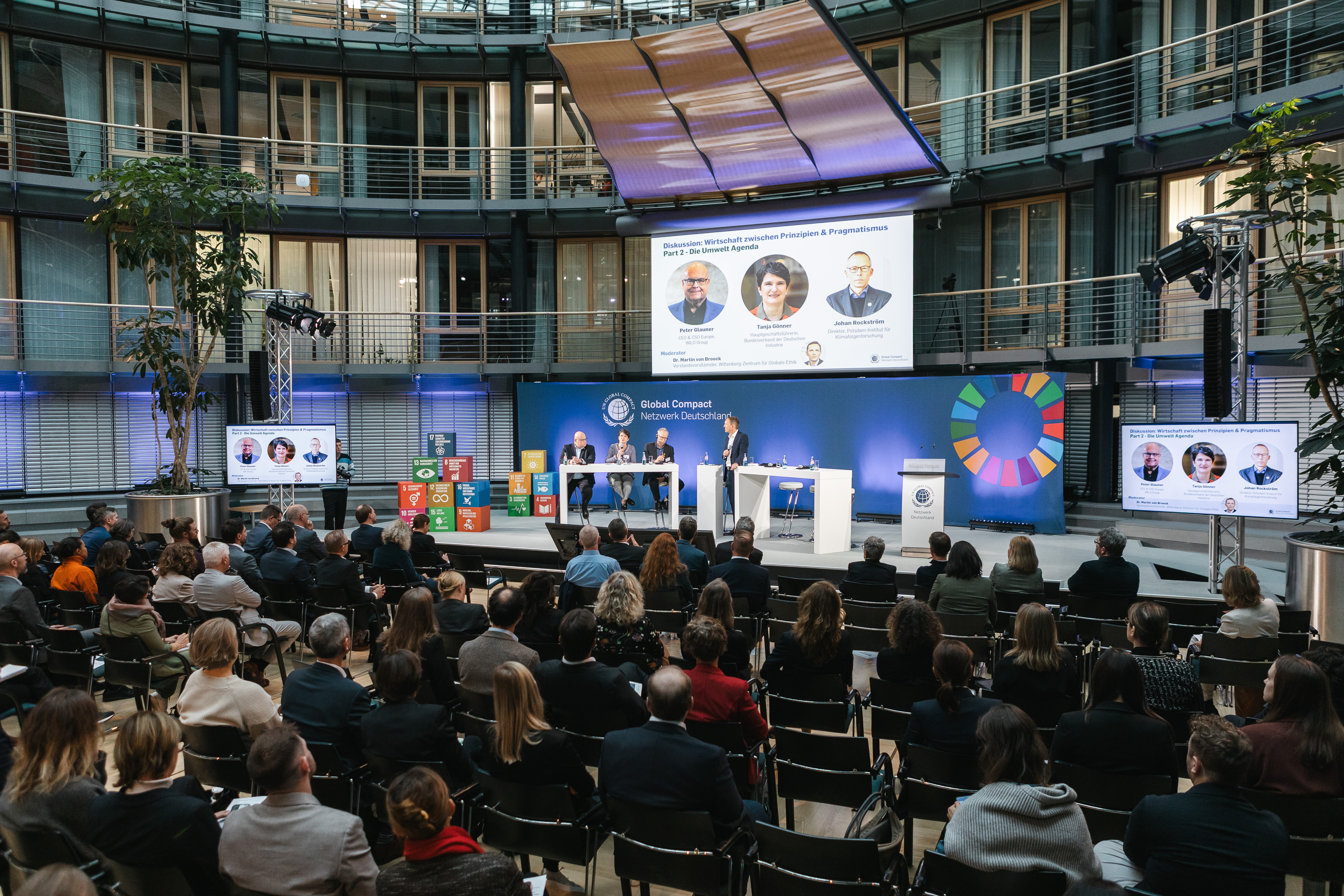
The dates tell an unusual institutional story. The German network began in 2000 on the initiative of German companies. Its current nonprofit association, UN Global Compact Netzwerk Deutschland e. V., dates from May 2023. Those years describe different milestones, rather than rival accounts of the same birthday.
Previously, GIZ carried the secretariat on behalf of the German government. The global initiative asked its country networks to become independent. After examining the options, the German network’s steering group chose an association; a majority at the November 2022 participant assembly supported the move. The change gave an established network its own institutional footing.
Its governing board combines business, civil society and government representatives, elected for two-year terms and working by consensus. That arrangement matters because a company’s definition of progress may differ from a union’s or an environmental organization’s. The structure gives those perspectives a place in the conversation, rather than leaving the entire discussion to the people buying the membership.
03 / An invoice sized to the business
This is a nonprofit membership model. Under the contribution schedule effective from 16 April 2026, independently listed companies with gross annual turnover below US$25 million pay €500 a year. The next tier, US$25 million to US$50 million, pays €1,000. Above US$30 billion, the annual contribution reaches €27,600. Subsidiaries have separate arrangements; non-business members are exempt.
The contributions develop programs and activities, with a portion passed to the global UN Global Compact foundation. Members gain access to learning and dialogue formats, while public resources offer a useful entrance without an application. Recorded webinars, guides and tools let a sustainability manager investigate a problem before asking colleagues to commit.
The network’s expertise is broad but connected: climate, water, biodiversity, human rights, integrity, reporting and sustainable finance. A water-management guide developed with WWF Germany asks companies to examine risks in context. Cooperation with the German Institute for Human Rights supports exchanges for human rights officers. The Alliance for Integrity contributes to anti-corruption work.
04 / The certificate people imagine
There is an important limit to the bargain. The network says the initiative has neither the mandate nor the resources to monitor or measure participating companies’ performance. Membership therefore supplies a commitment and a learning environment; readers should judge a company’s conduct using evidence about that conduct.
“Give globalization a human face.”Kofi Annan’s 1999 call to business, recalled in the network’s anniversary report.
Business participants must publish an annual Communication on Progress, or CoP. It includes a CEO statement and reporting on sustainability efforts. In 2026 and 2027, a sustainability-report PDF can replace the standardized questionnaire. A recurring deadline gives the commitment a calendar, although reporting alone cannot prove that conditions have improved.
Its June 2026 supply-chain study illustrates why implementation deserves scrutiny. Analyzing 313 public reports from 254 companies, it found that only 16% reported assessing whether affected people trusted complaint procedures enough to use them. Installing a channel and understanding whether workers trust it are different tasks. The finding concerns the study sample, not a verdict on every network member.
05 / Borrow the method, reserve the time
Consultancies can provide tailored implementation; reporting software can organize data; industry associations can concentrate on a particular sector. UN GCD’s place is between these services: an official country network combining international principles with local learning and dialogue. In July 2026, it continued the energy sector dialogue independently with 21 members, following its 2025 takeover of the automotive dialogue.
The approach is worth copying at a smaller scale. Choose one operational problem, use a public guide, assign an owner, find peers and schedule a review. Companies joining an accelerator should reserve the hours and secure leadership support first. Without access to colleagues, data and decisions, even an excellent discussion can end as a handsome notebook.
The network reported 59 one-off offerings and more than 5,000 participant attendances in 2025. Those figures measure activity. The useful outcome for an individual business is more specific: a better emissions inventory, a clearer risk assessment or a complaint procedure workers can use. A pledge becomes interesting when somebody can describe what happened afterward.