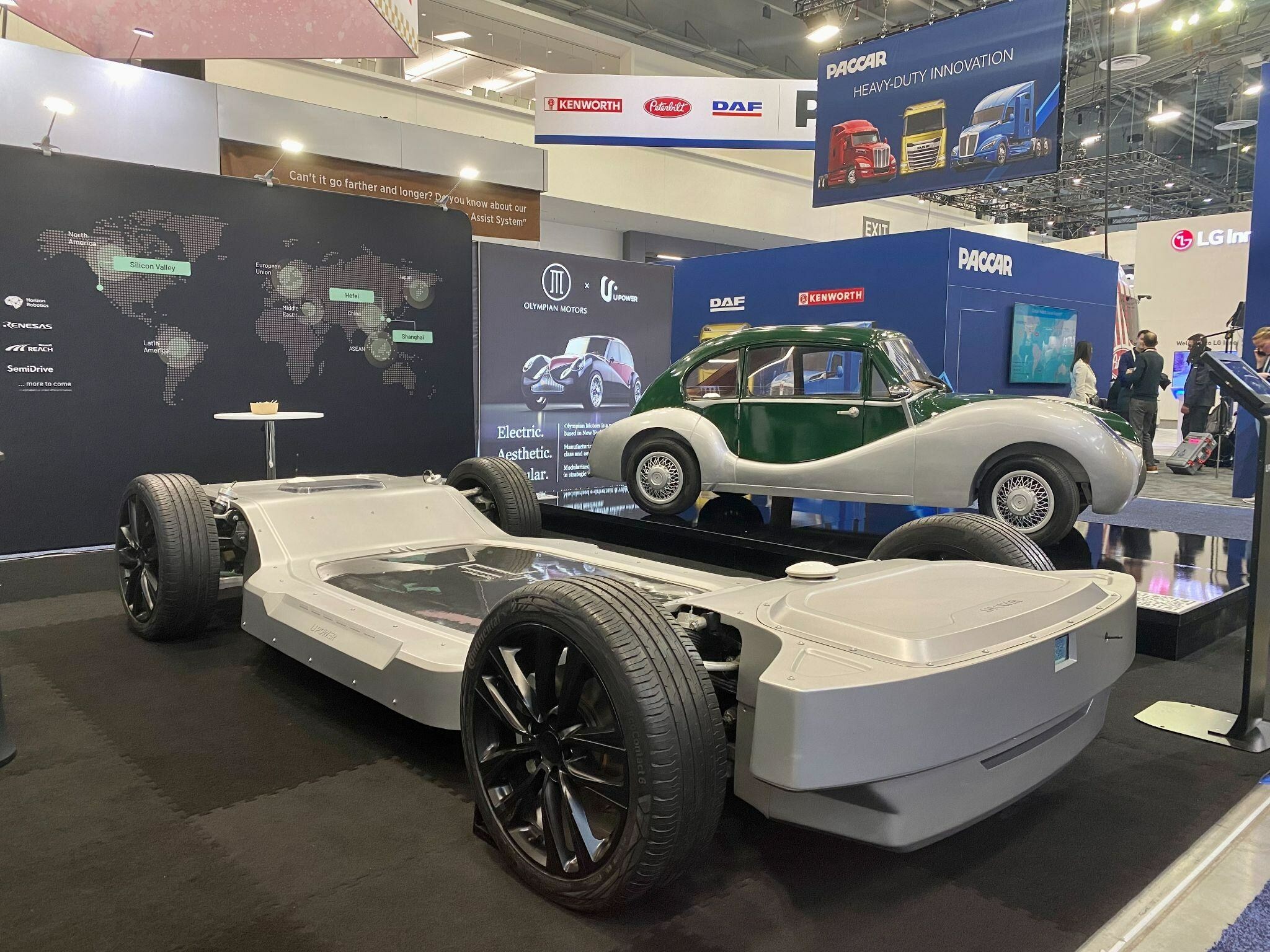
The Bottom Half of the Car
Feature · By the YesPress desk
There is a durable, expensive habit in the car business: every new electric vehicle starts, more or less, by reinventing the same slab of steel, battery and motors underneath the floor. U POWER Tech's pitch is that you can stop doing that.
The product is called the UP Super Board, and the company describes it as China's first mass-producible skateboard chassis-by-wire. The name is doing some work. "Skateboard" refers to the flat, board-like layout that carries the battery and drivetrain, so a body - a van, a pickup, an SUV - can be mounted on top the way a deck sits on a board. "By-wire" means the steering and braking are controlled through software and electrical signals rather than only mechanical linkages, which is precisely the property a body-builder needs if it wants to bolt on any cabin it likes and have the thing still drive.
Put those two ideas together and you get the business model. U POWER integrates the parts that are genuinely hard - electric propulsion, suspension, steering, braking, thermal management, and a Level 2+ advanced driver-assistance system - into a single validated platform. An automaker or fleet operator then designs the part customers actually see. The company's claim is that this shortens EV development by at least six months. In an industry where a product cycle is measured in years and a rushed one still isn't fast, six months is not a rounding error.
It is worth being clear about what is unusual here. U POWER is not, primarily, trying to sell you a car with its badge on it. It is trying to sell the layer beneath the badge, to everyone. This is closer to a components-and-platform play than to a consumer brand - the sort of decoupling that has reshaped other industries, where one firm standardizes the hard, shared layer and a thousand others build on top. Whether that works in automotive, which has resisted this kind of unbundling for a century, is the open question. But the thesis is coherent, and the company has been unusually direct about stating it.
The founders come from inside the industry rather than around it. Paul Li, the CEO, previously ran Great Wall Motor's high-end EV brand before starting U POWER in 2021 with co-founder Yao Zhai. The company set up on two coasts of the Pacific - a North American headquarters in Sunnyvale, California, and operations in Shanghai - and staffed itself from traditional OEMs, EV startups and internet-tech companies. That mix is deliberate: the chassis is a hardware problem, but the "by-wire" and ADAS parts are software-and-silicon problems, and U POWER has partnered with the chipmakers who supply that side, including NVIDIA, Renesas and Horizon Robotics.
"Design more customized upper bodies - from sedans and pickups to SUVs and vans - while slashing development time by at least six months."
The most persuasive evidence, so far, is demand for a finished vehicle built on the platform. The UP VAN - pitched, with the usual confidence of a press release, as the world's most energy-efficient commercial delivery van - has drawn more than 53,000 orders from customers in North America, Japan, Southeast Asia, Europe and China since it was announced. Orders are not deliveries, and a young company's order book should always be read with a raised eyebrow. But the number tells you something real about the market U POWER is aiming at: in commercial and last-mile logistics, the bottleneck was rarely appetite for electric vans. It was the cost and time of building them.
The partnership list reads like an argument in itself. A strategic tie-up with Bosch, the world's largest Tier-1 auto supplier, is not the sort of thing that happens to a company nobody takes seriously. First deliveries of the UP Super Board went to Olympian Motors, a new-gen EV company in New York. A development contract for the UP VAN was signed with Detroit-based LUMOS EV. Overseas, there are partners in Japan (G Three Holdings), the Philippines (ALACO) and Europe (FEST). For a five-year-old firm, that is a lot of counterparties betting that the chassis underneath is good enough to build on.
None of this makes U POWER a sure thing. The skateboard-chassis idea has attracted a competitive field - REE Automotive, Canoo, Rivian's commercial platform and others have all made versions of the same bet, and not all of them are thriving. The economics of being the standard layer only work if enough body-builders actually standardize on you, which is a chicken-and-egg problem that money and momentum solve slowly. What U POWER has going for it is a mass-production story rather than a concept, a Tier-1 partner willing to attach its name, and a founder who has clearly decided that the more interesting move in a mature industry is not to build another car, but to build the thing every car sits on.
#ev#skateboard-chassis#chassis-by-wire
#up-super-board#commercial-ev#last-mile
#adas#b2b#sunnyvale#shanghai