A customer has found something worth buying. A merchant would quite like to sell it. A bank, somewhere, has money it would quite like to lend. One might expect these parties to get along splendidly. Tushar Srivastava has built a company around the considerable difficulty of introducing them.
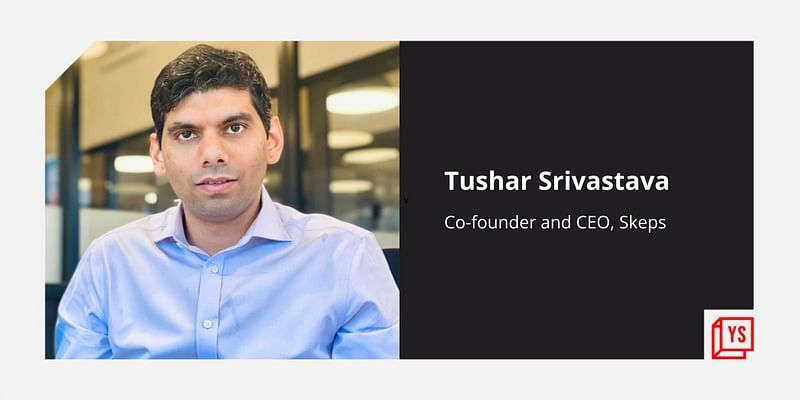
As co-founder and CEO of Skeps, he works on the machinery that brings financing into a purchase. The ambition sounds modest when stripped of industry vocabulary: let someone encounter a relevant credit option while they are deciding what to buy. Anyone who has abandoned an application halfway through can appreciate the appeal. A sale can survive a difficult choice of colour; it may fare less well against an expedition through unfamiliar forms.
Srivastava approaches that small drama with a background in payments and credit risk. His story sits at the meeting point of banking habits, merchant expectations and customer patience. It is a useful place to build a business, provided one enjoys dealing with several kinds of complexity at once.
An engineer learns the lending business
His education was in chemical engineering at IIT Delhi. His subsequent career took him into financial services: analyst and project management work at Inductis, a vice-presidential banking and financial services role there, and risk work at LendingPoint. The route into Skeps ran through the lending business itself.
That background matters to the kind of founder he became. A credit product has to make sense to the institution offering it, as well as to the person applying. The attractive interface is only the part a shopper gets to inspect. Underneath sit decisions about eligibility, information and how an offer reaches the customer.
In March 2022, he joined Akshay Datt for an 83-minute Founder Thesis conversation about point-of-sale financing. The subjects included lender integration, fundraising and the use of blockchain. It was a fitting combination for his career: institutional experience translated into a technology business, with plenty of practical questions left to answer.
A brother, a friend, a beehive
Skeps was founded in 2018. The people involved had known one another considerably longer. Prerit Srivastava is Tushar’s brother; Mayank Tewari was a schoolmate. Their working relationship began with an existing stock of familiarity, a resource rather harder to arrange than a shared calendar.
The name comes from a skep, a traditional beehive. The company uses the image to explain cooperation: separate participants contributing to a shared result. It is a surprisingly domestic name for a business concerned with credit distribution. Bees, at least, have never required a presentation explaining the advantages of a network.
Tushar’s reflections on entrepreneurship make room for changes of direction. His description of the journey includes a phrase worth retaining: “the journey of an entrepreneurial venture is full of zig-zags”. In that account, mutual trust gives colleagues room to revise their understanding as the business develops. The original relationships help explain why cooperation became more than a convenient metaphor.
The bank has a box. The merchant has a queue.
The problem Skeps addresses begins with a mismatch. A merchant serves people with different credit profiles and purchasing needs. An individual bank has its own lending criteria. A customer who falls outside one lender’s criteria may still fit another’s. Connecting those possibilities is part of the platform’s purpose.
There is also a problem of information. Merchants may know things about their customers through previous interactions and loyalty programmes. Banks have their own underwriting methods. In his explanation of Skeps, Srivastava describes technology that lets institutions use these separate pieces of information while keeping proprietary material in their own environments.
This gives his work a particular character. He has to make cooperation useful to organisations with good reasons to preserve control. A merchant wants the purchase to proceed. A bank wants to assess the customer on its terms. The technology has to serve both interests well enough for the relationship to work.
One purchase. Several possible lenders.
The art of letting the bank keep its name
White label lending is central to Srivastava’s argument. The term is less elegant than the arrangement: a financial institution can use someone else’s technology while offering a service under its own identity. The bank supplies the lending product; the platform helps put it into the buying experience.
In a September 2021 article, he laid out the practical case for buying that capability. An institution building a platform internally has to provide development, testing, maintenance and support. A vendor can spread technology costs across clients and bring experience from earlier implementations. His pitch concerns the work required to keep a service functioning after its launch.
There is an appealing absence of vanity in this business model. The technology company can do useful work while another brand remains visible to the customer. Success need not involve making the shopper learn a new company name. For a founder selling infrastructure, a quiet presence can be part of the proposition.
That helps explain his interest in banks as partners. The product is intended to give established institutions another way to reach customers. It asks them to connect their lending capabilities to the places people already shop.
“Ultimately banks have to come to the party and join the party, right?”
Tushar Srivastava · Banking Transformed, February 2022
Money for the unglamorous work
In September 2021, Skeps announced a $9.5 million Series A led by Bertelsmann India Investments, with existing investor Accel participating. The stated uses included expanding sales, marketing, engineering and product teams, growing the merchant and lender base, and broadening services.
Those are useful details because they put the funding in proportion. Capital pays for the people and work needed to deliver the product. A lending platform has to persuade institutions to join, make the connections function and support the resulting business. The announcement described a company preparing to do more of each.
Bertelsmann’s investment account identifies the opportunity as helping merchants find suitable credit solutions while enabling banks to offer branded financing and develop their lending portfolios. That is a demanding balancing act. A platform has several customers to satisfy, and each may arrive with a different definition of a good outcome.
September 2021
announced by U.S. Bank
A shorter application is a serious ambition
For the shopper, much of this institutional coordination becomes visible through a form. By January 2022, Skeps was using phone-number verification to prepopulate an application and running fraud checks in the background. QR codes could also begin an online application in a physical store.
The details are small enough to be overlooked and substantial enough to change the experience. Every field asks for a little more attention. Every unexplained transition gives someone another occasion to stop. The founder’s technical problem eventually becomes the customer’s decision about whether to continue.
Srivastava’s public appearances have repeatedly returned to that connection between enterprise technology and the end customer. In January 2022, he joined Rohit Sood and LetsTransport co-founder Pushkar Singh for a CNBC-TV18 discussion with Shruti Mishra about building for enterprises. The subject was how startups help large organisations reach customers faster. It placed his work in a broader company of businesses whose product must function inside somebody else’s operation.
The conversation moves to the kitchen table
By March 2026, there was another concrete institutional connection. U.S. Bank announced that Avvance had joined the Skeps platform. The announcement also introduced six- and seven-year Avvance loan terms for larger home improvement projects. These were bank product developments alongside an expansion of its integrated partner network.
Srivastava’s comment focused on the bank’s national reach, cost of capital and expanded term options. He linked those features to offer matching and a wider range of customer needs. The language fits his longstanding concern: the available product has to meet the purchase being considered.
A May 2026 Skeps article listed under his byline considered home improvement sales through the experience of colleague Mike Fredricks. Its emphasis was on introducing financing earlier in the conversation, giving customers access across channels and reducing repeated applications. The setting had moved from the online checkout to the conversation about a project at home. The underlying question remained recognisable: when does the customer get to understand the available options?
An invitation to the party
Later that May, Srivastava appeared on The Brunch Lab with Bertelsmann. The episode’s subject brought together blockchain, AI and the infrastructure for credit. Its description also promised a discussion of building through the zero-interest-rate era. The terminology around a business can change considerably while its central coordination problem persists.
There is a human scale to this story beneath the acronyms. An engineer moved into financial services, worked with lending problems, and built a company with people he knew. His business now asks institutions to cooperate at a moment when a customer needs a usable answer.
That gives Skeps a plain test. When someone is ready to buy, can the relevant financing arrive in time, in a form they can understand? Srivastava has chosen to spend his working life on the connections behind that question. A party with banks on the guest list may require rather more preparation than most. The invitation, at least, is clear.