Imagine submitting your own essay and receiving a similarity score of 100 percent. The number looks damning. Yet Turnitin’s student guide describes precisely this possibility: earlier drafts stored in an institution’s private repository can match the final submission. The software has found the words. Someone still has to explain how they got there.
That small distinction sits at the center of Turnitin, the Oakland education software company whose name has become classroom shorthand for checking originality. Its business depends on making comparisons at a scale no teacher could manage. Its usefulness depends on teachers resisting the temptation to let a comparison settle the case.
- Turnitin compares writing with existing material, supports feedback and grading, and sells assessment software.
- Institutions buy access; students usually encounter it through a course or learning platform.
- Its newer Clarity product records the writing process and offers instructor-controlled AI assistance.
The useful thing hiding inside peer review
Turnitin traces its beginnings to four University of California students: John Barrie, Emmanuel Briand, Melissa Lipscomb, and Christian Storm. Their original application helped classmates review one another’s work. Similarities between submissions revealed another problem worth solving. The company dates its education work to 1998; its own timeline places the launch of Turnitin.com’s similarity checking in 2000.
This origin explains an apparent contradiction in the product. Finding borrowed language and helping someone write better can be parts of the same task. Feedback Studio, launched in 2016, puts similarity checking alongside grading and formative feedback. An instructor can identify a passage that needs attribution, then explain how to fix it while revision is still possible.
The practical trick is to open the matched passages. A correctly quoted paragraph and an unattributed paragraph can both contribute matching words. A low score can also leave misconduct undiscovered. The score tells you where to begin reading.

The archive is part of the product
Turnitin’s media kit reports more than 91 billion web pages, 1.9 billion student papers, and 190 million journal articles in its comparison database. These are company-reported holdings, rather than independent measures of detection quality. Still, they explain why the business involves more than a clever text-matching algorithm.
Consider Crossref’s Similarity Check, powered by Turnitin’s iThenticate. Participating publishers contribute access to their published content and receive reduced-rate manuscript checking. Their participation expands the material available for comparison. Editors get a way to examine overlap before publication; the database gains more scholarly work to search.
That puts Turnitin between education software and research infrastructure. Feedback Studio serves classroom writing. iThenticate serves researchers and publishers. Gradescope groups similar answers for instructors to review and grade, including supported handwritten responses. ExamSoft handles secure digital assessment. The portfolio reaches from an undergraduate paragraph to a professional licensing exam.
Alternatives address pieces of that workload. Anthology’s SafeAssign offers text matching within Blackboard, while Copyleaks markets plagiarism and AI detection with learning-platform integrations. Turnitin’s particular proposition is the combination of its content collections, publishing relationships, and assessment products. Buyers still need to compare the tools against their own assignments.
Then the missing source became the problem
Generative AI changed the assignment. A machine could produce plausible prose without copying a passage that a similarity search would find. Turnitin introduced AI writing detection on April 4, 2023. Unlike matching text against an existing document, this asks a model to infer how the writing was produced.
An early obstacle was confidence in the result. In August 2023, Vanderbilt University announced that it was disabling Turnitin’s AI detector after testing, discussions, and concerns about transparency and false positives. That decision concerned the AI feature, rather than a rejection of every Turnitin product. It exposed the distance between producing a signal and trusting it enough to accuse someone.
Turnitin’s current guidance explicitly warns that its model can misidentify human and AI writing and must not be the sole basis for adverse action against a student. Reports suppress numerical results above zero and below 20 percent, where the company says false positives are more frequent. That threshold is a reporting rule, not a universal safe harbor for student work.
“Turnitin does not check for plagiarism.”
Turnitin’s own student guide
Show the draft, then the next draft
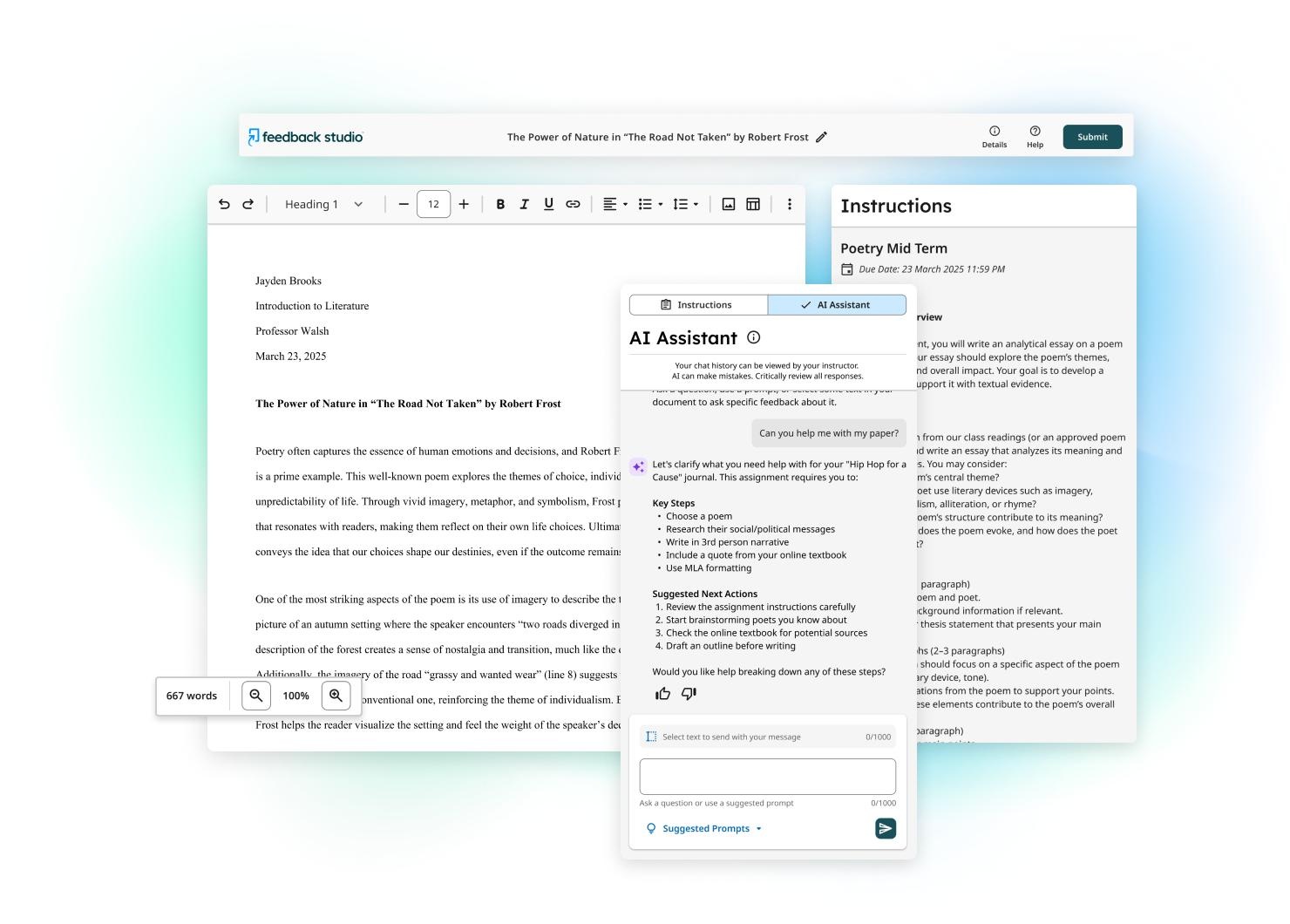
Clarity, announced in March 2025 and made available that July as a paid Feedback Studio add-on, changes what the teacher can inspect. Students compose inside a writing space. Instructors can review draft history, pasted text, writing activity, and interactions with the built-in AI assistant when enabled. The finished essay comes with a record of its construction.
“Students will need to use AI in their future careers,” product chief Annie Chechitelli said at the announcement. Instructors can permit assistance for an assignment and see how students used it. The company still sells detection. Alongside it, it now sells a place where some AI use can happen openly.
The change follows Turnitin’s reported conversations with educators after ChatGPT’s arrival. In August 2026, multipart assignments extended the approach: outlines, bibliographies, drafts, and final submissions could become connected checkpoints within one workflow. Turnitin was packaging a familiar teaching practice into its software.
There is a condition attached. A record of activity inside Clarity cannot reveal every thought or every action outside it. Pasted text needs context. Teachers must explain what assistance is permitted, and students need a chance to explain their process. More recorded activity only helps if someone can interpret it fairly.
Who pays for the extra context?
Turnitin primarily sells institutional software licenses, with prices depending on the organization, users, and features. Students generally receive access through their institution. For individual researchers, iThenticate publicly lists $125 for one manuscript up to 25,000 words and $300 for up to three manuscripts or one up to 75,000 words, excluding taxes. Those individual packages exclude AI writing detection.
The ownership history shows what investors thought the business was worth. Insight Venture Partners and GIC agreed to acquire parent company iParadigms for $752 million in 2014. Advance completed its acquisition of Turnitin in April 2019; the terms were officially undisclosed. These were ownership transactions, not a running total of venture funding.
The useful lesson costs less than a software contract: ask for an outline, discuss a draft, give feedback, and ask what changed. Turnitin can organize that evidence and search for overlaps. The educational work begins when a teacher asks the next question.
Keep asking questions
Explore the products, follow the company, or watch the writing workspace in action.