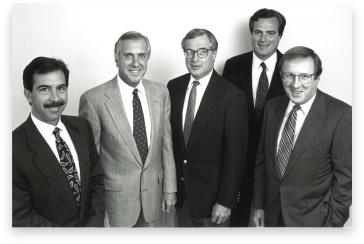
In the 1993 photograph, five men stand close enough to look like a small committee. Four are Trident Capital’s co-founders; the fifth is an adviser. There are suits, ties and very little indication of the sprawling technology portfolio to come. Look at it today, though, and a different question emerges. What happens when the expertise inside an investment firm becomes specific enough to deserve firms of its own?
- Trident backed information businesses, then expanded across enterprise technology.
- Its partners formed two specialist firms in 2015.
- The original team kept managing the original portfolio.
The answer is the most useful thing to know about Trident. Founded in Palo Alto in 1993, it financed companies across venture capital and growth equity. Its partners later formed Sunstone Partners and the cybersecurity business now called Forgepoint Capital. Trident itself continues to manage its portfolio. Those three identities explain more than a long list of investments ever could.
A map, a network, a business
Start with MapQuest. Trident says it helped fund and create the online directions business. Alongside it were less conspicuous information businesses: Cable Services Group, working in payment and billing services, and Pegasus, in travel reservations. The common thread was commercially useful information. Directions, reservations and billing each turn an awkward transaction into something a customer can actually complete.
That interest travelled well into enterprise technology. In April 2001, Qualys announced a $20 million second financing round with Trident and ABS Ventures among the investors. Qualys delivered vulnerability assessment over the internet. Customers could examine weaknesses in their networks remotely; service providers could build security offerings around that capability. Trident was financing a business that made a complicated technical job easier to buy.
The portfolio eventually included healthcare IT, cloud software, security and internet services. Familiar names such as Kayak, HomeAway, Teladoc and iRobot appear in its investment history. They illustrate breadth. They do not, by themselves, describe the economics of a fund: an investment list says little about ownership, the price paid or the cash ultimately returned.
The check came with homework
Trident’s stated service to entrepreneurs went beyond financing. Its history describes management advice, executive candidates, introductions to customers and strategic partners, and help planning liquidity. These are specific jobs. A company can have a functioning product and still need a sales leader, a credible first enterprise buyer or a plan for the next financing.
For a founder, that suggests a practical way to interview an investor. Ask which executive search the partner can help with. Ask which customer introductions are plausible. Ask how the partner has handled a company at this stage. These questions translate a broad promise of support into work someone can name and, later, assess.
Seven funds. Capital raised for investing, not annual revenue or a measure of investment returns.
The money belonged to investment funds. Trident reports raising $1.9 billion across seven funds between 1993 and 2010. Its January 2011 letter to the SEC identifies the latest, Fund VII, at $362 million. A Fund VII filing also describes an affiliate receiving an annual management fee calculated as a percentage of commitments. That is evidence of the management business behind the portfolio.
The SEC letter reveals how broadly Trident interpreted venture investing. It described backing seed companies, expansion businesses and later-stage companies, plus selected buyouts and investments in public companies. Its argument centred on operating risk and the prospect of growth. An unfinished management team could matter as much as the legal form of a transaction.
It also addressed a less glamorous problem: time. Portfolio companies sometimes needed bridge loans because a financing took longer than expected, or because reaching a near-term milestone could improve the next round’s terms. Trident argued that these loans belonged within venture investing. Behind the fund categories was a familiar operating predicament: a business could be making progress and still run short of cash before its next investor arrived.
There were two audiences for that work. Entrepreneurs needed resources to build companies; limited partners needed managers to look after investments over time. Hawaii’s retirement system, for example, reported a holding in Fund VII. The continuing portfolio therefore represents responsibilities to both companies and investors.
One partnership, two clocks
In 2015, those different kinds of investing acquired separate homes. The growth equity team formed Sunstone Partners, initially known as TC Growth Partners. The cybersecurity specialists formed Trident Capital Cybersecurity, renamed ForgePoint Capital in May 2018. Meanwhile, the Trident team continued working together on the existing portfolio. Starting something new did not erase earlier obligations.
“We spun out to build a new firm focused exclusively on growth stage investing”
John Moragne and Michael Biggee · April 2016
Sunstone’s April 2016 announcement made the distinction unusually concrete. Its first fund closed at $300 million. The stated targets included companies with at least $10 million in annual revenue, growth above 20 percent and operations at breakeven or better. Planned equity investments ranged from $15 million to $75 million per company. Those were its launch criteria, anchored to that moment.
Sunstone Partners
Growth equity
Technology-enabled services
Forgepoint Capital
Cybersecurity venture
Formed under the Trident name
The cybersecurity firm’s first fund also reached $300 million. By its 2018 renaming, it reported eleven investments from that fund. The specialist focus followed years of security investing. Trident’s earlier portfolio included Prolexic, which Akamai acquired in February 2014, and AlienVault, which AT&T agreed to acquire in July 2018 to expand threat detection and response for business customers.
The useful part is the fit
What distinguishes Trident’s story is the combination of a broad investment history and a deliberately more specialised next chapter. Operational help alone is no exclusive invention: software investor Insight Partners also describes recruiting and marketing support, while JMI Equity emphasises software expertise. The useful comparison is which team understands the company’s next problem and has a mandate suited to solving it.
Today, Sunstone describes $1.7 billion in committed capital across its first three funds and larger investment checks than it outlined at launch. That evolution is a reason to date the numbers. A 2016 growth threshold explains a historical decision; it should not become a permanent rule for a different business a decade later.
The lesson readers can borrow is modest: define the work before choosing the money. Specialist capital makes sense when its experience matches the business, its stage and its financing needs. For Trident, the present-tense description is portfolio management. The five men in the photograph began one firm. The expertise accumulated inside it eventually supported two more.