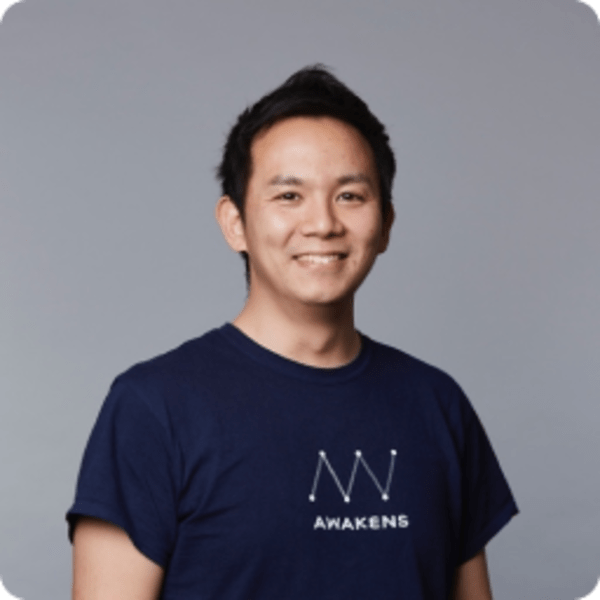
Somewhere in your inbox is a file you paid for and forgot. A spit test, a few weeks of waiting, a pie chart of percentages, and then nothing. Tomohiro Takano built a company on the suspicion that the file was worth more than the afternoon you spent reading it.
Today Takano is co-founder and CEO of Genomelink, the Berkeley consumer-genomics company that runs under the corporate name AWAKENS, Inc. The pitch is unusually clean for a biotech outfit: take the raw DNA data you already own from a service like 23andMe or AncestryDNA, upload it, and unlock a catalogue of apps - ancestry breakdowns, comparisons against ancient DNA samples, hundreds of trait readouts, and DNA matching with relatives you have never met. He has called the idea a "DNA App Store." The metaphor does a lot of work. The DNA test is the phone you bought; Genomelink wants to be the place you actually spend time once the novelty wears off.
What is striking about Takano is how little he resembles the cinematic founder. He does not sell himself as a daredevil. Asked to place himself on the entrepreneurial spectrum, he picked the unglamorous end without hesitation.
“Entrepreneurs are categorized either in the risk-taking type or risk manager type. I am the latter in that sense.”
It is a tidy line, and it would be easy to file him as cautious and move on. The trouble is the evidence. A risk manager does not usually move to a country where he has no visa, no funding, and a product that investors have already rejected. He did. And the most-told story about him is the kind a careful man is not supposed to generate.
The email that arrived one day too late to be sensible
By 2017 the team had run the experiment and the experiment was failing. They had landed in the Bay Area as outsiders - a Japanese founding crew with a thin angel round raised from their home network, no work visas, and not much of a map for how Silicon Valley money actually moved. The early product had been turned down. The runway was the kind you measure in days. So they did the rational thing a risk manager does: they decided to go home, and possibly to close the company.
“I still remember getting the SkyDeck acceptance email - literally one day before we were about to fly back to Japan and possibly shut the company down.”
Berkeley SkyDeck, the university's accelerator, said yes with roughly twenty-four hours to spare. The acceptance did the thing accelerators are supposed to do and rarely manage: it bought credibility the team could not buy for themselves. Network access. Strategic guidance. A Demo Day that gave the fundraising real momentum. The company that had been packing its bags instead pushed forward, raised a larger round, and later went through Y Combinator as well. The flight home was, in the end, the one decision he got to unmake.
Before the DNA: questions, not answers
Takano did not arrive in genomics by way of a lab coat. He studied at the International Christian University in Tokyo, taking a bachelor's in the liberal arts and then a master's in public economics. He talks about that education the way other founders talk about a first paycheck or a formative failure - as the thing that shaped how he works.
“Posing meaningful questions is the most critical skill. ICU forced us to spell out the challenges and pose the right questions on our own.”
From there his path reads like a slow zoom into the work he does now. He helped get Impact Hub Tokyo off the ground around 2013, working as a community and project manager for a space built to support social entrepreneurs - close to the energy of startups without being one yet. In 2015 he joined M3, Inc., a Japanese medical venture, as a business producer inside its Genomics Business Group, doing business development and marketing. That was the room where genomics stopped being abstract. By 2016, he and a couple of friends were spending their weekends building Genomelink on the side.
The founding team has a detail that sounds invented and is not: three of the four co-founders turned out to be classmates from ICU's English Education Program, a connection they only pieced together by coincidence after graduation. The company did not begin with a grand thesis and a pitch deck. It began the way a lot of durable things begin - as something a few people could not stop tinkering with on a Saturday.
The signal that the idea was not crazy
Before any of the rescue drama, there was a quieter moment of validation. The founders were not the only ones who thought DNA data deserved a platform of its own. When Helix, a genomics company spun out of the sequencing giant Illumina, raised more than $100 million to chase a similar concept, the Genomelink team read it as proof rather than threat. A bigger, better-funded player betting on the same shape of future meant the direction was sound. Most founders would flinch at a hundred-million-dollar competitor appearing in the rear-view mirror. Takano's crew took it as a green light. That is the risk-manager's reflex again: a rival's bet is also free market research.
The numbers behind Genomelink stayed modest by Bay Area standards, and Takano has never pretended otherwise. The company has run lean - on the order of fifteen people - and its disclosed funding sits in the millions rather than the hundreds of millions: a seed round around 2021, with total capital raised reported in the single-digit millions. For a category where rivals burned through nine-figure war chests and several flamed out spectacularly, staying small was not a failure to scale. It was a decision. A business that does not need to raise a fortune does not have to bet the company to survive the next quarter.
From one upload box to a shelf of products
Genomelink today is no longer a single page with a trait quiz attached. The original product - upload your file, get back a spread of trait readouts and ancestry detail - has grown into a small ecosystem. The strategy behind that sprawl is the most quietly revealing thing Takano has said about how he thinks.
“Defensibility doesn't come from one product, but from the combination of multiple layers of uniqueness.”
It is a risk manager's sentence dressed as product strategy. Do not bet the company on one clever feature that a larger rival can copy in a quarter. Stack enough distinct things - the data, the interpretation, the catalogue, the community of uploaders - that the whole becomes hard to reproduce even when any single piece looks imitable. The bet is not on a moment of genius. It is on accumulation.
YourRoots
An interactive family-history tool that leans on AI and global mapping to turn percentages into places.
Trait Reports
Hundreds of readouts pulled from a file you already own - the everyday reason people keep coming back.
Ancient DNA
Compare your genome against ancient samples and find the bloodlines time tried to erase.
The catalogue has even reached toward clinical territory. One product, T1D Scout, was built to help flag misdiagnosed type 1 diabetes - a step beyond the for-curiosity reports that the platform started with, and a hint at where Takano thinks consumer DNA data eventually goes. Entertainment first, then genealogy, then the early edges of something more consequential. Each layer recruits a slightly different kind of user, and each one makes the platform a little harder to walk away from.
The larger ambition is bigger than any one app. Takano has described wanting to build the infrastructure that lets people carry their genetic data through life and reuse it across many contexts - personalized medicine on one end, fitness on the other, with a lot of unbuilt ground in between. In that framing the trait reports and ancestry maps are not the destination. They are the on-ramp. The destination is a world where your genome is something you own and bring with you, rather than a one-time purchase that ends with a chart.
There is a neat logic to building on top of tests other companies already sold. The big consumer-DNA brands spent years and fortunes convincing tens of millions of people to spit in a tube. Genomelink does not have to repeat that. It meets customers at the exact moment the original product runs out of road - when the ancestry pie chart has been admired and there is nothing left to click. A raw-data upload, a few minutes, and the file you thought was finished starts producing again: deep ancestry, trait readouts, ancient bloodlines, matches against strangers who share your code. The company's whole position depends on a simple bet about human nature - that curiosity about yourself does not expire after one pie chart.
On wanting it badly enough
For a man who manages risk, Takano is unusually honest about the unmanageable part of building a company across an ocean. He does not pretend it runs on spreadsheets alone.
“You have to want to do it. Sometimes it's driven by ego - and that's not always a bad thing.”
And when other founders ask him for the secret, he refuses to hand over a formula, because he does not believe there is one worth copying. His advice is almost aggressively plain.
“Each founder's path is different. Just focus on your own: raise what you need, talk to users, build something valuable.”
It is the same instinct that runs through everything else about him. No fireworks. No master plan revealed in the third act. Raise what you need - not what flatters you. Talk to the people who actually use the thing. Build something that earns its place. For a company that started as a weekend habit between old classmates and survived on an email that landed a day before the bags were packed, it turns out to be a strangely sturdy way to run a business.
There is a kind of founder who tells you the future is inevitable and another who simply keeps showing up until it arrives. Takano belongs to the second group. He did not predict that a Tokyo weekend project would land him in Berkeley, or that an accelerator email would beat a shutdown flight by a single day. He just kept the company alive long enough for the odds to turn, and built enough layers into it that no single bad quarter could end the story.
The file in your inbox is still sitting there. Tomohiro Takano has spent the better part of a decade arguing it deserves a second look - and building the place to take it.