A ticket gate is a surprisingly useful place to begin a story about an executive. On one side are the people already inside. On the other are the people deciding whether the price of admission fits the evening’s budget. The game may belong to the whole town. Getting through the gate can still require a small financial negotiation.
The Paris organization led by Tommy Haggard announced a commitment to cover student admission to athletic events for both Paris Independent Schools and Bourbon County Schools. It is a specific promise, with an easily understood purpose. Students can turn up to support their schools without paying that admission charge. A corporate contribution becomes something a teenager can actually use.
Haggard is chief executive officer of Centerpoint Health - Paris, formerly Bourbon Community Hospital. He is also listed as board president of the Paris-Bourbon County Chamber of Commerce. These two positions place him within the working life of a Kentucky town: an employer’s responsibilities on one side, a wider circle of businesses and public institutions on the other.
The ticket commitment offers a way into that larger story. It connects an institution to people who may encounter its name on a sponsorship before they ever encounter its executive. For a student at the gate, the distinction between a regional strategy and a local one is fairly simple. Can you get in?
Ten years before the next move
Before Paris came Versailles. Haggard became CEO of Bluegrass Community Hospital in 2010 and remained in that role for a decade. His appointment in Paris was announced on July 31, 2020, with a start date of August 24. He succeeded interim CEO Mike Poore. The move changed his workplace while keeping his career firmly within Central Kentucky.
A decade is a useful interval in an executive biography. It makes room for the unglamorous parts of running an organization: learning its routines, working with successive teams, and living with decisions after the announcement has disappeared. Haggard’s Versailles tenure gives his later move to Paris a substantial professional prehistory.
He arrived with three university qualifications: a bachelor’s degree from the University of Kentucky, a master’s from Western Kentucky University, and an MBA from Midway University. Lexington, Bowling Green and Midway appear in his education before Versailles and Paris appear in his executive career. Kentucky supplies much of the geography of this working life.
His University of Kentucky years are listed as 1988 to 1993, with FarmHouse Fraternity among his activities. That small undergraduate detail sits alongside the later business degree. The résumé contains both a campus affiliation and management training; neither needs to be dressed up as a childhood prophecy to be interesting.
A region with room for individual towns
By 2018, Haggard was working within a regional arrangement that linked four Central Kentucky institutions. William Haugh was named market president, adding oversight of Versailles, Paris and Winchester to his Georgetown responsibilities. Haggard continued as Bluegrass CEO, responsible for daily operations and reporting on regional issues and opportunities.
That division of responsibility matters to his story. A market president’s territory and a local chief executive’s working day occupy different scales. The arrangement kept an executive attached to the individual institution while creating another level for decisions involving several places. Haggard’s job sat at the point where those scales met.
The four cities returned together in January 2026 when the organizations adopted the Centerpoint Health name. Bluegrass became Centerpoint Health - Versailles; Bourbon became Centerpoint Health - Paris. Georgetown and Winchester adopted the same naming pattern. The city remained part of each name, giving the shared identity a local address.
Ownership and operations did not change with the new branding. For Haggard, the new name therefore represented continuity as well as change: the Paris chief executive remained in place. A fresh sign can make an institution look newly arrived. The career behind it may have been moving through the same region for years.
“I am looking forward to joining the team at Bourbon and becoming part of its community.”
Tommy Haggard · on his 2020 appointment
The other board table
Haggard’s chamber position adds a second setting. The Paris-Bourbon County Chamber of Commerce lists him as board president alongside executive director Allyson Wellman. Its leadership includes people from finance, contracting, tourism, education and local government. His work there places him among organizations whose daily concerns extend well beyond his own employer.
A chamber board is a useful reminder that a town’s institutions share a place even when they have different balance sheets. Schools, shops, public agencies and large employers each have their own responsibilities. They also have reasons to speak to one another. Board service creates a formal place for some of those conversations.
The connection with schools is especially visible in the student admission commitment. Both local systems were included. The initiative carries an institutional name, and deserves to be understood as an organizational commitment. Its relevance to Haggard’s profile lies in the overlap between the organization he leads and the community board he chairs.
There is a pleasing lack of mystery about the intended result. More students should be able to attend athletic events without an admission bill. The idea does not require a management vocabulary to explain itself. School spirit has many moving parts; a ticket price is one that an outside sponsor can directly address.
Student athletic admission covered for Paris Independent Schools and Bourbon County Schools.
A town also runs on payroll
Another measure of the institution’s local presence is considerably less photogenic than a school crowd. For 2024, Bourbon Community reported approximately 230 employees and $18,582,090 in salaries, wages and benefits. Those are organization-wide figures from Haggard’s tenure, rather than a calculation of his personal contribution. They describe the scale of the employer he leads.
The same annual account recorded $4,287,003 in local and state taxes, plus more than $124,813 for professional development and tuition assistance. These categories make the economic relationship with a place easier to see: employment, public revenue and investment in people’s qualifications. A corporate address becomes a set of recurring obligations.
The sponsorship list offers a different view of that relationship. It includes both school systems, local athletics, Habitat for Humanity, the farmers market, Paris Rotary, Picnic on the Creek and Secretariat Park. Taken together, the names reach into ordinary community life: classrooms, gathering places, civic groups and public events.
For an executive profile, the useful point is proportion. Haggard leads a local employer within a much larger organization. The local numbers belong to that employer. Keeping them attached to Paris makes them more informative than borrowing a parent company’s size to enlarge an individual biography. Two hundred and thirty jobs already tell a substantial story.
Making room for someone else’s name
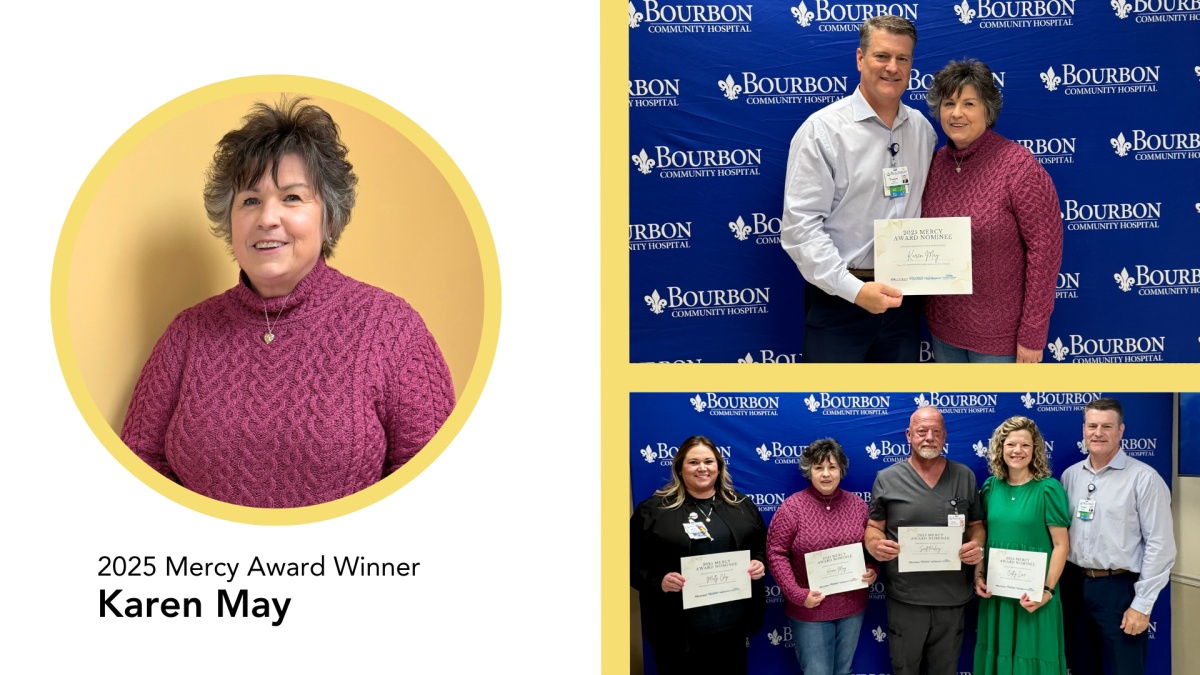
Leadership also becomes visible in the people an organization chooses to recognize. In May 2025, Karen May was named Bourbon Community’s Mercy Award winner. The accompanying account described work outside her job: helping children receive birthday cakes and presents, arranging beds for families, collecting supplies and supporting animal rescue.
Haggard’s description was direct: “Karen is someone who truly leads by example.” The recognition placed her practical work at the center of the occasion. An executive’s name appears in many announcements because someone must speak for the institution. Here, the sentence directs attention toward a colleague and the things she does for other people.
Three years earlier, the organization recognized registration department lead Shannon Ritchie with its 2022 Mercy Award. Her community activities included fostering children, filling backpacks, volunteering at a homeless shelter and donating gifts. Haggard praised her as a role model for her peers. The recognition again connected the workplace with voluntary commitments beyond it.
These are May’s and Ritchie’s stories, and their work belongs to them. Their presence in Haggard’s professional story shows another part of the chief executive’s public role: naming contributions that might otherwise remain familiar only to the people helped. An award ceremony gives that work a date, an audience and a photograph.
The city stays in the name
The city in a title also helps readers keep the story straight. Regional brands can gather several organizations beneath one name. Paris supplies the particular setting for Haggard’s present role, just as Versailles identifies the earlier chapter. The distinction is small, and useful.
In 2026, Haggard’s title carries Paris explicitly: CEO, Centerpoint Health - Paris. The wording brings the regional organization and the individual place into the same line. His earlier decade in Versailles, his Paris appointment and his chamber presidency make that geographical detail more than a convenient way to distinguish one location from another.
When he accepted the Paris position, Haggard spoke about joining the team and becoming part of the community. That ambition has an everyday quality. It is fulfilled, if it is fulfilled, through the repeated business of institutions: employing people, working alongside other organizations, supporting schools and acknowledging colleagues. None of those activities comes with a final finish line.
The student ticket commitment gives this story its most compact image. An organization agrees to meet a cost so that students can attend. Responsibility passes from a family’s pocket to an institutional budget. Whatever happens on the court or field, that change has already happened before the first whistle.
For Haggard, the career landmarks are easy enough to list: Versailles in 2010, Paris in 2020, Centerpoint in 2026. The more revealing detail is what surrounds those dates. A chamber board. Two school systems. A payroll. Colleagues receiving recognition for work done beyond their shifts. The places and people keep filling in the meaning of the title.