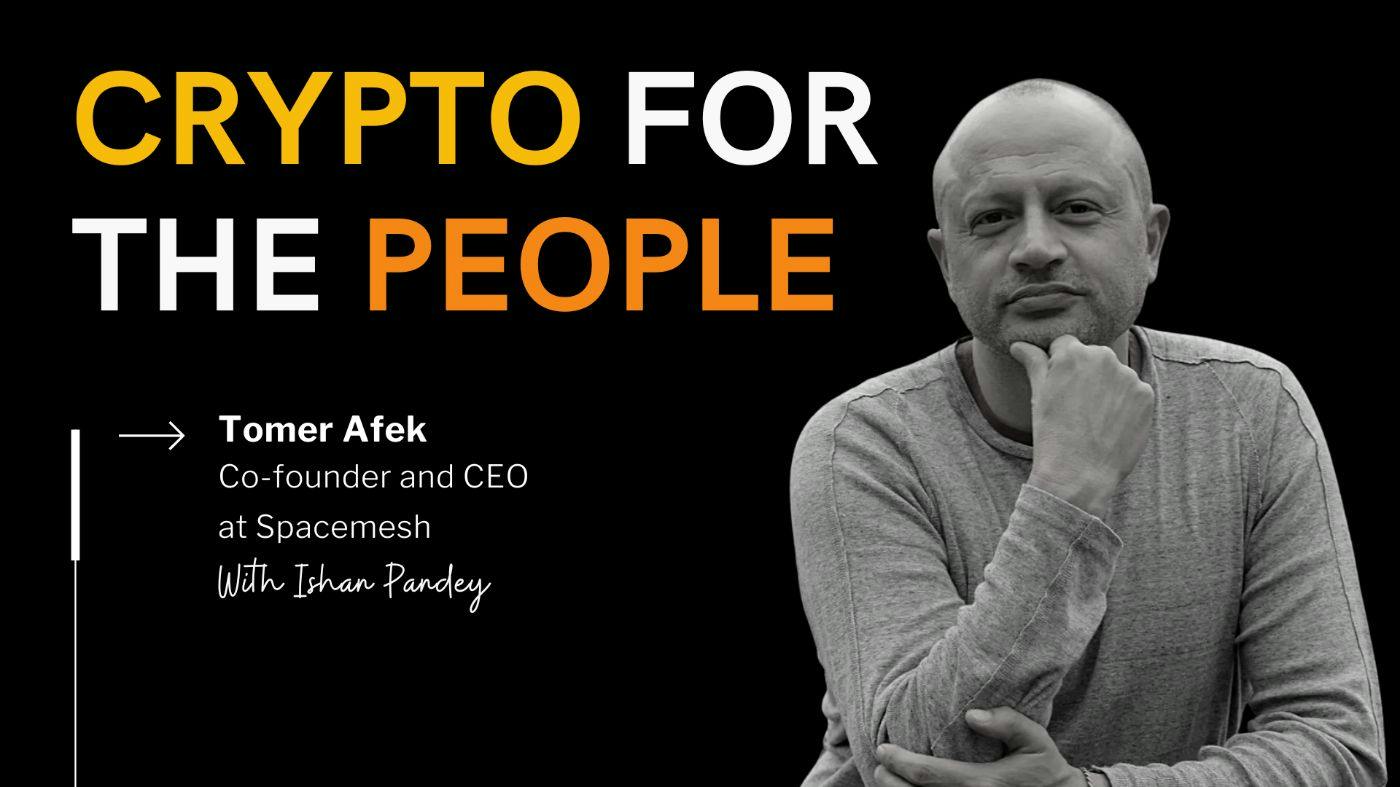
In October 2023, Tomer Afek offered a surprisingly domestic description of the cryptocurrency project he had helped create. Spacemesh, he said, was “the IKEA of blockchain.” Here was an industry accustomed to talking about the future of civilization, suddenly finding room for the emotional appeal of assembling a bookcase. His point concerned ownership: people value something differently when they have taken part in making it.
That thought provides a useful entrance to Afek’s career. He had been a venture investor, a co-founder and CEO at ConvertMedia, and the co-founder and chief marketing officer of Showbox. With Spacemesh, he wanted ordinary computer owners to help produce a cryptocurrency. A spare stretch of disk space would become a means of participation. The person at home would have a role in the machinery.
The ambition was easy to admire and difficult to engineer. By 2024, Afek was publicly discussing a development that complicated it: large pooling providers had aggregated much of the network’s storage. The question of who gets to join had acquired a sequel. On what terms could they remain independent?
A seat on either side of the table
Afek’s early professional life gave him several views of the technology business. He was on the founding team of Sanctum, a web application security company. He spent seven years at Evergreen VC, responsible for Internet and new-media investments. He also earned a degree in economics and computer science, graduating cum laude from Tel Aviv University.
Those are unusually convenient subjects to find on the same diploma when your later work concerns computer networks that distribute money. His subsequent career would repeatedly put technical design beside economic incentives. A product needed users; a business needed revenue; a network needed a reason for people to contribute resources. The software and the arrangement surrounding it both mattered.
At ConvertMedia, Afek served as co-founder and CEO before his Showbox chapter. The company’s later acquisition gives that early role a visible place in the history of online advertising. It also requires keeping the chronology straight: Yoav Naveh was ConvertMedia’s CEO when Taboola announced the deal in 2016.
By that announcement, ConvertMedia had reached an annual revenue run rate of $50 million. Its technology put video advertising into publishers’ pages, extending video inventory beyond the familiar advertisement attached to a video player. Taboola planned to combine it with its recommendation and personalization systems. The transaction closed on August 22, 2016.
A television studio without the television studio
Afek’s next major product chapter brought the work closer to the person making the video. Showbox offered a browser-based production environment. Someone could choose a format, add footage, work with backgrounds and other production elements, and publish without assembling the conventional apparatus of a studio.
By 2014, Showbox was working with Canal+, which had agreed to use its virtual studio tools and workflows. The applications included news, cooking and travel formats. Templates and libraries did some of the work that might otherwise require specialist tools or extra people. The proposition had the pleasing practicality of giving a small publisher a bigger-looking production.
As co-founder and CMO, Afek was making the commercial argument for that access. Showbox’s July 2015 announcement reported an $8 million Series A, with backers including IMAX chairman Brad Wechsler, Wix co-founder Giora Kaplan, former American Express Travel executive Charles Petruccelli and TPG partner Karl Peterson.
In June 2016, Showbox introduced a version for brands. Its announcement described custom video creation without prior production experience, alongside relationships with creator networks and imagery providers. This was access packaged as a commercial service: the business could guide the look, while contributors supplied material. The production process moved into a browser; the need for something worth saying remained stubbornly human.
The computer at home gets a part
Afek dates the idea for Spacemesh to 2017, after Bitcoin mining had become industrialized. The home participant was the figure he wanted to bring back into the picture. He worked with a founding group that included Tal Moran, Iddo Bentov, Rami Kasterstein and Aviv Eyal.
There was a useful distinction in how he described the enterprise: Spacemesh was an open-source public protocol, while Unruly Technologies was the company developing it. He led the development company. After roughly five years of research and development, the public mainnet launched on July 14, 2023.
The design used proof of space-time, tying participation to committed storage over time. Afek’s argument centered on how contributions and rewards related to one another. He wanted a cooperative structure that left room for people with ordinary equipment, with rewards proportional to the storage they contributed. Entry would not depend on buying a large holding of an existing coin.
In his 2021 conversation with Trond Arne Undheim, the discussion had already focused on distribution and barriers to entry. The practical issue was whether a person could enter a network without expensive computing resources or elaborate technical expertise. That concern preceded the launch and continued after it.
Assembly required
When Afek reached for the IKEA comparison, he was describing attachment to participation. A coin earned through contributing to a network carries a different personal history from one bought on an exchange. His explanation gave the home miner an active place in the story. The network would be something a participant helped operate.
He also acknowledged that the setup still needed work. In October 2023, he described onboarding difficulties and resource requirements that remained higher than he wanted. Smaller devices, including Raspberry Pi computers and smartphones, appeared in his account as ambitions for future participation. They were goals, rather than a reason to declare the equipment problem solved.
Afek’s account of the early launch period included a different kind of friction: congestion, high CPU usage and synchronization problems as participation grew. Growth supplied evidence of interest and engineering work in the same delivery. In an October 2023 interview, he said the network had attracted 50,000 miners. That was his report at that point in its history.
He linked usefulness to the size of a community, comparing cryptocurrency with language. The comparison puts an everyday test beside the technical one. A functioning mechanism needs people who can use it with one another. The value of joining depends partly on who else has joined.
When the pools arrived
In August 2024, Afek addressed the concentration question directly. His update said that more than six exbibytes of space had been committed to Spacemesh, with the majority arriving through aggregation by a few sophisticated pool providers. The project’s emphasis on independent participation now faced the actual choices of its participants.
He discussed protocol changes, software for managing nodes, open-source pooling software and services intended to help people initialize mining without suitable hardware of their own. These were proposed responses to a particular distribution of resources. Making the independent route easier was part of the work ahead.
The November update returned to the problem. Afek acknowledged community frustration and the distance between the project’s aspirations and its current condition. He announced Node Split as part of the response, intended to give storage owners more options for participating independently.
“For now, the burden of proof remains on us.”
Tomer Afek · November 2024
That sentence belongs in the story alongside the launch date. The idea had entered public use, and public use had produced evidence that demanded further work. For a project organized around permissionless access, the distribution of participation was a test of its central promise.
A founder with an argument about management
Afek’s writing also extends into how teams learn. In a January 2024 essay, he challenged management advice built by copying successful companies, arguing that visible habits can be mistaken for the causes of success. He favored experimentation and adaptation, with assumptions exposed to practical results.
He credited the published work of complexity thinker Dave Snowden as a major influence, adding the rather endearing qualification that they had never met or spoken. Intellectual mentorship, in this case, did not require a calendar invitation.
His example came from the relationship between researchers and developers at Spacemesh. An implementation could reveal a weakness in an idea; research could deepen the understanding behind an implementation. He wanted the exchange to work in both directions. Neither group could simply hand down instructions and consider its part finished.
The next question has a new company name
Afek now publicly identifies himself as co-founder and CEO of PolygonEyes. The company, established in 2025, describes work on geometric patterns within complex systems, converting tacit knowledge into explicit, teachable material. Doron Avital is listed as president and co-founder. Its website carries the phrase “Artificially Assisted Wisdom.”
That chapter follows a career moving through security, venture investment, advertising, video creation and decentralized money. The details differ enough to resist a tidy founder formula. What the Spacemesh years make particularly visible is the difficulty of carrying an invitation into the workings of a system. Afek wanted people at home to have a part. Keeping that part accessible became work of its own.